Why Nvidia Is Becoming the Bank Behind the AI Boom
 |
| By Jurica Dujmovic |
Hut 8 Corp. announced on July 201 that it had fully commercialized its 1-gigawatt Beacon Point data-center campus in Texas.
The tenant? Unconfirmed so far.
The only lead Hut 8 gave on the company that will move in is that it is an "existing investment-grade customer" that had leased 704 megawatts of IT capacity across two 352-megawatt phases.
The two leases carry a base-term contract value of $19.6 billion over 15 years, with three five-year renewal options that could lift the total to $50.2 billion.
The Financial Times supplied the missing name this week: Nvidia Corp. (NVDA)
To be clear, the chipmaker has not confirmed the report,2 which cited five people familiar with the arrangement.
But if accurate, it means one of the world's most valuable companies has committed to roughly $1.3 billion a year in rent for a campus near Corpus Christi. One that’s being built to Nvidia's own DSX reference architecture. And will be filled with Nvidia's own chips.
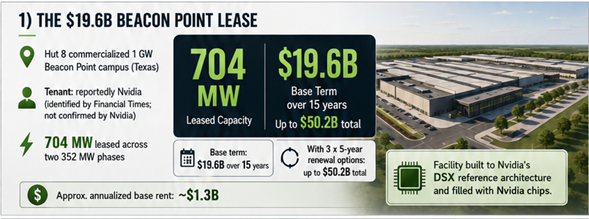
The Financial Times added that Nvidia may sublease the capacity to "neo-cloud" companies — the specialized providers that buy Nvidia GPUs and rent them out as AI computing.
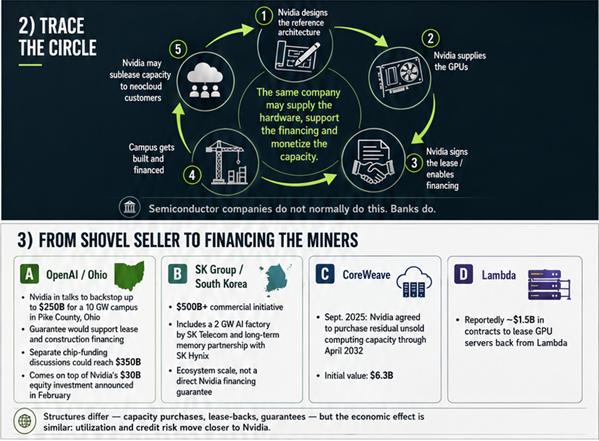
Let’s trace that circle …
- Nvidia provides the reference architecture the facility is built to,
- Makes the hardware that fills it,
- Signs the lease that lets the landlord raise construction financing,
- And may then become a landlord itself, to its own customers.
This isn’t something semiconductor companies normally do.
But it is something banks do. And it’s part of an interesting pattern for Nvidia.
The Balance Sheet Becomes the Product
The term shadow bank normally describes a nonbank that performs credit intermediation outside the regulated system.
That is increasingly a reasonable analogy for part of what Nvidia now does.
It lends its investment-grade credit to sub-investment-grade borrowers, guarantees their leases, backstops their capacity and holds equity in many of the entities it finances.
That said, the analogy breaks down on structure, since Nvidia takes no deposits and answers to no banking regulator. It holds on concentration. Every exposure is the same trade: Demand for AI computing must keep growing faster than the cost of building it.

If confirmed, Beacon Point will be just the latest example in a rapidly growing list.
Nvidia is in talks to provide a backstop of up to $250 billion that would let OpenAI raise debt for a 10-gigawatt data-center campus in Pike County, Ohio, on the strength of Nvidia's credit3, CNBC confirmed this week.
OpenAI is unprofitable and has no investment-grade rating. Instead, Nvidia's balance sheet would effectively stand in for one.
And this is the shift investors need to watch.
Because Ohio and Texas aren’t isolated events. Days before that, Nvidia and South Korea's SK Group signed letters of intent for what the companies describe as a $500-billion-plus commercial initiative4 that will plan a 2-gigawatt AI factory built by SK Telecom and a long-term memory partnership with SK Hynix.
Unlike the Ohio and Texas arrangements, that figure describes the expected scale of the ecosystem. Not just a specific Nvidia financing guarantee or lease obligation.
The distinction matters.
And the fact that it needs drawing at all shows how routinely headline numbers now blur the line between what Nvidia sells and what Nvidia underwrites.
Further down the stack, the practice is already institutionalized.
The structures vary, spanning capacity purchases, leasebacks and guarantees of partners' facility leases.5 But the economic effect is consistent: utilization and credit risk that would otherwise sit with operators and their lenders migrates toward Nvidia.
Debt investors have taken the hint: Financing built on backstopped capacity and contracted cash flows6 prices near hyperscaler credit, at roughly 2.25 percentage points over the SOFR benchmark.
The comparison pairs secured project debt against unsecured paper, so collateral and seniority do part of the work.
But the direction is the point: Lenders price the contracts, collateral and guarantees standing behind these vehicles far more favorably than the operators' standalone credit.
Nvidia's own filings show how quickly the exposures are stacking up. As of April 26, the company disclosed maximum gross exposure of …
- $3.5 billion under guarantees of partners' facility leases,7
- roughly $30 billion of multiyear cloud-service commitments,
- and $32.4 billion of future lease obligations expected to commence through fiscal 2033, primarily for data centers.
It also reported a carrying value of $42.3 billion for nonmarketable equity securities, with another $27 billion of investment commitments outstanding, subject to contingencies.
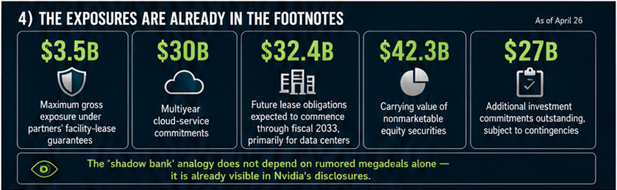
The shadow-banking analogy does not rest on rumored megadeals. It is already visible in the footnotes.
The Credit Market Has Noticed
On Monday, the cost of insuring Nvidia's debt against default posted its largest intraday jump8 since the contracts began actively trading in November. The stock fell nearly 5%.
The bond market's concern is straightforward: infrastructure is being financed faster than AI revenue is arriving.
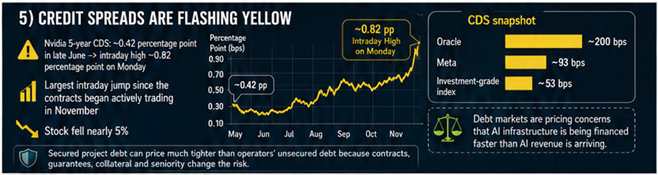
Which means someone’s balance sheet will absorb the gap if that revenue disappoints.
Selling Shovels, Financing Miners
The standard framing of Nvidia has been the shovel seller of the gold rush.
That framing is out of date.
Now, Nvidia is helping to finance the miners, secure their buildings and support the credit structures that let them buy more shovels.
Here’s the catch: Vendor financing has a long history in technology, and little of it is reassuring. Lucent Technologies extended billions in loans to telecom carriers in the late 1990s to keep equipment orders flowing.
When the carriers collapsed, the receivables collapsed with them.
The bull case is that Nvidia's version is smarter. That’s because the company …
- Earns hardware margin at the sale,
- Gains access to cloud capacity it can use or sublease,
- And exercises greater strategic control over where its chips land.
Guarantees require no cash outlay while counterparties perform, and demand remains extraordinary. Used this way, the balance sheet extends the boom, pulls forward buildouts that would otherwise wait for financing and deepens the moat around Nvidia's architecture.
For a company whose customers' creditworthiness is the binding constraint on its own growth, lending them creditworthiness is rational.
What Investors Should Watch
But it changes what Nvidia's earnings mean. And that’s what investors need to understand.
Each record data-center quarter now arrives with a lengthening tail of leases, guarantees and equity stakes whose value depends on customers paying rent well into the 2030s.
The risk migrates quietly, from the income statement to the commitments footnote. And it compounds precisely when the headline numbers look best.
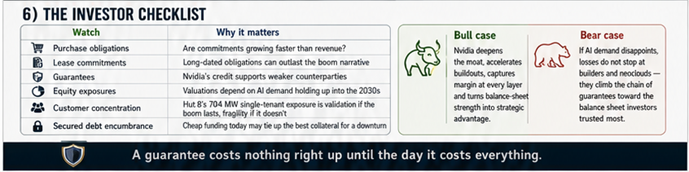
The key Nvidia metric is shifting from GPU shipments to the commitments disclosures in its filings: purchase obligations, lease commitments, guarantees and equity exposures.
Investors should keep a close eye on how fast those lines grow relative to revenue.
Bottom Line
Nvidia is making a big gamble. And most investors haven’t caught on yet.
If AI demand continues to compound, Nvidia will have financed itself into the deepest moat in technology. It will be able to collect margin at every layer of the stack.
But if it disappoints, the losses will not stop at the neo-clouds and the leveraged builders. They’ll climb the chain of guarantees to the balance sheet everyone assumed was the safest in the trade.
If Nvidia is on your watchlist, this shift needs to enter your calculations.
If you already own Nvidia, you should recalibrate your investment thesis to reflect this new reality. And watch closely for further developments.
Best,
Jurica Dujmovic
2https://finance.yahoo.com/technology/articles/nvidia-behind-50-billion-lease-041340807.html
6https://newsletter.semianalysis.com/p/nvidia-gpu-debt-backstop-unleashes
7https://www.sec.gov/Archives/edgar/data/1045810/000104581026000052/nvda-20260426.htm