5 AI Stocks to Avoid: CoreWeave, Applied Digital, Nebius, IREN and Hut 8 Carry Weiss Sell Ratings

 |
| By Sean Brodrick |
A mini-selloff started Wednesday and raced through the tech sector. So I want to share a list of stocks that probably shouldn’t be in your portfolio if you’re worried about a steeper tech sell-off.
On Wednesday, CoreWeave (CRWV) plunged 15.5% as yields on some of its bonds blew past 15% into distressed-debt territory.
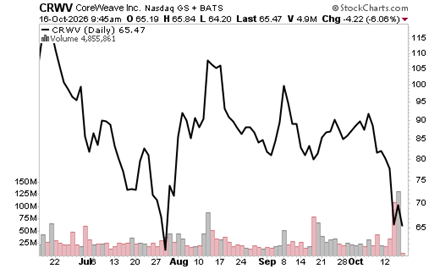
But CoreWeave wasn't alone. Nebius Group (NBIS) sank 10.1%, IREN (IREN) dropped 12.2%, Hut 8 (HUT) fell 10.5%, and Applied Digital (APLD) lost 9.4%.
The carnage spread through the tech sector.
Oracle (ORCL) plunged 8%, Dell (DELL) 11% and Hewlett Packard Enterprise (HPE) 7% as investors suddenly questioned the debt-fueled AI infrastructure boom.
Even enterprise software and cybersecurity — industries that are tangential at best to neoclouds — felt the hammer.
Related story: AI Stocks Sold off After OpenAI’s Revenue Reset
Many of these stocks bounced Thursday. The market is catching its breath. But more carnage could be ahead. So, let’s talk about the companies most at risk.
The Debt Monster Rears Its Head
The AI boom has produced spectacular winners.
But now, investors are discovering there may be a monster hiding underneath the AI data-center buildout:
Debt. Lots and lots of debt.
And the companies potentially sitting closest to the blast zone are the “neoclouds.”
What are neoclouds?
They’respecialized cloud providers.
They’ve also borrowed billions of dollars to buy Nvidia (NVDA) GPUs, build data centers, and rent that computing power to AI companies.
On Wednesday, the market suddenly took that risk seriously.
Coreweave Is the Poster Child for the Neocloud Boom
It plunged, but not because it missed earnings. The bond market was the catalyst.
Yields on some CoreWeave bonds surged above 15%, while the cost of insuring its debt against default exploded above 1,000 basis points.
That implies a roughly 63% probability of default over five years.
Hotter-than-expected inflation poured gasoline on the fire. It raised the possibility that the Fed may hike interest rates again.
That’s exactly what highly leveraged AI infrastructure companies don’t need.
What the Heck Is a Neocloud?
Think of a neocloud as a specialized version of Amazon Web Services or Microsoft Azure, but built primarily for AI.
Instead of offering thousands of general-purpose cloud services, neoclouds concentrate on the hottest commodity in technology: GPU computing power.
They buy Nvidia’s latest chips by the tens of thousands, install them in power-hungry data centers, and rent that computing capacity to AI developers.
It’s a potentially great business when demand is exploding. There’s just one problem: It requires massive amounts of capital.
And that leads to a second problem: The assets they’re buying can become obsolete incredibly quickly.
Epoch AI recently studied the cost of achieving a fixed level of AI performance.
It found that cost has fallen 47% per quarter since 2023 — equivalent to roughly 13-fold per year.
That’s much faster than historical cost declines in computing, batteries, or even DNA sequencing.
That does NOT mean GPU rental rates are falling 13-fold every year. But it does tell you how rapidly the technology is improving underneath these companies.
Older GPUs can lose economic value fast.
Rental rates on Nvidia’s H100 GPUs, for example, fell 64% to 75% from their 2023 peaks before rebounding in 2026.
One analysis found that a five-year H100 contract could produce a 12.4% return if rental prices remained constant — but returns approach zero if prices decline just 10% annually.
Yikes! Guess what’s happening to prices on those GPUs?
This means a neocloud may be borrowing money for five or seven years to buy hardware whose earning power is tumbling down the stairs.
Below, I’ve compiled a list of the five most indebted, publicly traded neocloud companies.
To be clear, many private companies have even worse financials.
But we’re not worried about them — I’m more worried about the public companies that you might own.
Here are five I suggest that you avoid or sell now. And they have the “Sell” Weiss stock ratings to back it up.
Meet the Neocloud Five
CoreWeave is the purest neocloud and, in my view, the most exposed to a credit crunch.

As of June 30, CoreWeave had $35.1 billion of recourse and non-recourse debt on its balance sheet.
Subsequent borrowing has pushed bonds and loans to roughly $48 billion to $50 billion.
Against that, CoreWeave had $5.5 billion in cash at midyear.
What’s more, CoreWeave paid $640 million in net interest expense in the second quarter alone — more than double the previous year’s $267 million — while reporting a $626 million quarterly loss.
CoreWeave argues that its enormous backlog supports that debt.
There’s truth to that. But a leveraged business is vulnerable not just when existing contracts fail.
It can get into trouble when financing its NEXT round of expansion becomes too expensive.
At bond yields above 15%, that danger is no longer theoretical.
***
Applied Digital comes next on my worry list. It develops and operates AI data centers rather than functioning as a pure GPU-rental neocloud.

Its latest filing shows roughly $6.4 billion in debt, including $6.09 billion of senior secured notes.
Some of that debt carries hefty coupons, including $2.35 billion yielding 9.25%.
Applied Digital has a major cushion: $2.95 billion in cash at the end of August.
But it also reported a $184 million quarterly loss and paid an extraordinary $243 million in interest during the quarter.
That’s why I’d put it second in vulnerability.
***
Nebius Group is harder to categorize.

Nebius operates a full-stack AI cloud platform and has been spending at an astonishing rate.
Capital expenditures reached $8.1 billion in the first six months of 2026 alone.
As of June 30, Nebius had about $8.55 billion in debt.
It subsequently added $775 million in secured financing and another $5.75 billion in convertible notes, taking gross borrowings above $15 billion.
That’s enormous!
But Nebius also had $8 billion in cash on June 30, expects billions in customer prepayments, and has structured much of its borrowing as relatively cheap convertible debt. Its August convertibles include $3.45 billion carrying just a 0.5% coupon.
So Nebius is leveraged, but it isn’t facing anything resembling CoreWeave’s immediate refinancing squeeze.
***
IREN is next on my worry list. The former Bitcoin miner is rapidly becoming an AI cloud company.

AI cloud revenue jumped roughly eightfold in fiscal 2026, and the company says its 2026 capacity is largely sold out.
IREN had roughly $7.6 billion of borrowings at fiscal year-end — but also $5.9 billion in unrestricted cash plus another $1.7 billion in restricted cash.
More importantly, it has been matching financing to specific deployments.
A $3.6 billion investment-grade GPU financing tied to its Microsoft contract carries a 6% rate and, together with customer prepayments, funds 96% of the associated GPU capex.
That’s still aggressive financing. But it’s different from borrowing first and hoping customers show up later, like CoreWeave.
***
Hut 8 may actually be the least vulnerable, despite having $7.5 billion in project debt.

Why? Because virtually all that debt is sitting at the project level.
Hut 8’s $7.5 billion of AI data-center financing is investment-grade.
Long-term leases with investment-grade counterparties back its projects. And the company says it currently has no general-recourse debt at the parent level.
That’s an entirely different risk profile from CoreWeave.
The Real Danger
Neoclouds are borrowing enormous sums against two things: rapidly depreciating technology and assumptions about future AI demand.
Right now, demand is enormous. That should continue.
But AI is simultaneously becoming cheaper at a rate we’ve rarely seen in another industry.
The cost of achieving the same level of AI performance is dropping roughly 13-fold per year.
Eventually, those efficiency gains should work their way down the stack.
New chips do more work per dollar.
Models become more efficient.
Customers require fewer GPUs to accomplish the same task.
Older hardware commands lower rental rates.
That’s great for AI users.
It may not be so great for the companies that borrowed billions to buy yesterday’s GPUs.
This doesn’t mean the neoclouds are going bankrupt. Nor are all neoclouds created equal.
Hut 8’s project-level financing and IREN’s customer-backed GPU financing look much sturdier than CoreWeave’s mountain of corporate leverage.
But credit markets are starting to make that distinction themselves.
Coreweave’s Bonds Are the Warning
If investors stop funding AI infrastructure growth at any price, overindebted companies are first on the chopping block.
The survivors will prove they can survive without constantly returning to the debt markets.
So, I think this tech selloff is industry-specific, or at least heavy-debt-specific.
Rising bond yields will bring some chickens home to roost. But we’re still on track for a cyclically strong Q4, as well as the rally that usually comes after the midterms.
I don’t want to sit on my hands during that, and neither do you.
Remember, the best time to buy is when the market is scared. At the same time, you need to avoid the real turkeys — like CoreWeave.
And that's exactly why being selective matters more than ever.
You don't want to miss the opportunities this market creates. But you also don't want to get caught holding stocks flashing warning signs.
That's where Weiss Ultimate Portfolio can help. It brings Weiss Ratings research together to help you identify promising opportunities while steering clear of unnecessary risks.
This Tuesday, you’ll have a chance to see how Weiss Ultimate Portfolio has identified a high-profit window for select stocks between now and the midterm election next month.
All the best,
Sean