Beijing Just Did What Washington Only Talked About

 |
| By Gavin Magor |
Last week, Washington proposed a ban on diesel exports.
This week, Beijing enacted one.
Chinese refiners just suspended fuel exports to everywhere but Hong Kong and Macau for October, according to Reuters.
State oil major PetroChina (PCCYF) canceled a handful of the gasoline and jet fuel cargoes it had planned for the month.
Neither Beijing nor the refiners have confirmed the report.
The news sent international benchmark Brent, domestic benchmark WTI, and crude byproduct diesel higher.
Those are up some 90%, 85% and 71%, respectively, year to date.
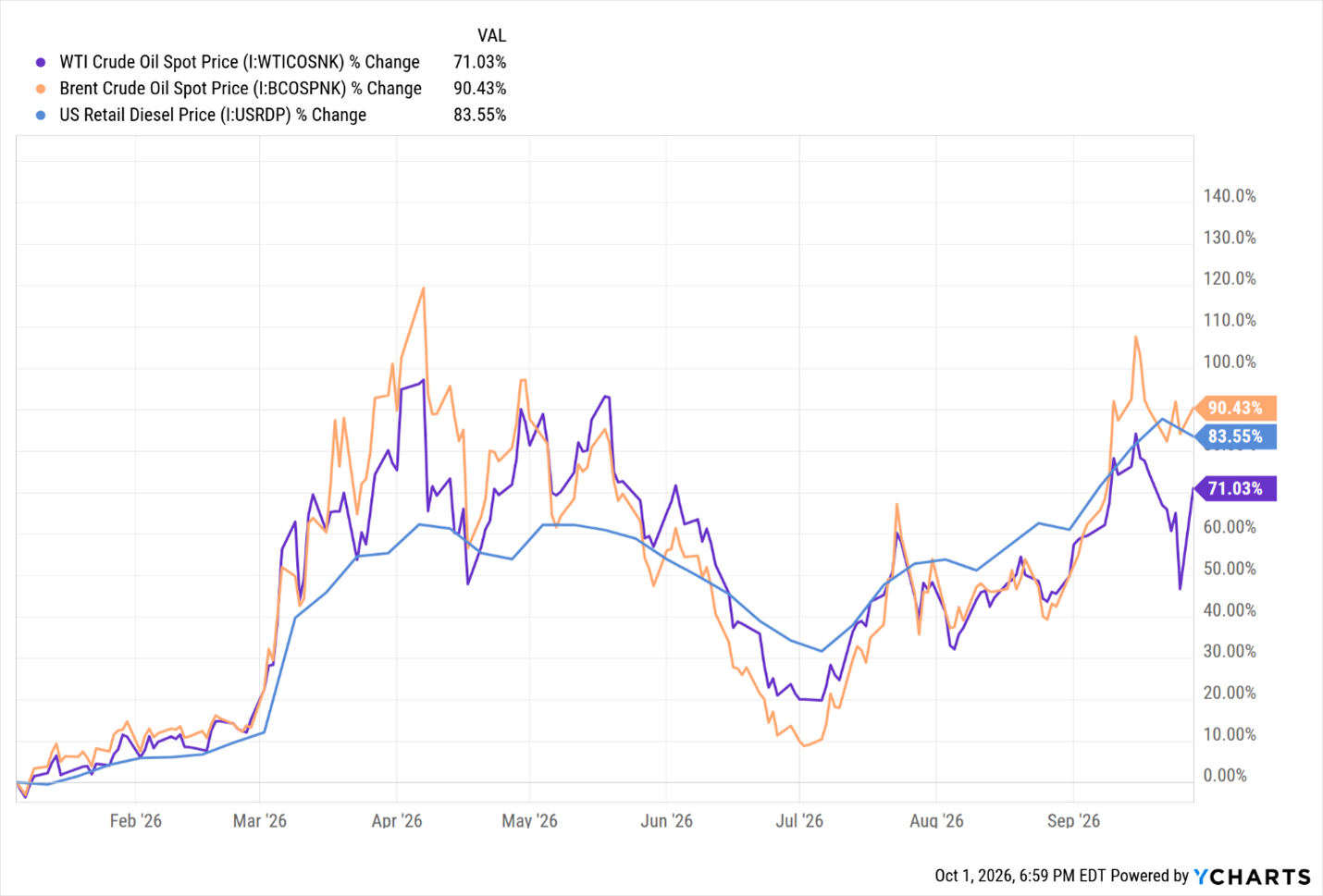
In Asia, diesel refining margins surged above $87 a barrel.
Those were near $22 just before the U.S.-Iran War started eight months ago.
Beijing has made exports contingent on local stockpiles returning to pre-war levels. So, I wouldn't count on a quick restart after the Golden Week holiday ends on Oct. 7.
Why This Sounds Familiar
Last Wednesday, we looked at President Trump's idea of banning U.S. diesel exports, with the national average at a record $6.52 a gallon.
Related story: The Fuel You Never Buy Just Hit a Record
Our point then was simple: Diesel is priced globally, so pulling barrels off the world market pushes world prices up, not down.
China has now run that experiment for real.
The world's largest refining hub just took its fuel off the market, and prices moved the way we said they would.
U.S. Energy Secretary Chris Wright has said a blanket ban won't happen, though the White House is reportedly weighing a 90-day restriction.
Nothing has been signed.
But Reuters reports the administration has told France and Germany to draw down their emergency diesel reserves or face a possible U.S. export ban.
Diesel is still near $6.50 a gallon, about 70% above where it was before the war.
So, the world's largest diesel exporter is debating limits just as its largest refining hub imposes them.
That's bullish for anyone selling refined fuel into the world market, and costly for anyone buying it.
Brent or WTI?
If you want to own oil directly, the first question is which barrel.
Brent is the international, seaborne benchmark.
WTI is priced at Cushing, Oklahoma, in the middle of the country.
A fuel shortage in Asia is an ocean problem, and Brent is the ocean's barrel.
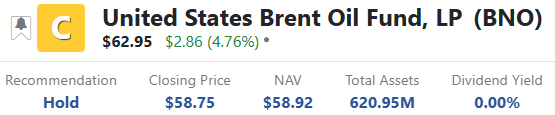
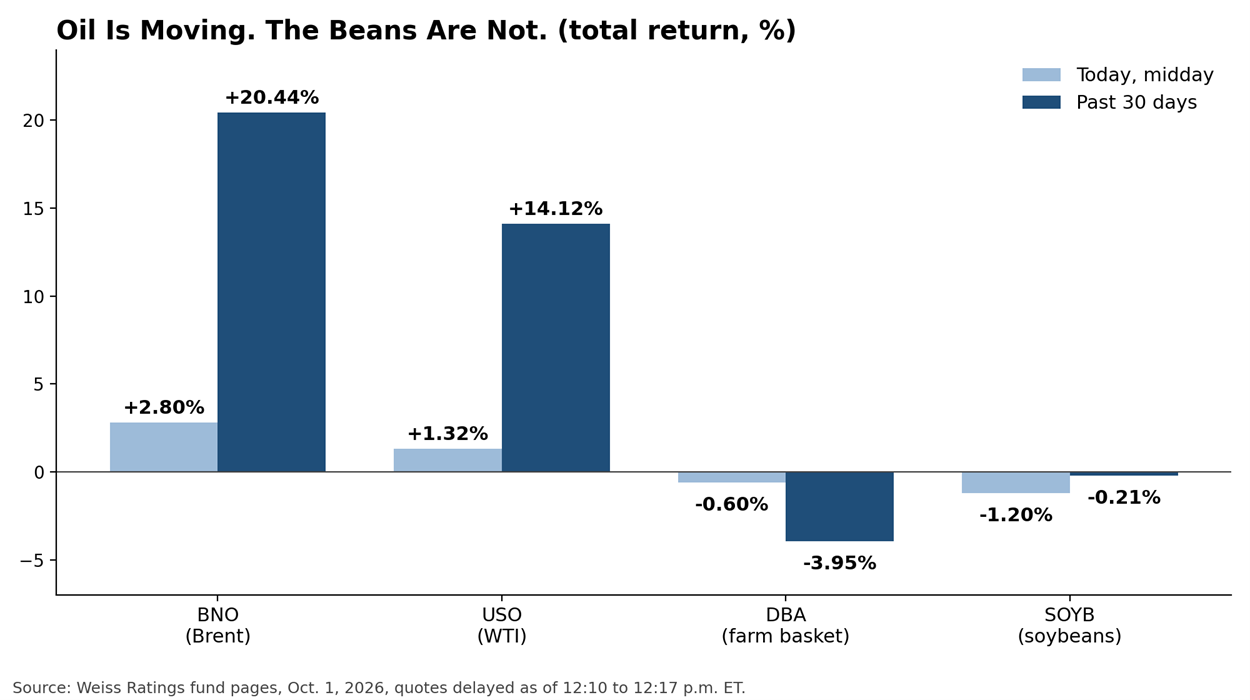
At Thursday’s close, the United States Brent Oil Fund (BNO) was up 4.8% at $62.95.
Compare that to a 3% gain for the United States Oil Fund (USO), which tracks WTI. USO ended Thursday at $150.02.
Over the past 30 days, Brent's fund has returned more than 20.4% to WTI's 14.1%.
So, our pick is Brent.
But both funds carry a Weiss rating of “C,” a HOLD, and both have surged this year.
Crude itself is easing: Saudi Arabia has resumed loadings from its Red Sea port of Yanbu, and Middle East crude flows are reportedly nearing pre-war levels.
The squeeze is in refined fuel, like diesel — not crude.
That makes any crude fund an imperfect hedge for this shortage.
In our view, Brent belongs in a portfolio as a small hedge against fuel shocks, not as a core holding bought after doubling in price.
Bunkers and Beans
Now to a trade some commodity desks love: long bunkers and beans.
After all, ships burn bunker fuel.
Carbon rules increasingly require them to blend that fuel with biodiesel, which can be made from soybean oil.
And when world trade booms, ships burn more fuel and carry more grain at the same time.
So, the thinking goes, own the fuel and the beans together.
The logic is real.
Under the European Union’s FuelEU Maritime rules, ships calling at EU ports had to cut the greenhouse gas intensity of their fuel by 2% starting in 2025, rising to 80% by 2050.
Singapore, the world's largest bunkering port, sold 1.36 million metric tons of biofuel blends last year.
And the Baltic Dry Index (BDI), a gauge of what it costs to ship raw materials, reached 3,628 on Sept. 4 — its highest since November 2021.
But Right Now, I See Three Cracks In This Strategy
First, the feedstock.
The blends sold in Singapore and Rotterdam lean heavily on used cooking oil and animal fats, because Europe's rules penalize virgin vegetable oils like soybean oil.
Second, the mandate.
The International Maritime Organization (IMO) put off its vote on a global shipping carbon rule for a year last October, and that decision is now set for early December.
Third, and most important, the beans aren't following the oil.
Soybeans touched a four-week low on Monday after China kept its 10% tariff on U.S. soybeans following the Trump-Xi summit.
Thursday, with Brent above $100, the Teucrium Soybean Fund (SOYB) was down more than 1%.
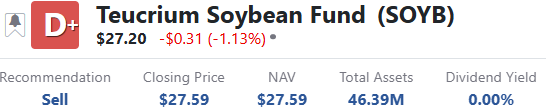
That's not a pair moving together.
Energy economist Philip Verleger compared a diesel export ban to President Nixon's 1973 soybean export restriction — which sent buyers looking to Brazil.
Tariffs are doing much the same thing to U.S. soybeans today.
Customers Who Find a New Supplier Don't Always Come Back
Bunkers and beans work best when shipping demand surges, lifting both.
This week’s move was a supply squeeze, not a demand boom.
One Singapore source describes bunker demand as below average, even as stocks run tight.
Midweek in Singapore, a 30% biofuel blend cost $1,025 a metric ton, against $836 for standard very low sulfur fuel oil.
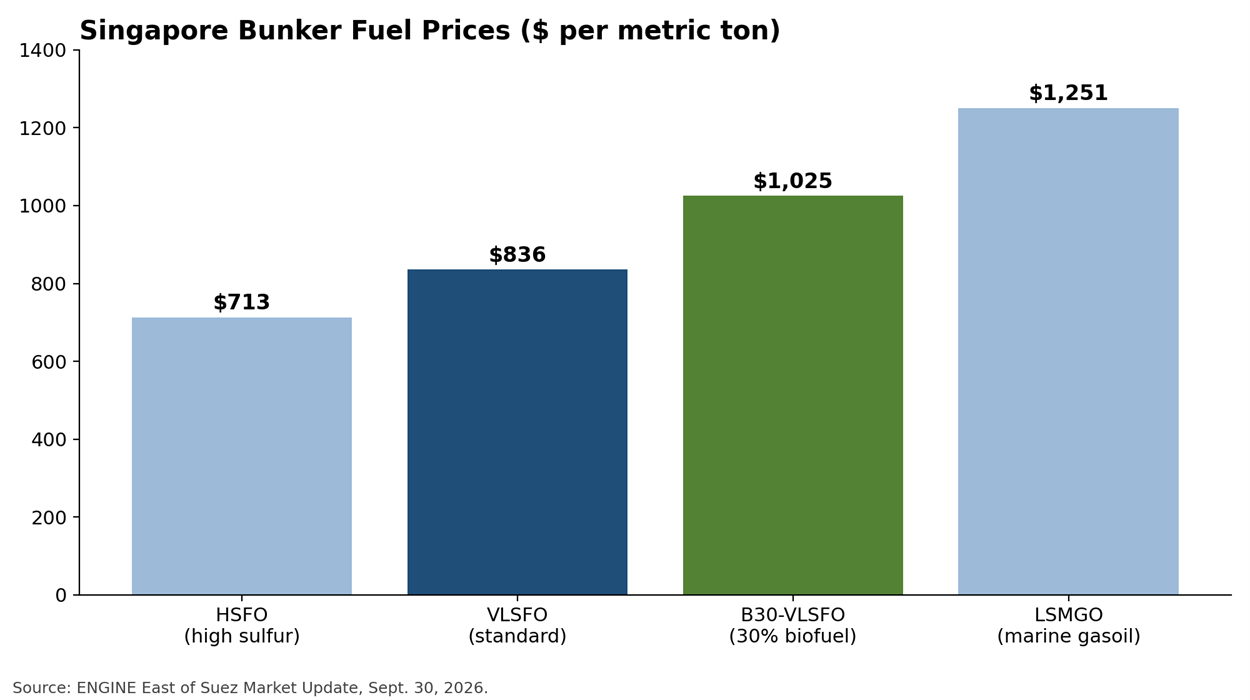
That's a premium of about 23% for going green at sea.
What We'd Do Now
Whilst the bunkers and beans story makes sense over the next decade, it isn't the trade for this month.
For oil exposure, we'd favor Brent over WTI, held small, and we wouldn't chase it after today's jump.
For soybeans, we'd pass.
The Teucrium fund carries a Weiss rating of “D+,” a SELL.
It happens to be based in Burlington, here in Vermont, and I'd still pass.
If you want farm commodities in the mix, the Invesco DB Agriculture Fund (DBA) carries a Weiss rating of “B,” a BUY.
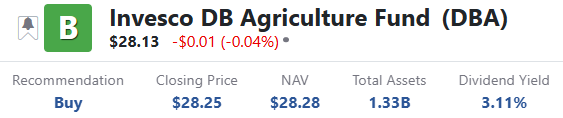
It spreads its bets across corn, soybeans, wheat, sugar, cocoa, coffee, cotton and livestock. So, no single tariff decides its fate.
It's down about 4% over the past 30 days, which makes for a calmer entry point than chasing oil today.
And if you own refiners, last week's view stands: if they've grown past your target weight, rebalance.
Key Items We're Watching
- Whether Beijing lets refiners export again after Golden Week ends on Oct. 7. A quick return would take much of today's premium out of Brent.
- Any U.S. diesel export restriction. A 90-day limit would tighten world supply further, just as China pulls back.
- The IMO's global shipping carbon rule, with its adoption vote scheduled for Dec. 4. Adoption would turn the bunkers and beans story from a European trade into a global one.
- Chinese buying of U.S. soybeans under the 10% tariff. Steady purchases would put a floor under the beans.
Bottom Line
Last week, Washington argued about keeping its diesel at home, and this week Beijing simply did it.
That's a fuel story, and the cleanest way to own it is Brent, kept small.
The beans will have their day when shipping demand and a global carbon rule line up, but not on a day when they fall as oil rises.
Cheers!
Gavin