How to Beat Inflation with Your ‘Keep Safe’ Money

 |
| By Sean Brodrick |
Are you feeling the bite of rising prices in your wallet? You’re not alone.
A new Congressional study says American households have paid an extra $4,200 since January 2025 because of a vicious combination of tariffs, price spikes from the war with Iran and other factors.
The good news is I’m going to show you how your “keep safe” money can keep inflation at bay.
Let’s start with a chart released by the Democratic staff of the congressional Joint Economic Committee on Sept. 15.
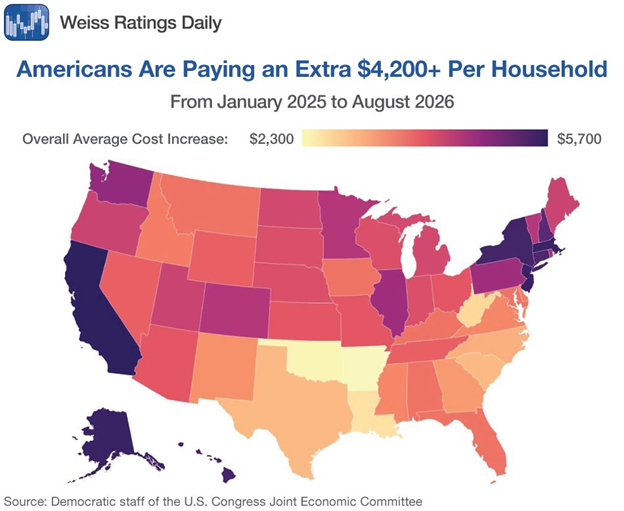
You can see that some states like Texas and West Virginia have seen less inflation.
States like California and New York have taken much bigger hits.
Importantly, other factors are driving inflation besides tariffs and the war.
This is not a nonpartisan report. It comes from the Joint Economic Committee's Democratic staff.
Then again, you wouldn’t expect the Republicans to raise the issue.
The report bases its conclusions on facts. I’d love to see a Republican response so we can compare.
You’ll remember that on the campaign trail, President Trump said he would “immediately bring prices down, starting on Day One,” “end inflation” and make America affordable again.
He specifically cited prices of groceries, cars and electricity.
In August 2024, President Trump said he’d cut energy and electricity prices “by half within 12 months, at a maximum of 18 months.”
And Trump said his policies would bring gasoline below $2 a gallon.
So, how’s he doing? There’s a chart for that, too.
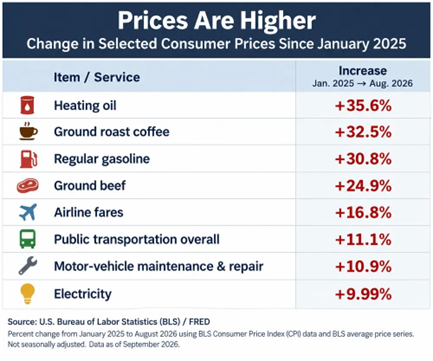
U.S. Bureau of Labor Statistics (BLS) data shows that since President Trump’s second term began in January 2025, prices for gasoline, restaurant meals and airline tickets are marching higher.
Tariffs are part of it. Also, the war with Iran lit a fire under gasoline and airfares.
Now you might be thinking, “gasoline prices spiked during the Biden administration, too.”
Yes, they did, thanks to a combination of the world coming out of the pandemic lockdown and Russia’s invasion of Ukraine.
Gasoline prices averaged $5.02 in June 2022. Prices at the pump came down after the spike, and when Biden left office, the average gasoline price was about $3.13 per gallon.
We can only hope that gasoline prices calm down this time around, too. The question is when that will happen.
That leads me to today’s recommendation: Short-duration Treasury Inflation-Protected Securities, or TIPS.
TIPS are U.S. Treasury securities whose principal is indexed to inflation.
TIPS preserve purchasing power versus inflation because their principal adjusts with the Consumer Price Index (CPI).
And TIPS’ short maturity reduces the price damage that can occur when real interest rates rise.
As of Sept. 19, short-duration TIPS real yields were 2.5%.
Let’s say you buy a five-year TIPS.
If CPI inflation averages 3% over your holding period, a TIPS purchased at a 2.5% real yield would have an expected nominal return of 5.5%.
Wait a Minute! Treasurys Are Falling
Yes, Treasurys are in a bear market because real interest rates jumped.
Five-year real yields rose from about 2.04% on Aug. 25 to 2.38% by Sept. 12. That’s a 34-basis-point jump. Bond prices move inversely to bond yields.
However, TIPS are getting hit less than regular Treasurys.
While short-term Treasurys are down 1.7% during that time and long-term Treasurys are down about 2.6%, short-term TIPS are down about 0.7%.
You could put your keep-safe money in cash, but that will lose value even faster than TIPS due to inflation.
At some point, inflation expectations will flatten out.
The Fed’s dot plot, which I told you about in my Sept. 17 column, predicts one more rate hike this year and then no rate hikes in 2027.
That view may change, but the market now believes the Fed will tackle inflation head-on.
After inflation expectations flatten out, they then tend to fall.
That’s when TIPS should power up your returns because your existing TIPS lock in a higher inflation rate.
How to Buy TIPS
You can buy individual TIPS directly from the U.S. Treasury through a free TreasuryDirect account.
You will need a Social Security number or taxpayer ID, a U.S. address, email address and a U.S. bank account.
You can also buy TIPS through your broker.
Or you can buy a TIPS ETF, like Vanguard Short-Term Inflation-Protected Securities ETF (VTIP).
It has an expense ratio of just 0.03% and a Weiss Rating of “C.”
Here’s a performance chart comparing VTIP to five-year Treasurys over the past three months.
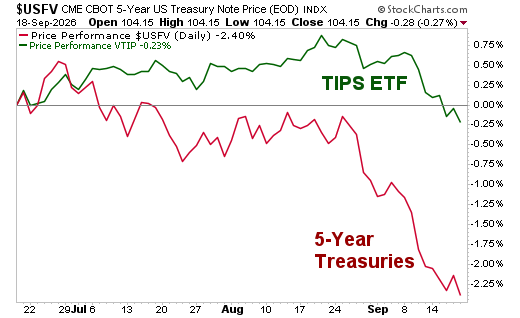
You can see VTIP is down a little since August. Regular five-year Treasurys are down about 10 times as much.
Here’s a table of how you can buy TIPS …
|
Approach |
How It Works |
Advantage |
Trade-Off |
|
Buy a new 5-year TIPS at TreasuryDirect |
Purchase at the next 5-year auction and hold |
Direct ownership; no fund expense ratio |
Starts with about five years of duration |
|
Buy TIPS through your broker |
Select an existing TIPS with 1-5 years remaining |
You can target your desired maturity and sell easily |
Bid-ask spread; minimum order sizes may be larger |
|
Use a short-duration TIPS ETF |
Buy a diversified portfolio in a brokerage account |
Convenient, liquid, automatically rolls maturities |
No individual maturity date; expense ratio and market-value fluctuation |
Inflation is a secret wealth killer. TIPS are one way to tame that beast.
All the best,
Sean Brodrick
P.S. Another way to tame the inflation beast is to find investments that throw off far more income than you’re losing from price increases.
My colleague Nilus Mattive just revealed his Friday Income Machine system that does exactly that. For a very short period of time, you can find out how it works here.