 |
| By Nilus Mattive |
Jerome Powell is no longer at the helm of the Federal Reserve. And I doubt he’s too upset about that.
Even during periods of calm, heading up the U.S. central bank is a thankless job.
These days? I’d rather be out on an Alaskan fishing boat in the middle of a tsunami.
So let us have a moment of silence for Kevin Warsh and this, his first full week as the new Fed Chair.
Warsh is certainly inheriting quite a dilemma.
As we’re often reminded, Congress has given the Fed a dual mandate: With one hand, the central bank is supposed to keep inflation at bay. Its other must create a healthy job market.
This is kind of like telling someone to eat whatever they want while staying skinny.
Actually, that’s doable. It just requires an awful lot of work.
Keeping prices down and employment up is much harder … especially right now.
Let’s start with the biggest problem: inflation.
Ever since 2012, the Fed has maintained an official annual inflation target of 2% 1.
This is what they consider “price stability.”
Never mind that ever-rising costs are hardly stable.
Or that there’s a compounding effect always happening.
Or that, as I explained two weeks ago, the Washington, D.C., complex — which includes politicians, central bankers and government economists — consistently and systematically understates the rising prices we experience 2 in our daily lives.
The reality is that the U.S. government benefits from consistent inflation.
Reason: Uncle Sam is almost always increasing his massive debt pile.
So as the dollar loses purchasing power, the future value of his tab goes down, too.
If inflation is running hotter than what is officially reported, that’s even better.
Since many government outlays — things like Social Security increases — are tied to official measures of inflation, Uncle Sam also gets to spend less on his ongoing obligations.
Of course, the Fed can’t let things get too out of control.
Which is what they’ve been wrestling with for years now.
Because even using the various flawed official measures, inflation has not been anywhere near the Fed’s official target since 2021.
Worse yet, it’s starting to accelerate once again …
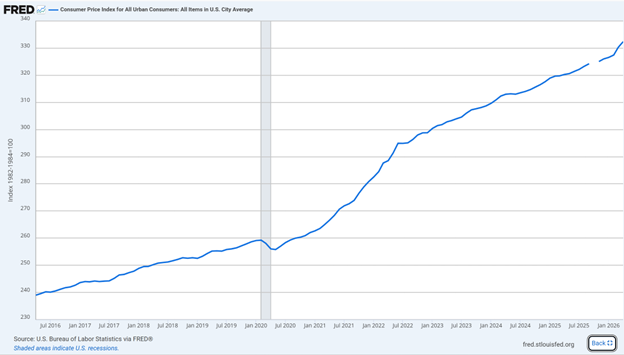
Inflation will almost certainly go higher still in the weeks and months ahead, as we see delayed effects from previously imposed tariffs and the massive energy shock that has taken place over the last several months.
Plus, the relationship between energy costs and inflation isn’t linear.
The longer the situation, the more parabolic and longer-lived the ripple effects become.
Yet the Fed has not been addressing this publicly.
Rather, they are sticking to the same playbook they used when massive post-Covid monetary stimulus was causing huge price spikes that were being deemed “transitory.”
The bond market is where you’ll learn the truth.
Here’s a long-term chart of the 30-year Treasury yield …
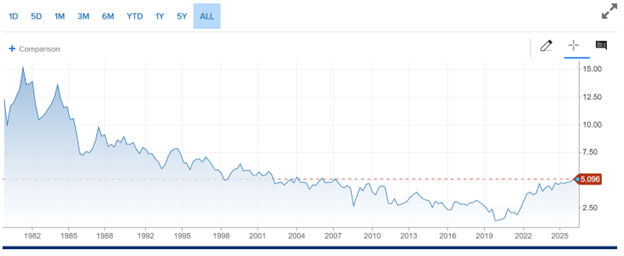
As you can see, investors are already demanding multidecade-high interest rates to buy longer-dated Treasury bonds.
Their message is clear: Get inflation under control now OR ELSE.
Don’t underestimate the danger here.
After all, we just got the minutes from the Fed’s latest April meeting.3
And while more members expressed concern that inflation was running hotter than they expected, the overall vibe was that any possible rate hike was still months away.
I doubt it’s any closer with Warsh taking over.
That leaves quite a time gap for price jumps to continue gaining steam.
On the economic side of the ledger, we did see first-quarter U.S. gross domestic product (GDP) rise 2%.
That was a substantial improvement from the 0.5% growth we saw in the fourth quarter of last year.
However, business spending — most of it related to AI — was the main driver of that growth.
Consumer spending slowed.
It’s a mixed message in the labor market, too.
We saw a better-than-expected 155,000 new jobs created in April. But the unemployment rate was unchanged at 4.3%.
When we connect the data points going back further, we still see an overall cooling trend.
Thus, the Fed is still stuck in the same place it’s been for half a decade now — trying to eat all the cake without gaining any weight.
Maybe Chairman Warsh will finally break the cycle.
But I’m not betting on it.
Instead, I recommend you pursue a different dual mandate — protecting your purchasing power from continued inflation while also building a portfolio that can weather a possible crash.
To do that, you need a range of assets including dividend-paying companies that operate defensive businesses … precious metals and related investments … plus real estate, ideally both actual property as well as more liquid options like real estate investment trusts (REITs).
But a bare minimum, understand that inflation is essentially baked into our financial system these days.
It doesn’t matter who’s in charge of the government or the Fed.
Because failing to recognize that simple fact almost guarantees you will lose financial ground over time.
Best wishes,
Nilus Mattive
2 https://weissratings.com/en/weiss-ratings-daily/inflation-is-higher-than-they-say
3 https://www.marketwatch.com/story/fed-minutes-show-increased-chances-of-interest-rate-hike-e808453b