REPORT: Tech's Worst Day Since June Pushed the 10-Year Yield Below 5%. Here's Why We'd Keep That Money Short.

 |
| By Al Qureiyeh |
If you moved money into long-term Treasury funds on Thursday, you were not alone, and you may want to rethink it.
The Nasdaq Composite, which tracks most stocks on the Nasdaq exchange, fell 2.6% on Thursday, its worst day since June.
Money ran into Treasurys, and the 10-year yield closed at 4.96%, back to where it stood a month ago.
The same day, Brent crude, the world's benchmark oil price, rose 4% after attacks on Saudi oil facilities. It settled at $113.
A bond rally while oil jumps is a fear trade, not a sign that inflation is easing. We'd keep the safety money short, in the 2-year note, and leave the long-bond funds alone.
What Happened
Meta, Lam Research and chipmakers such as Nvidia, Micron and AMD led the fall after Meta raised its spending plans.
More stocks rose than fell on the New York Stock Exchange, so the selling stayed inside artificial intelligence (AI) and technology.
Jobless claims released Thursday came in at 194,000, a strong number, and the prior week's figure was barely revised. The bond rally came from the stock sell-off, not from the jobs data.
Gold fell 2.7% too, a sign investors were raising cash rather than buying every haven at once.
On our scorecard, if you bought Berkshire Hathaway (BRK.B) on our Oct. 20 or Oct. 22 reports, you're ahead of the S&P 500.
If you avoided CoreWeave (CRWV) when we said to, you sidestepped a fall of 31%. SpaceX (SPCX), our caution from Wednesday, fell 9% on Thursday alone.
We're behind on Eaton (ETN) and GE Vernova (GEV), our October power picks, which fell alongside the technology stocks.
Why the Bond Buyers Are Half Right
The Kobeissi Letter, a widely followed market newsletter, says it has owned the long-bond fund TLT since early October, with a target of $82.
Investors are split on bonds, and the bond buyers have a point. First, a growth scare is the classic reason a bond rally keeps going.
Second, higher oil can hurt growth as much as it lifts prices.
Where we part ways is on what Thursday's move was made of.
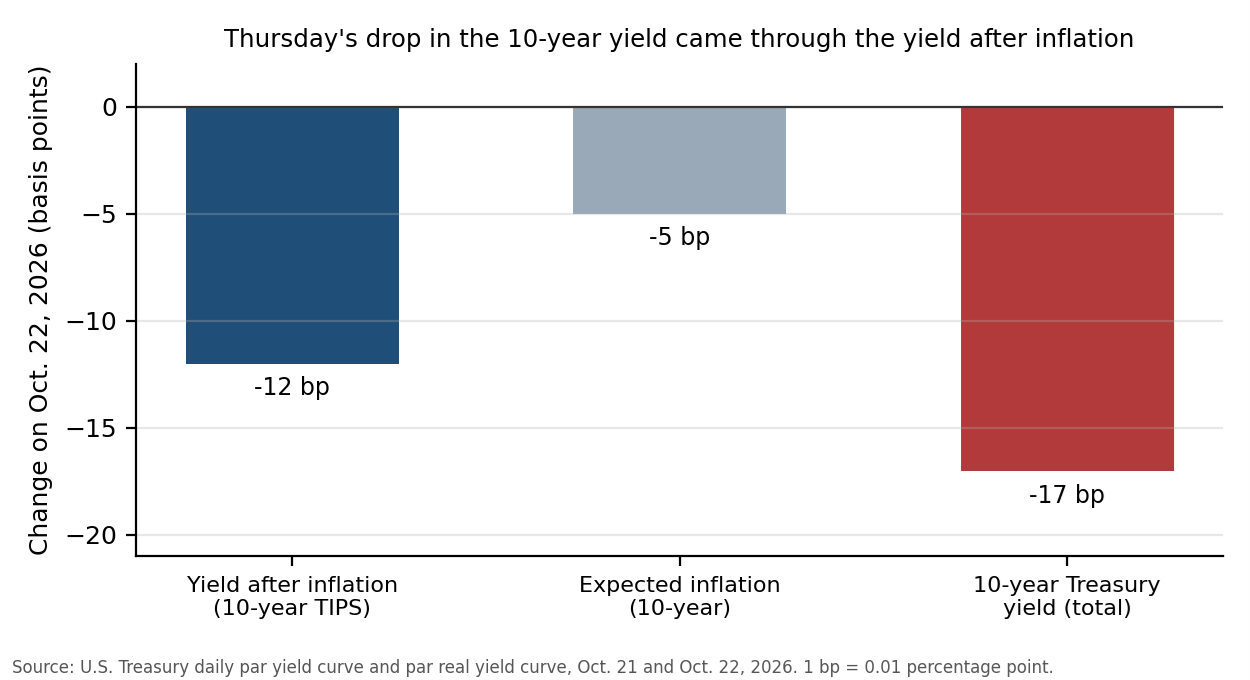
The 10-year yield fell 17 basis points, each one hundredth of a percentage point.
Most of that drop came from the yield after inflation, not from lower expected inflation.
Over five years, expected inflation actually rose during the week as oil climbed.
And over a full month, the 10-year yield is unchanged. Thursday reversed the past month's rise, nothing more.
Weiss Rates the Long-Bond Funds SELL
Weiss rates the two oil producers we discuss below BUY, and the long-bond funds the Street is buying SELL.
Weiss rates the iShares 20+ Year Treasury Bond ETF (TLT) D, a SELL, with Risk rated D, Weak. The iShares 7-10 Year Treasury Bond ETF (IEF) is D+, also a SELL.
The short-term Treasury funds rate C, a HOLD: the WisdomTree Floating Rate Treasury Fund (USFR) and the SPDR Bloomberg 1-3 Month T-Bill ETF (BIL).
Chevron (CVX) is B+ and Exxon Mobil (XOM) is B, both BUY.
The Oct. 22 Weiss Ratings Daily piece "Why Isn't the Stock Market Rallying in Q4? 5 Headwinds to Watch" named yields and oil.
We agree, and this report is about those two.
The Oct. 19 piece "Tech Terror Is Good News for Gold" said stress in AI debt was pushing money into Treasurys and gold. It saw the Treasury bid coming; where we read it differently is the long end, where the funds rate SELL and fear rallies have faded.
Related story: Why Isn't the Stock Market Rallying in Q4? 5 Headwinds to Watch
Avoid the iShares 20+ Year Treasury Bond ETF (TLT), rated D, a SELL. Avoid the iShares 7-10 Year Treasury Bond ETF (IEF), rated D+, a SELL.
Fear Rallies in Long Bonds Have Not Lasted
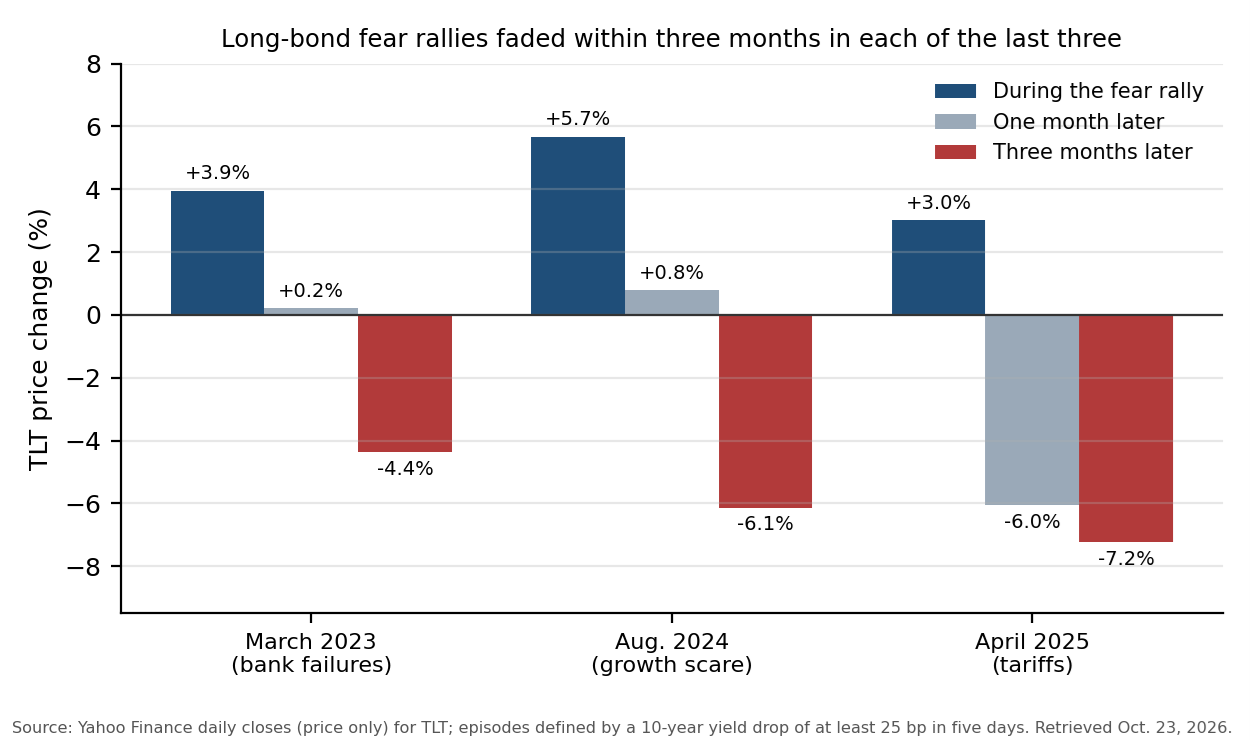
Long bonds move the most when yields fall, which is why they jump on a scary day. They also give it back when the fear passes.
We checked the last three times the 10-year yield fell sharply during a stock sell-off: March 2023, August 2024 and April 2025.
In each case the long-bond fund was lower three months later than at the peak of the fear.
This time, futures traders still price a December rate increase from the Federal Reserve (Fed), and every economist in a Reuters poll expects one. That is the opposite of the setting a lasting bond rally needs.
Lock In the 2-Year Note Instead
Buy the 2-year Treasury note through your brokerage or TreasuryDirect; it closed Thursday at a yield of 4.65%.
No Weiss rating applies to a Treasury note. The short-term Treasury funds that hold similar paper are rated HOLD, not BUY, so the note itself is our action.
It pays you to wait: about $465 a year on every $10,000, fixed for two years. The 1-month bill paid less at Thursday's close, and its rate resets every month.
If the Fed raises rates in December, the note's price would slip, but only by a fraction of a percent. You would still collect the full yield if you hold it until it repays its face value in two years.
What could work against it: if the slowdown deepens and the Fed turns to cuts, long bonds would gain far more than the note. We'd take that trade only after the Oct. 28 Fed meeting shows a change in tone.
The Oil Stocks Are on Watch, Not on the Buy List
Chevron and Exxon are where we'd look if oil stays above $100, but not yet.
On Thursday, with oil up 4%, the Energy Select Sector SPDR Fund (XLE) fell. The oil stocks followed the market down, not oil up.
They have also run: Chevron closed Thursday near the average Wall Street target.
After two of the last three oil spikes, the producers lagged the S&P 500 over the next three months. Both are BUY-rated; we'd buy them if Brent holds above $100 past the Fed meeting and they start trading on oil again.
What We're Watching
First, the Fed on Oct. 28. If the statement signals a pause for good, we'd revisit the long-bond funds, and we'll say so.
Second, this month's 2-year note auction. The Treasury's advisory committee has penciled in $69 billion, and a weak auction would tell us buyers want more yield.
Third, Brent. If it falls back below $100 and traders stop pricing a December increase, our reason for staying short weakens.
Bottom Line
Thursday's bond rally was built on a bad day for technology stocks, not on good news about inflation. With oil at $113 and traders still pricing a December increase, it looks like the last three such rallies. Each faded within three months.
So, if you moved money into long-term Treasury funds on Thursday, rethink it. Buy the 2-year Treasury note at 4.65% instead, and avoid TLT and IEF, both rated SELL.
Take care,
AL Qureiyeh