REPORT: Treasury Yields Fell the Most in a Year, but Riskier Companies Got No Relief. Walmart Beat the Market After Four of Five Past Credit Scares.

|
Key Takeaways
|
 |
| By Al Qureiyeh Reviewed by: Leo Tavolaro |
If you breathed easier as Treasury yields fell this past month, look at what riskier companies pay to borrow. If you own their shares, they got none of that relief.
The 10-year Treasury yield, what the U.S. government pays to borrow for a decade, fell to 4.86% Friday, its biggest one-month drop in a year.
That made safe borrowing cheaper.
Yet the yield on junk bonds, which are loans to riskier companies, barely moved over the same month.
The extra yield lenders demand from those companies reached its highest level in a year Thursday.
Lenders are getting pickier about whom they fund. We'd own a company lenders favor, one that has usually held up when credit tightens.
What Happened
Banks and bond investors are pulling back from debt tied to the artificial intelligence (AI) build-out, Reuters reported Monday.
Some AI-related bond deals were shelved, Reuters said.
Thursday, the S&P 500, the index of America's largest companies, fell 4.4% after the midterms, CBS News reported.
The extra yield on junk bonds jumped that day, then eased Friday.
Friday's jobs report showed 165,000 new jobs, and hiring in the two prior months was revised higher.
The Labor Department made no change to how it measures jobs.
So, markets took the number at face value.
A December rate hike still looks likely, by the CME Group's FedWatch tool, which reads futures prices.
Our scorecard, through Friday's close, is measured against the S&P 500.
If you bought SPDR Gold Shares (GLD), Ross Stores (ROST) or Microsoft (MSFT) on our advice, you are ahead of the index.
The same goes for Coca-Cola (KO), Morgan Stanley (MS) and Visa (V).
JPMorgan Chase (JPM) has held up better than the index since our Nov. 3 call.
If you skipped Zscaler (ZS) on our Oct. 30 advice, you avoided a drop of about 20%.
We are behind on Valero (VLO), Cisco (CSCO) and Phillips 66 (PSX).
We are also slightly behind on our Nov. 6 calls on JPMorgan and gold.
Why the Worriers Have Only Half the Story
Individual investors are gloomy: more expect stocks to fall than rise, in the American Association of Individual Investors survey for the week ended Nov. 4.
Two facts argue against alarm.
First, the extra yield on junk bonds is still well below its April 2025 peak, so this is a warning, not a panic.
Second, company profits are still growing fast, and most companies beat forecasts last quarter.
We grant both. But lenders are already shelving deals, and that is where tighter credit starts.
What Weiss Is Saying
Weiss rates Walmart (WMT) B-, a BUY.
Berkshire Hathaway (BRK.B) is A-, a BUY, and holds a large pile of cash.
Its shares already trade above the average analyst target, so we would wait for a better price.
Two junk-bond exchange-traded funds (ETFs) rate lower.
The iShares iBoxx $ High Yield Corporate Bond ETF (HYG) and the SPDR Bloomberg High Yield Bond ETF (JNK) are each C, a HOLD.
The Nov. 6 Weiss piece "AI Is Competing with the U.S. Government for Your Money" warned that heavy AI borrowing raises refinancing risk.
That means AI companies may have to replace maturing debt at higher rates.
We agree, and lenders now demand more to fund AI companies.
The Nov. 5 Weiss piece "Cheesecake Factory, Darden and Walmart: Winning the Kitchen-Table Economy" said value-focused businesses are gaining market share.
We agree, and we add a second reason to own Walmart: lenders favor its debt.
The Nov. 7 Weiss piece "These Sectors Can Keep Your Portfolio Afloat Even When AI Fails" said staples and financials held up.
We agree on Walmart; for JPMorgan, pickier lenders now matter more.
Related story: AI Is Competing with the U.S. Government for Your Money
Related story: Cheesecake Factory, Darden and Walmart: Winning the Kitchen-Table Economy
Walmart Has Usually Held Up When Credit Tightens
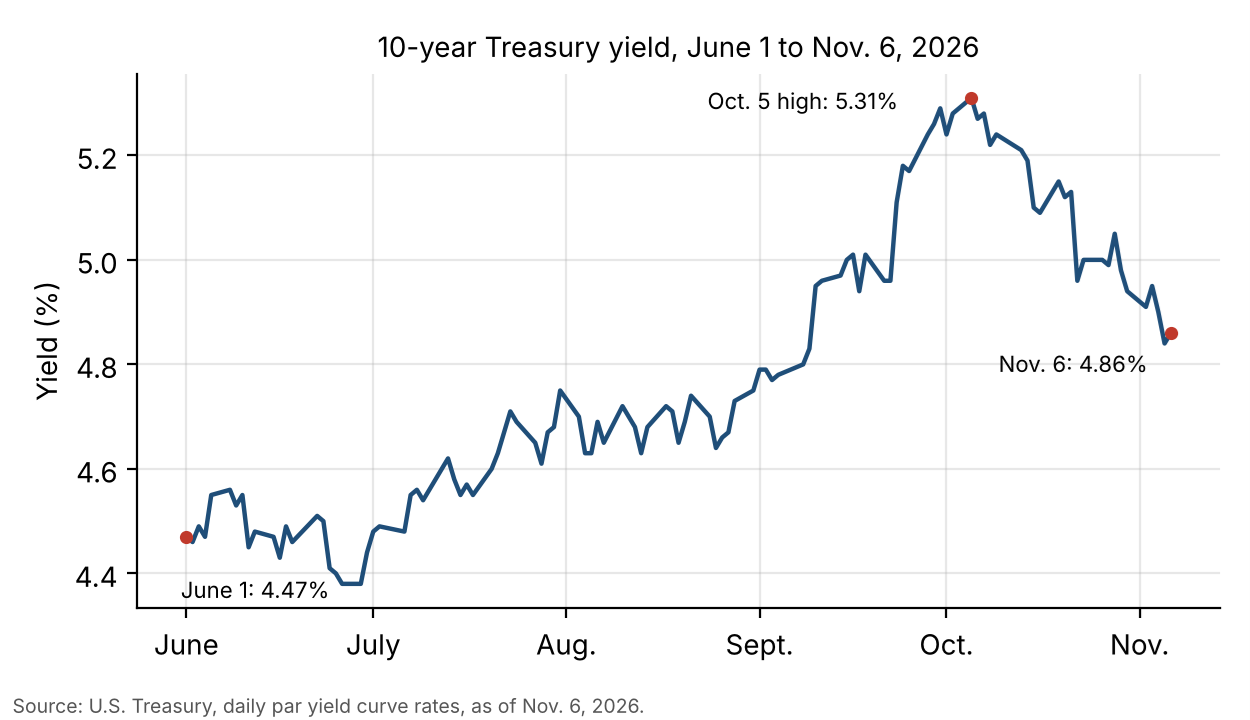
The chart shows the 10-year yield falling from its early-October high.
Junk-bond yields did not follow it down, which is how pickier lending shows up in prices.
In our own back-tests, we looked at every month since 2020 when the extra yield on junk bonds jumped sharply.
Walmart beat the S&P 500 in the three months after four of the five we could fully measure.
Berkshire, Coca-Cola and JPMorgan each beat it after only two.
Berkshire and Coca-Cola beat it when stocks fell in late 2021 but lagged badly in the 2020 and 2025 rebounds.
Walmart held up in both kinds of market, which is why it is our pick.
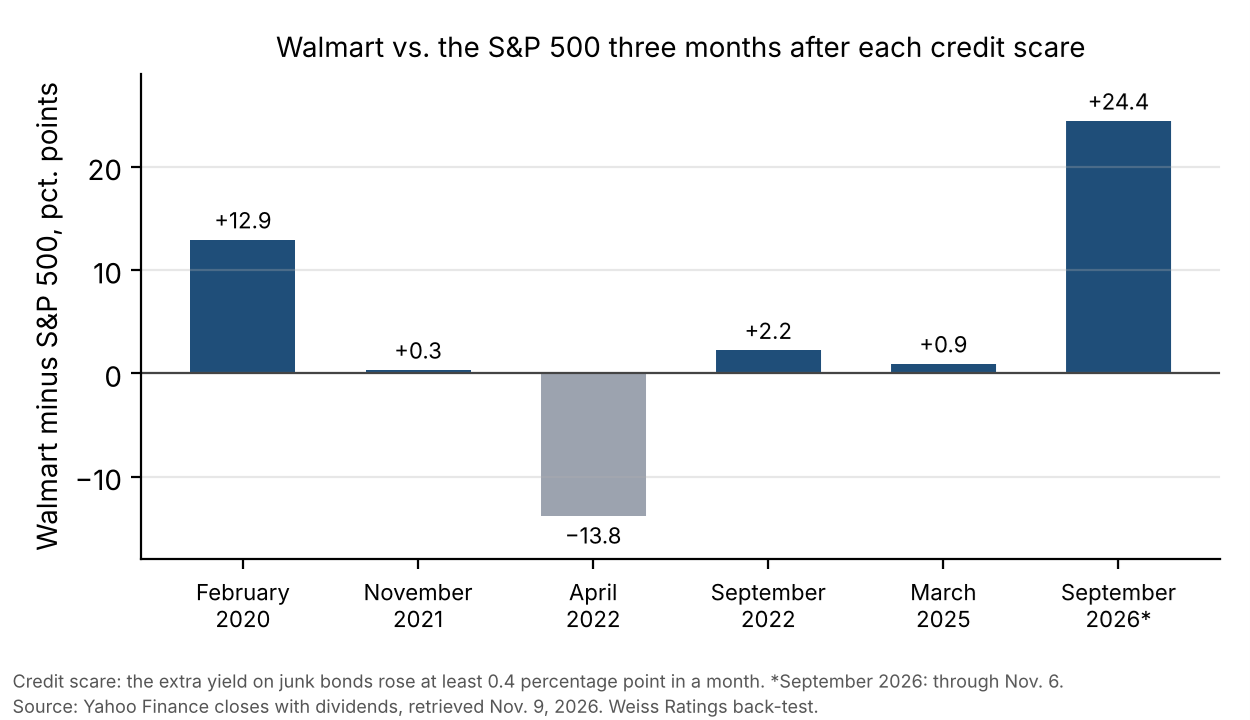
The record is evidence, not proof, and each period had its own story.
Buy the Retailer Lenders Favor
Buy Walmart (WMT), rated B-, a BUY, at the next close; it closed Friday at $125.52.
Walmart's bonds carry AA ratings, among the highest a company can earn, so it can borrow cheaply when riskier companies cannot.
Shoppers squeezed by prices also trade down to stores like Walmart.
Lenders and shoppers both favor Walmart when money gets tighter, which is the link to this credit warning.
Its Risk sub-grade is C, lower than its Reward grade of B.
What could work against it: at about 42 times expected earnings, any stumble at its next quarterly report could send the shares lower.
Friday's close is about $2 to $7 below the average analyst targets of StockAnalysis and MarketBeat. That is a potential gain of about 2% to 5%.
Walmart pays $0.2475 a share each quarter while you wait. At Friday's close, that is a yield of about 0.8% a year.
Our time frame is within a year, with the first check at its expected Nov. 19 report.
Trim JPMorgan as Lenders Get Pickier
Trim JPMorgan Chase (JPM), rated B+, a BUY, at the next close; it closed Friday at $334.49.
A bank's loans are exposed if riskier borrowers keep paying more.
JPMorgan beat the S&P 500 after only two of five past credit scares in our own back-tests.
What could work against trimming: JPMorgan's loan losses were still falling in its October report, and a December rate hike still looks likely.
What We're Watching
First, Walmart's expected Nov. 19 report. If sales growth slows, we would rethink the call and say so.
Second, junk-bond yields. If the extra yield falls back to its early-October level, the warning has passed, and we will tell you.
Third, Berkshire Hathaway, rated A-, a BUY. If its shares pull back toward the average analyst target, we would look at buying.
Fourth, AI debt. If more data-center bond deals are pulled, we would expect riskier companies' borrowing costs to keep rising.
Bottom Line
Treasury yields fell, but riskier companies got no relief, and lenders are getting pickier. Trim JPMorgan Chase (JPM), rated B+, a BUY, which closed Friday at $334.49, at the next close.
So, don't take falling Treasury yields as an all-clear: Walmart has usually held up when credit tightens. Buy Walmart (WMT), rated B-, a BUY, which closed Friday at $125.52, at the next close.
Take care,
AL Qureiyeh