AI Is Competing with the U.S. Government for Your Money

|
Key Takeaways
|
 |
| By Jim Nelson Reviewed by: Victoria Goldstein |
All year, the AI buildout has been pushing up U.S. Treasury yields.
I’m not using metaphors here. This is real.
The hundreds of billions of dollars in bonds being issued to fund data centers, chip purchases and AI infrastructure are competing for the same pool of investors that usually buys long-term government debt.
And the bond market is showing strain.
The Number That Should Catch Your Attention
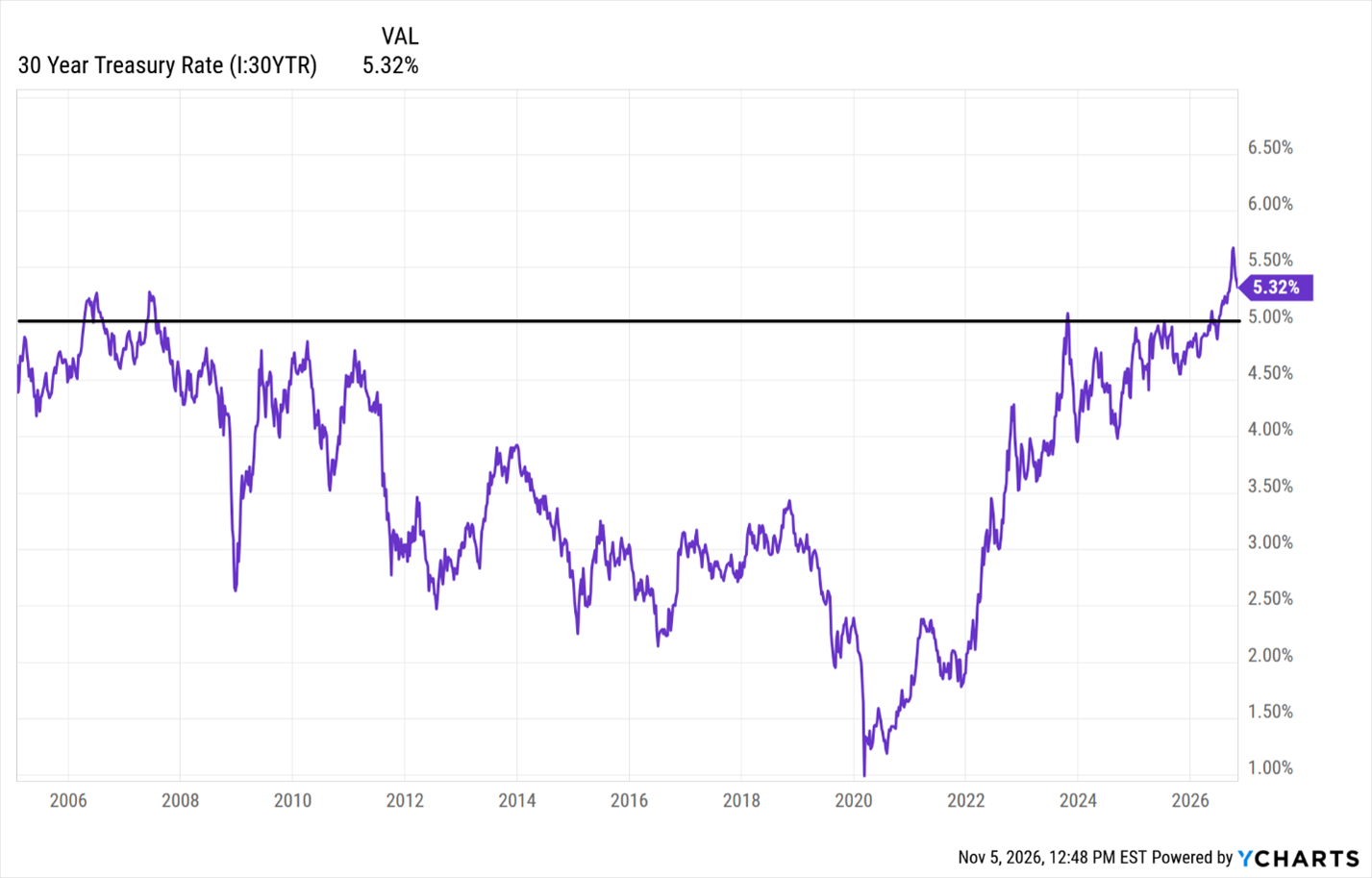
The U.S. 30-year Treasury yield has now held above 5% for the longest consecutive stretch since before the 2008 Financial Crisis.
It has sustained this level since July.
None of this is happening in a vacuum.
The major AI players sold approximately $220 billion in bonds in just the first half of 2026. That’s more than double the $108 billion they issued in all of 2025.
When you flood the bond market with that volume of new debt at the same time the U.S. government is running a $40 trillion national debt and issuing its own paper, something has to give.
What gives is the prices of existing bonds, which fall as new issuers compete for the same buyers.
As Tony Rodriguez at Nuveen Asset Management said, “Whoever’s issuing, be it a government or a hyperscaler or a non-hyperscaler, credit is now competing with more borrowers on that long end for the same group of investors.”
The AI boom isn’t just affecting chip stocks and data center real estate anymore. It’s affecting your bond portfolio and your mortgage rate.
CoreWeave Just Showed Us What Happens When Rates Rise
We recently got a live demonstration of how sensitive the leveraged end of the AI trade is to higher borrowing costs.
CoreWeave (CRWV), the Nvidia (NVDA)-backed compute provider, saw its stock crash as much as 15.5% in a single day.
To add to the misery, its bonds fell below 80 cents on the dollar, and the cost to protect its debt against default spiked to an all-time high.
And one of its bonds due in 2031 briefly traded at a yield more than 10 percentage points above comparable Treasurys.
This is the threshold the industry uses to classify a bond as distressed.
So, what happened?
This wasn’t a case of investors getting spooked by a collapse in AI demand.
Instead, it was the combination of hot inflation data and growing questions about whether companies carrying this much debt can actually refinance it at reasonable rates when the time comes.
CoreWeave carries at least $35 billion in debt on its balance sheet. S&P rates its debt as junk/speculative grade.
Here at Weiss, we give the stock a “D-”.
While CoreWeave was getting beaten down, Microsoft (MSFT) and Alphabet (GOOGL), with their massive cash flows and investment-grade balance sheets, barely flinched.
It’s companies like CoreWeave, Nebius (NBIS), IREN (IREN), and the other newer, debt-heavy players that got hit hard.
That divergence is the story …
Rising rates hit the weakest borrowers hardest, and in the AI trade, the weakest borrowers are everyone except the cash-rich hyperscalers.
Ray Dalio & Paul Tudor Jones Are Paying Attention
Bond traders aren’t the only ones watching this …
On Oct. 13, Bridgewater founder Ray Dalio wrote that the bond bear market “probably has a long way to go.”
The same day, billionaire hedge fund trader Paul Tudor Jones told CNBC there’s roughly a 60% chance markets are heading for serious trouble.
He cited the race between AI spending and government borrowing as a key pressure point.
Their concern is structural.
The U.S. government needs to borrow enormous sums, but traditional buyers of long-term Treasurys — pensions, insurers, foreign central banks — are increasingly choosing from a bigger menu.
They now have more options than they’ve had in years, and those options increasingly include high-yield AI infrastructure bonds offering 10%-plus yields.
This represents a fundamental shift in how capital flows through the system.
The Easy Money Is Gone
The cheap-money era that funded the AI buildout is over.
Every company that borrowed heavily to build data centers now faces a world where refinancing that debt costs more.
The companies with fortress balance sheets can absorb that. They were always going to be fine.
But the companies running on debt to fund a buildout they haven’t yet monetized are in trouble. And the bond market is signaling that loud and clear.
The AI trade might not be over. But the easy chapter of it may be.
Here’s what makes this moment matter for everyday investors like you …
From the circular financing arrangements to the GPU-backed loans to the special purpose vehicles keeping debt off balance sheets, none of it goes through the traditional banking system in ways that let anyone see the full picture.
And rising rates have the ability to unravel all of it in ways that spread further and faster than most people expect.
Dr. Martin Weiss and safe-money expert Nilus Mattive have been following exactly this problem.
They’ve traced the web of AI debt and circular deals to understand where the real pressure points are and what breaks first when rates stay higher for longer.
What they’ve found didn’t reassure them …
But they’ve also identified specific ways to get ahead of the fallout.
They’ve outlined your next steps in this presentation.
Sincerely,
Jim Nelson