REPORT: Utilities Jumped 10% as Yields Fell and Tech Sold Off. Now Job Openings Are Beating Forecasts. Here's Why JPMorgan Is the Better Buy.

|
Key Takeaways
|
 |
| By Al Qureiyeh Reviewed by: Leo Tavolaro |
If you moved money into utility stocks for safety this fall, October paid you well. Before you add more, look at what happened the last three times yields fell this fast.
The Utilities SPDR (XLU, C) rose about 10% in October.
The S&P 500, the index of America's largest companies, fell 0.9% in the same month.
Utilities rose because bond yields fell, and because investors sold technology funds such as the Technology SPDR (XLK, B-).
After each of the last three sharp drops in yields, utilities trailed the market over the next three months.
The safety trade has already paid. We'd hold the utilities you own and buy the bank that has done better after drops like this one.
What Happened
The 10-year Treasury yield, the rate that guides mortgages and how much investors pay for stocks, closed Monday at 4.91%.
It fell about a third of a point in October, its biggest one-month drop in a year.
Almost all of that drop came in the yield investors keep after inflation. So, this was not inflation cooling.
Investors bought Treasurys for safety as technology stocks sold off. Late in the month they also trimmed bets on a Federal Reserve (Fed) hike.
The Fed held rates steady on Oct. 28, with two officials voting for a hike. Traders in interest-rate futures, as measured by CME FedWatch, still lean toward one in December.
The Labor Department said Tuesday that job openings rose to 7.5 million in September, well above forecasts. It also revised August higher.
A strong report like this could make it harder for yields to keep falling.
Mortgage rates barely moved. Freddie Mac's 30-year rate was 7.24% in its Oct. 29 survey.
That saves a family borrowing $400,000 only about $22 a month from the week before.
If you bought Phillips 66 (PSX) on our Oct. 29 advice, you are about 3 percentage points ahead of the S&P 500.
If you skipped Zscaler (ZS) on our Oct. 30 advice, you avoided a drop of nearly 10%.
We are behind on Cisco (CSCO), our Oct. 30 pick, by about 4 percentage points.
We are also behind on Valero (VLO), our Oct. 14 pick, by about 13 percentage points.
We also trail on Microsoft (MSFT) by about 2 percentage points.
If you bought Morgan Stanley (MS) or Ross Stores (ROST) on our advice, you are ahead.
Why the Skeptics Have a Point
In the American Association of Individual Investors survey for the week ended Oct. 28, more investors expected stocks to fall than rise.
First, the safety trade can keep working if the artificial intelligence (AI) sell-off deepens. In 2022, utilities rose slightly while the S&P 500 fell sharply.
Second, utilities pay you to wait. At Monday's close, Duke Energy's (DUK) dividend yielded about 3.4% a year.
Third, a weak jobs report on Nov. 6 could push yields lower still.
We grant all three, and they are why we would hold utilities rather than sell them. They are not a reason to buy more after a 10% month.
What Weiss Is Saying
Weiss rates the Utilities SPDR C, a HOLD.
Its biggest holdings rate higher. NextEra Energy (NEE), Southern (SO) and Duke Energy are each B, a BUY.
The weak links are the power producers selling to AI data centers. Constellation Energy (CEG) and Vistra (VST) are C, a HOLD, with Risk rated D+.
Weiss rates JPMorgan Chase (JPM) B+, a BUY, with Reward rated A- and Risk rated B.
The Oct. 31 Weiss piece, "Healthcare and Consumer Staples Stocks Led the Market. Here Are the Winners Rated 'Buy,'" saw money leave technology too.
The Oct. 29 Weiss piece, "S&P 500 Sector Performance: Healthcare & Consumer Staples Rally as Technology Stalls," preferred exchanges to big banks.
We read it differently: in our own back-tests, JPMorgan beat CME Group (CME), rated B, a BUY, after all three drops.
The Oct. 28 Weiss piece, "Fed Holds Rates: Why the 2-Year Treasury Note Still Beats Your Savings Account," expects no Fed rate cut soon.
That helps JPMorgan, which earns more when rates stay high.
Monday's Weiss piece, "We Called It First. Now the Bill Comes Due After Tuesday," warned that rising Treasury yields put long-term bonds at risk.
We agree with that warning.
Related story: We Called It First. Now the Bill Comes Due After Tuesday.
Related story: Healthcare and Consumer Staples Stocks Led the Market. Here Are the Winners Rated 'Buy.'
Yields Have Risen Again Before
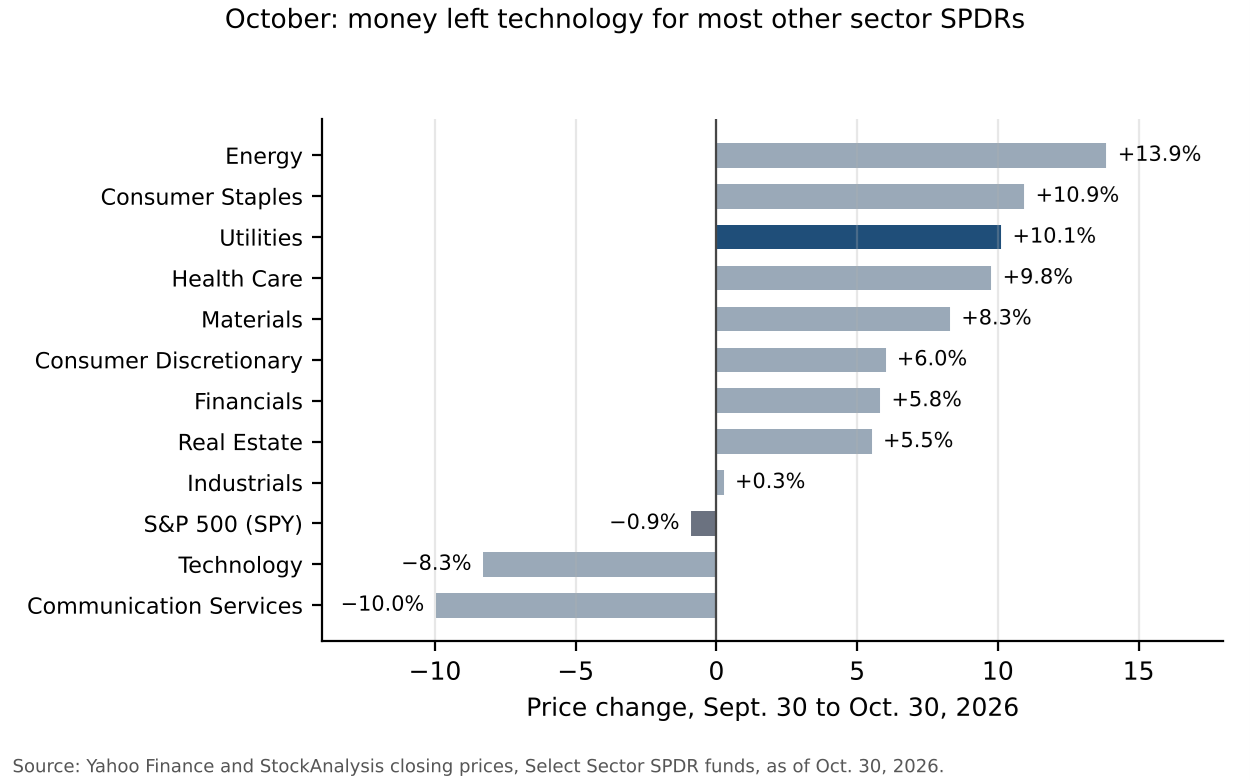
The chart shows technology funds falling while most other sectors rose.
By our own estimate, lower yields explain at most about half of the utilities' October gain.
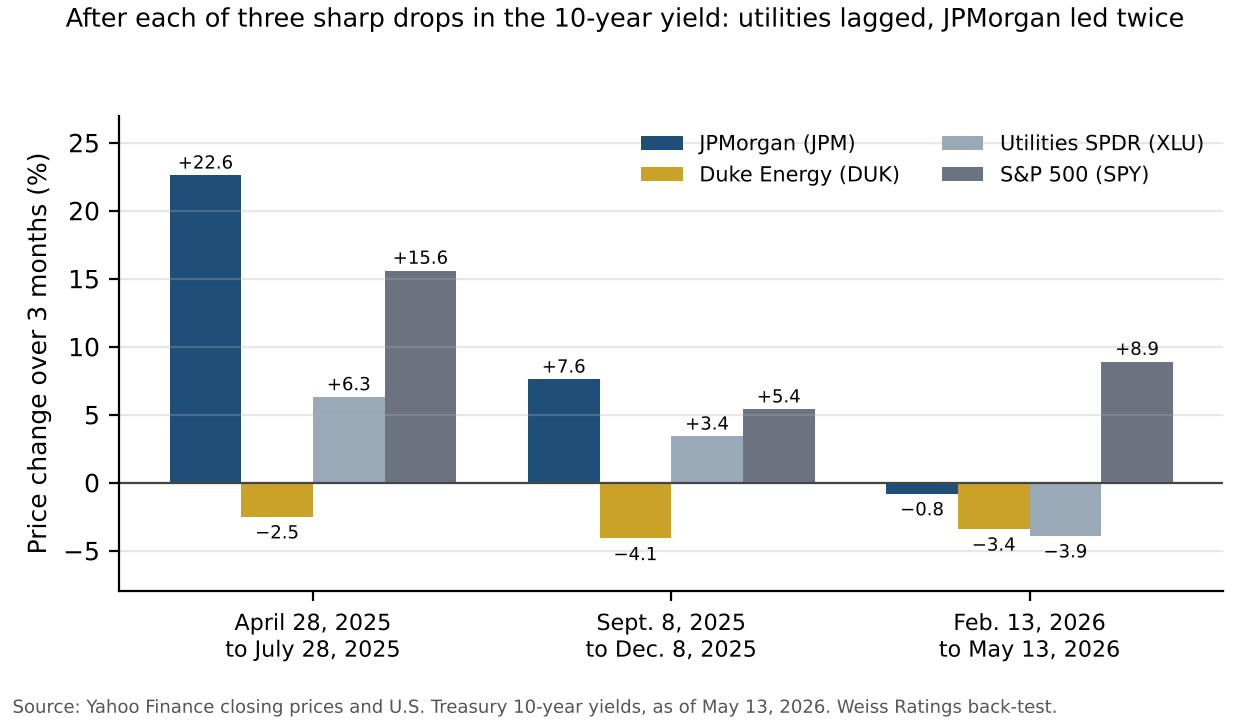
In our own back-tests, the 10-year rose again after each of the last three sharp drops.
Duke and the Utilities SPDR trailed the S&P 500 all three times.
JPMorgan beat the index in two of the three.
The Better Buy After a Big Yield Drop
Buy JPMorgan Chase (JPM), rated B+, a BUY, at the next close; it closed Monday at $340.58.
A bank earns more on its loans and deposits when rates rise.
That is the opposite of a utility, which competes with bonds and loses ground when yields climb.
So, if yields rise again, JPMorgan is positioned for it, and a December hike would add to its interest income.
Its net interest income, what it earns on loans and securities minus what it pays depositors, grew 13% from a year earlier.
What could work against it: a credit scare like March 2023, when JPMorgan fell as yields dropped, or another profit miss like October's.
Monday's close is about $32 below the average Wall Street target. That is a potential gain of about 9%.
JPMorgan pays $1.65 a share each quarter while you wait. At Monday's close, that is a yield of about 1.9% a year.
Our time frame is within a year, with the first check at its Jan. 14 report.
Hold the Utilities You Own, but Don't Add
Hold Duke Energy (DUK), rated B, a BUY, if you own it; we would not add after October's run.
Hold the Utilities SPDR (XLU, C) if you own it.
What We're Watching
First, the Nov. 6 jobs report. If hiring comes in strong and the 10-year climbs back toward its October high, we would revisit our hold on utilities.
Second, credit. On Oct. 30, the extra yield on risky company bonds was just below its highest level in a year.
If it moves above that level, we would sell JPMorgan, and we will say so.
Third, Duke's Nov. 5 report. If it reaffirms its outlook and the shares give back part of October's gain, we would look again at buying.
Fourth, JPMorgan's Jan. 14 report. If card losses climb past the levels the bank has flagged, we would sell.
Bottom Line
October paid anyone who moved into utilities, partly because yields fell. After each of the last three sharp drops, yields rose again.
In our own back-tests, JPMorgan did better than utilities each time yields rose again.
So, if you moved into utilities for safety, hold Duke Energy (DUK), rated B, a BUY, and the Utilities SPDR (XLU, C).
Buy JPMorgan Chase (JPM), rated B+, a BUY, which closed Monday at $340.58, at the next close.
Take care,
AL Qureiyeh