Stocks Now Pay Barely More Than a 10-Year Treasury. Berkshire Hathaway Fell Less Than the S&P 500 in Six Sell-Offs.

 |
| By Al Qureiyeh |
If you've felt nervous about the market but haven't changed what you own, you're in good company.
Investors put a record $1.54 trillion into U.S. exchange-traded funds through September. More than $100 billion of it went into the Vanguard S&P 500 ETF (VOO) alone.
Yet stocks now pay you barely more than Treasurys. Companies in the S&P 500 are expected to earn about $5.26 over the next year for every $100 of stock price. A 10-year Treasury pays $5.15.
An index fund keeps you level with everyone else. It doesn't keep you safe. I'd own a top-rated company that has held up when the market falls.
What Happened
Profits are strong. Most companies that have reported so far beat forecasts, and Wall Street keeps raising its profit estimates, FactSet reports.
What changed is the other side of the comparison. The 10-year Treasury yield has climbed nearly a full percentage point since the start of the year, so a safe bond now pays almost what stocks are expected to earn.
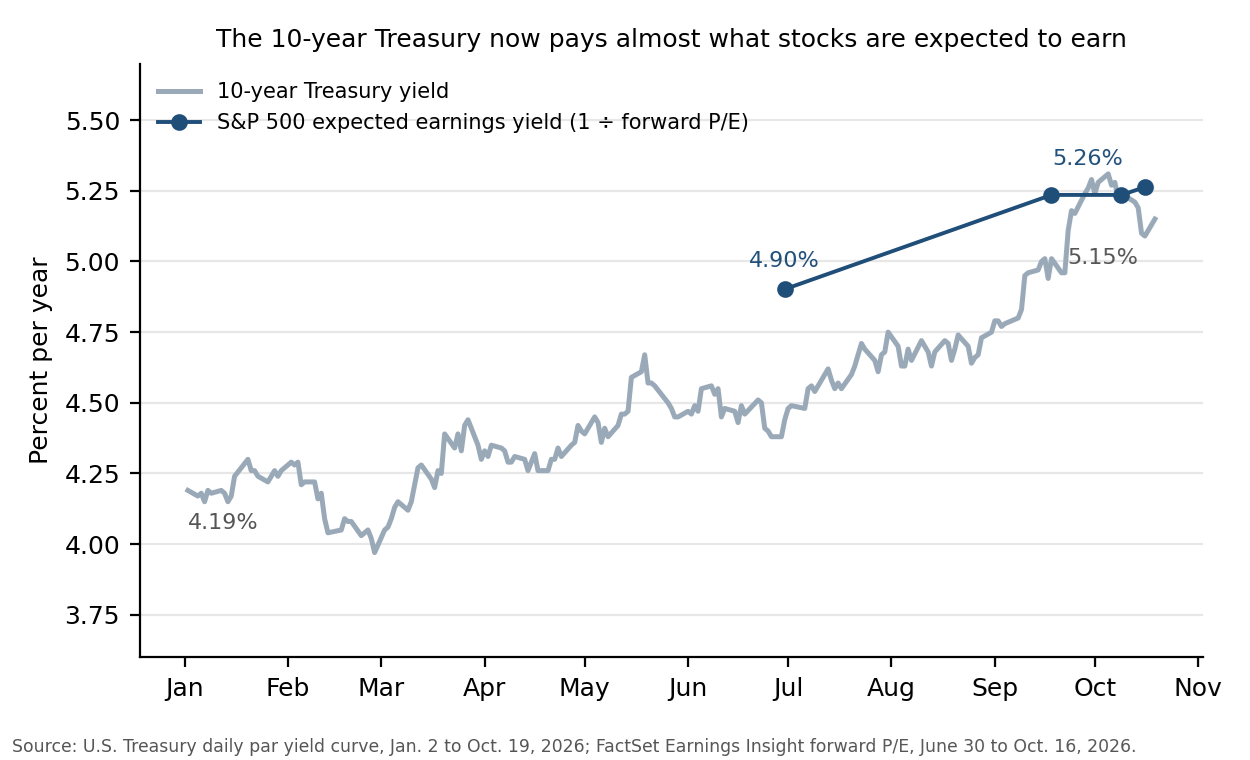
That leaves you very little extra pay for the risk of owning stocks. And the index leans on a few companies, including Nvidia and Apple.
On my scorecard, if you avoided CoreWeave (CRWV) when I said to, you sidestepped a fall of nearly a quarter. If you bought Johnson & Johnson (JNJ) and the VanEck Semiconductor ETF (SMH) when I suggested them, you're ahead of the S&P 500.
We did give up ground on Monday, when the fund built to move three times as much as chip stocks each day, the one I told you to switch out of, bounced more than the VanEck fund. That was the risk I named, and one day doesn't settle it.
Why the Optimists Are Half Right
Small investors are uneasy. More called themselves bearish than bullish in the American Association of Individual Investors survey released Oct. 15.
The optimists have a point. First, prices have risen about in line with profit estimates, not faster. Stocks are not expensive by their own recent history.
Second, a small gap between what stocks earn and what Treasurys pay is not a signal to sell. In early 2025, stocks paid even less than Treasurys and went on to new highs.
Where I part ways is what that small gap means for your money. In my view, with so little extra pay, an earnings disappointment would have little to absorb it, and an index fund would fall with the whole market.
Weiss Rates the Index Funds HOLDs and Berkshire a BUY
Weiss rates two of the biggest S&P 500 funds, the Vanguard fund and the SPDR S&P 500 ETF Trust (SPY), "C+," a HOLD. The funds sold as the safer route rate no higher: the iShares MSCI USA Min Vol Factor ETF (USMV), which holds steadier stocks, is "C," and the Invesco S&P 500 Equal Weight ETF (RSP), which gives every member the same weight, is "C+," both HOLDs.
Some companies rate far higher. Berkshire Hathaway (BRK.B) is "A-," and Travelers (TRV) is "A+," both BUYs.
The Oct. 19 Weiss Ratings Daily piece "The Danger You Face as AI Outpaces Consumer Spending" noted that the seven big technology companies known as the Magnificent 7 make up about a third of the S&P 500. I agree, and that's the risk an index fund hands you.
"If You Feel Poorer, You're Right," also on Oct. 19, said buying the S&P 500 "is the simple solution" when pay buys less as prices rise, then asked why settle for average. I agree with both halves: own stocks, not cash, and own the ones that rate highest rather than the whole index.
Keeping Pace Is Not the Same as Staying Safe
When you own the index, you never fall behind the crowd. That is relative risk, and an index fund keeps it small.
But you also fall with the crowd. That is absolute risk: how much money you can lose. With so little extra pay and so much riding on a few companies, an index fund carries plenty of it.
The way to lower it is to own a company that has fallen less when the market fell, and that earns interest while it waits.
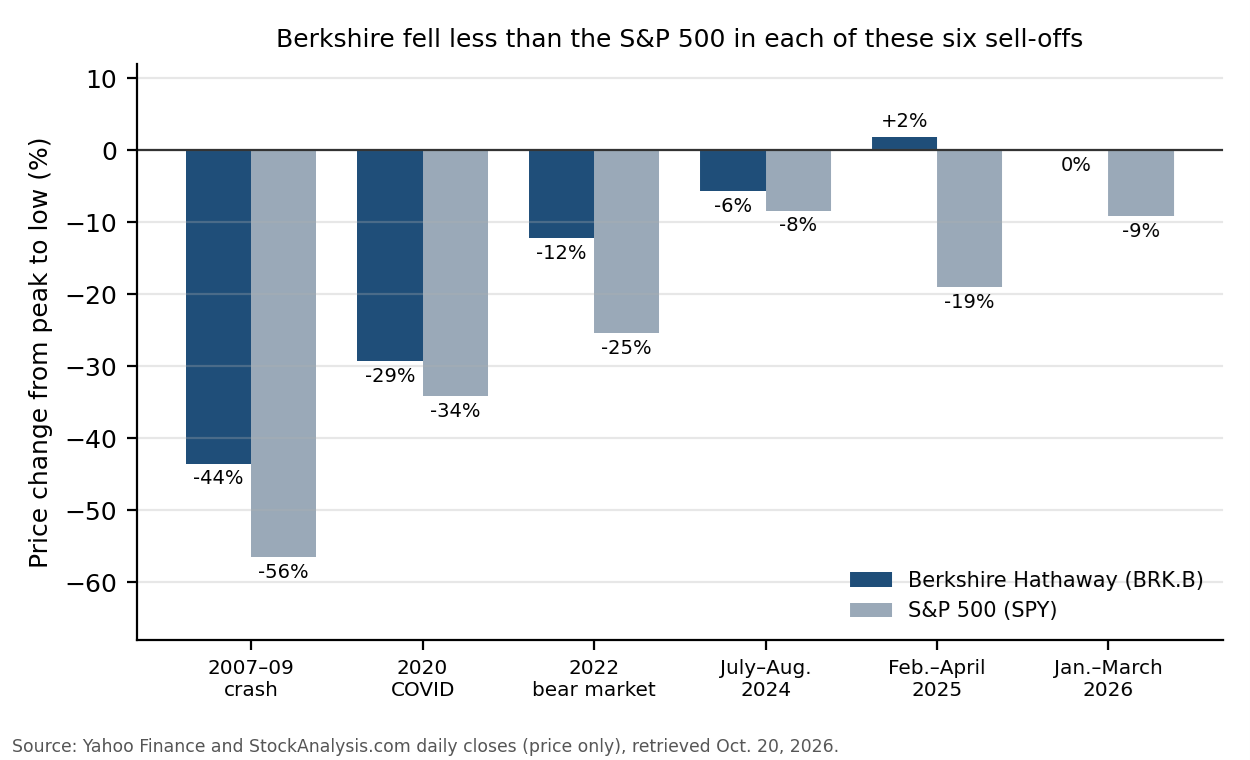
This "A-" BUY Has Fallen Less Than the Market in Every Sell-Off I Checked
Buy Berkshire Hathaway (BRK.B) at the next close; the stock closed Monday at $532.
Berkshire owns insurers, a railroad and utilities, and it held a large pile of cash at the end of June. Most of that sits in Treasury bills, which pay interest while Berkshire waits for bargains.
Weiss rates it "A-," a BUY, with Risk rated "B," Good, and its ability to pay its debts rated Excellent.
In each of the six big sell-offs I checked, including 2008 and the 2020 crash, Berkshire fell less than the S&P 500.
Monday's close was about $10 below the average Wall Street target of $542.50, per MarketBeat on Oct. 20. That's only about 2%, so you buy Berkshire for how it holds up, not for a quick gain.
It pays no dividend. It uses cash to buy back its own shares instead. Give it a year, with the first check at its third-quarter report in early November.
What could work against it: Berkshire lagged the S&P 500 in five of the six rebounds that followed. If the market races higher from here, you'll likely trail it.
Berkshire is the kind of idea my process surfaces. If you want ideas tested against a stricter, fundamentals-first screen and tracked for you, that's what my AI Profit Accelerator does.
The Takeaway
What happened: Investors keep pouring money into index funds even as a 10-year Treasury pays almost what stocks are expected to earn.
What it means: An index fund keeps you level with the crowd, but with so little extra pay for the risk, it doesn't keep you safe.
What to do today: Buy Berkshire Hathaway (BRK.B) at the next close; the stock closed Monday at $532.
If the market keeps climbing quickly, Berkshire will likely trail it; that is the risk we take.
What We're Watching
First, Berkshire's third-quarter report in early November. If profit from its businesses falls from a year earlier, I would sell, and I will say so.
Second, earnings estimates. If Wall Street starts cutting its profit forecasts, the small extra pay for stocks matters, and that's when Berkshire's record should show.
Third, Travelers, "A+," a BUY. It closed Monday above the average Wall Street target. I'll revisit it if it falls below that target, about $363.
Take care,
AL Qureiyeh