The Danger You Face as AI Outpaces Consumer Spending

 |
| By Nilus Mattive |
My Pop-Pop’s family needed money, so he started working in a Pennsylvania coal mine at the age of 13 and never went back to school again.
But he wasn’t stupid. He became a completely self-taught plumber, electrician and car mechanic.
In fact, it seemed like Pop-Pop could fix just about anything he put his mind to.
I enjoyed watching him work on stuff, and I cherished his gruff commentary just as much.
For example, he absolutely disdained the simple warning indicators on car dashboards, telling me to “never trust the idiot lights.”
Pop-Pop’s point was that they were often inaccurate, too late or both.
You really needed to pay attention to the more detailed gauges and regularly check things out under the car’s hood.
Today, I’m going to give you that same advice when it comes to the stock market.
If you look at the S&P 500, things look great: We’re near all-time highs and there’s not a warning light to be seen.
However, take a look under the hood and it’s a different story …
Internally, the major indexes are a mess.
Since ChatGPT first launched, about 75% of the S&P 500’s gains have come from AI-related stocks.
Meanwhile, 212 S&P 500 stocks were recently trading in bear-market territory — i.e., they are down 20% or more from their 52-week highs.
That’s more than 40% of the index’s constituents!
Take a look at the following chart. It compares a regular market-weighted S&P 500 ETF (SPY) to one that assigns an equal weighting to each company in the index — Invesco’s Equal Weight ETF (RSP).
Since the beginning of 2024, the difference in performance is absolutely staggering …
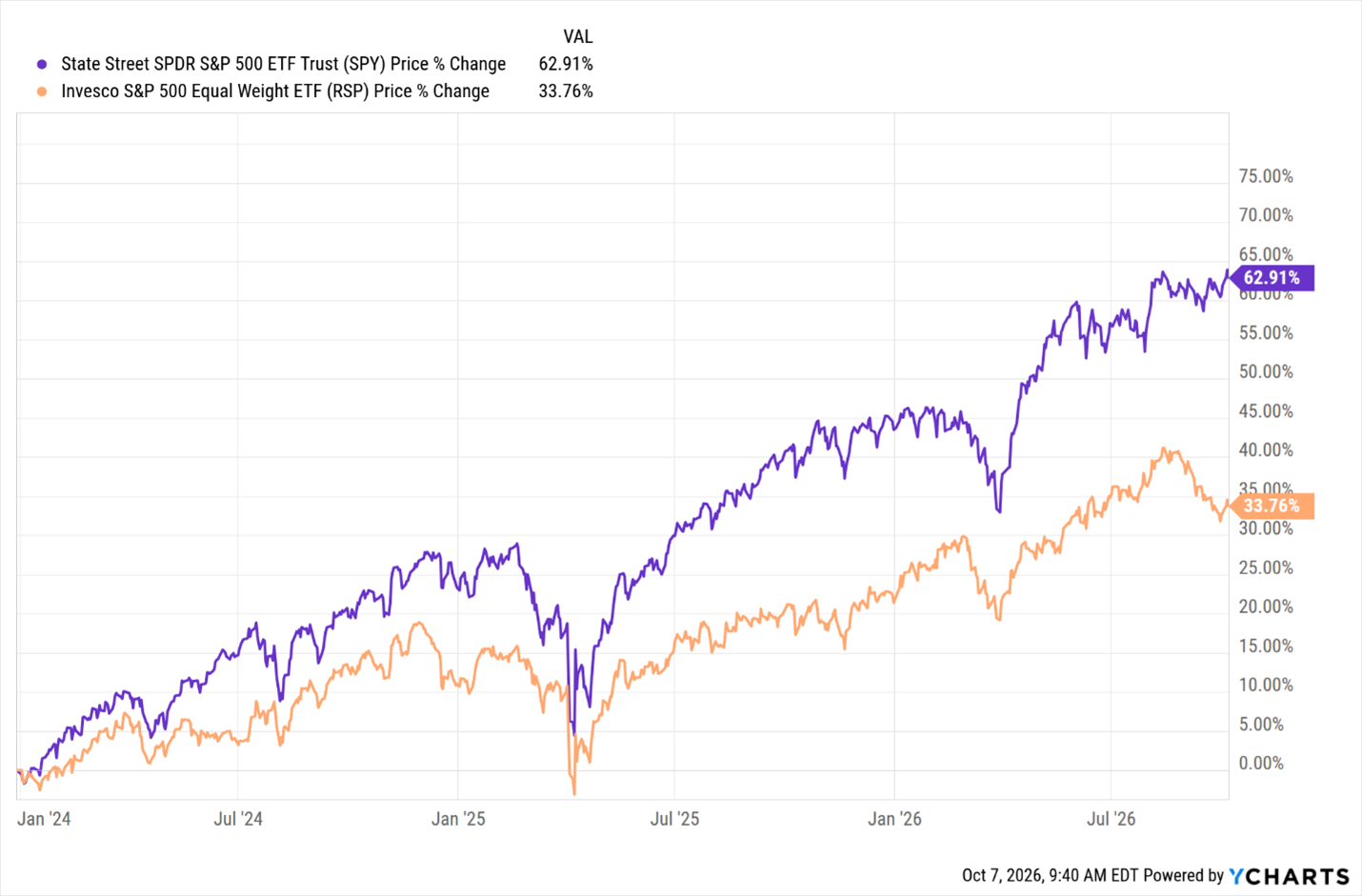
You can also see that sometimes the gap has narrowed and other times it has widened.
Right now, it’s actually near its widest point yet.
So, we’re in a bifurcated market, and all the momentum is back behind a few companies once again.
That alone is a problem because millions of American investors think they are well diversified.
They are dead wrong.
As I have warned repeatedly, the so-called “Magnificent 7” stocks currently account for about one-third of the entire S&P 500’s market capitalization.
We have only seen this type of concentration — with the top 10 companies accounting for 30% to 40% of total value — three times before:
No. 1: Right before the Great Depression in 1929, when a handful of massive industrial and railroad companies dominated indexes right before the 1929 crash.
No. 2: In the early 1970s, when a small group of high-flying blue-chip growth stocks dominated institutional portfolios before a significant market downturn.
And of course …
No. 3: During the 1999-2000 Dot-Com Bubble top, when certain tech names peaked before the subsequent market crash.
Three times that led to three big market drops.
Now consider this …
Apple (AAPL) and Nvidia (NVDA) alone currently account for about 15.7% of the market’s total value.
We have NEVER seen this level of concentration before.
But there have been a few other examples from history where two stocks made up a sizable portion of the index’s value.
Again, one of them was back in 1999, when Microsoft (MSFT) and General Electric (GE) at one point accounted for about 9.1% of the S&P 500.
GE rose more than 50% that year. MSFT was up more than 67%. Both later went on wild roller coaster rides, each losing more than half their value at various points along the way.
It actually took MSFT about 17 years before it regained its same peak Dot-Com valuation. GE never did.
I will also reiterate one more time just how expensive the stock market is right now.
Sure, on a straight price-to-earnings ratio, the S&P 500 looks pricey but not extremely so.
That’s because the aforementioned tech companies are propping up the “e” part with their circular financing deals and analysts’ forward estimates remain extremely optimistic.
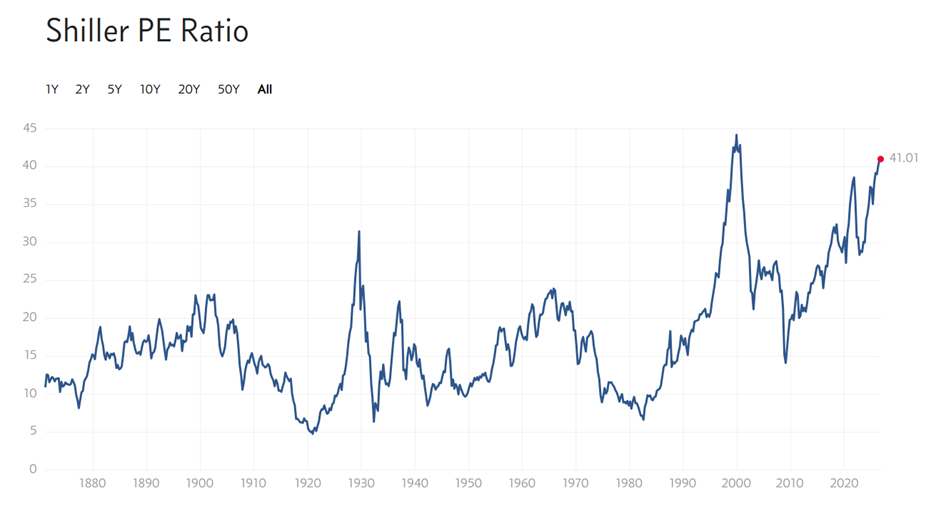
If you use a smoothed-out measure like Robert Shiller’s CAPE ratio, you’ll see that stocks have only been (slightly) more expensive once before … 1999.
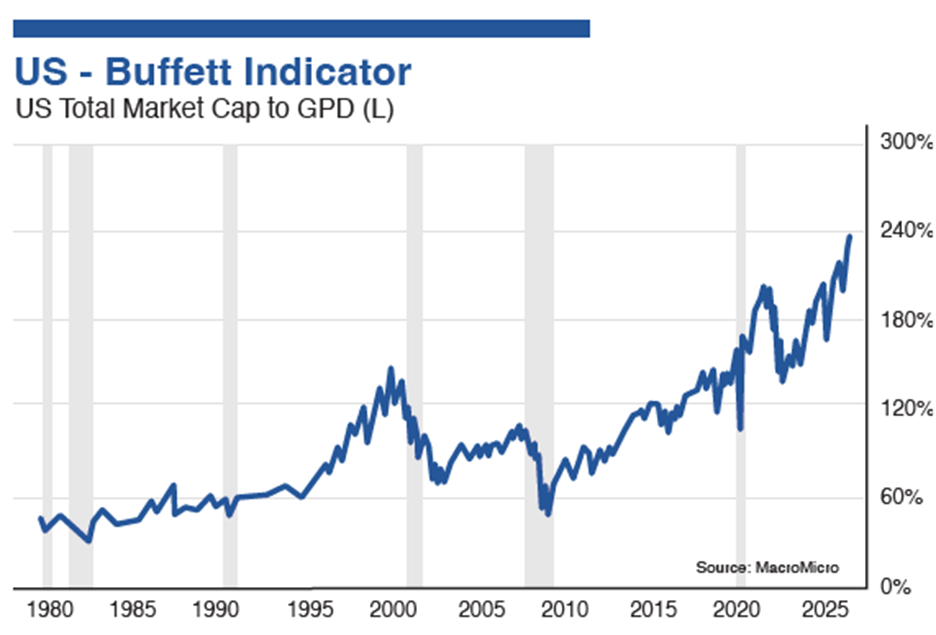
And if we use Buffett’s market-to-GDP gauge? Then the indexes have NEVER been more expensive than they are today.
Here’s another interesting way to look at it …
Michael Burry, the famed investor from “The Big Short,” recently highlighted this dichotomy by pointing out that a soon-to-go-public company like Anthropic is effectively being valued as highly as 78 different companies currently inside the S&P 500.
Think about that: One relatively new company, with unproven financials, carrying the same value as dozens of long-standing firms like Domino's Pizza (DPZ), Clorox (CLX), Stanley Black & Decker (SWK), McCormick & Company (MKC) and on and on.
And it isn’t just a stock market problem.
The stock market is merely reflecting what’s happening in the U.S. economy as a whole.
U.S.-based AI startups raised a record $222 billion last year.
And the spending taking place is so extreme, it’s changing our country’s entire economic landscape.
Since World War II, there has been one constant when it comes to the economy: The consumer has always been the undisputed engine, accounting for 60% to 70% of annual GDP and the highest percentage of yearly growth, too.
It seemed implausible to think that would ever change.
But last year, AI expenditures contributed more to the growth of the economy than all consumer spending COMBINED.
One Harvard economist said AI investment accounted for 92% of GDP growth in the first half of 2025.
If AI spending slows …
If investor confidence wanes …
If there’s even a small hiccup …
The entire U.S. economy is toast.
This is why I think a blowup could be like a combination of the 1929 crash … the 2000 Dot-Com Bubble … and the 2008-2009 Financial Crisis all at once.
And it’s why we just put out this major video warning that digs deeper into the problems and also outlines the protective steps I recommend taking right now, while there’s still time to get ahead of things.
Best wishes,
Nilus Mattive