 |
| By Jim Nelson |
The market is jumping higher today on news that the U.S. and Iran agreed to a deal to open the Strait and end the Mideast war.
We don’t know what the terms are. And we likely won’t until closer to the scheduled signing on Friday in Geneva, Switzerland.
Currently, President Trump is at the G7 Summit in nearby Évian-les-Bains, France.
So, plenty can happen and change over the next five days.
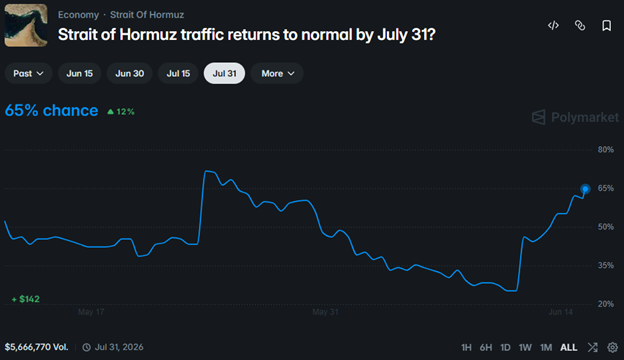
As of this morning, some 65% of bets on Polymarket anticipate Strait traffic returns to normal by July 31.
Even if the war does end quickly and in perfect harmony, we need to look at the costs of it … and what comes next.
I’m not only talking about the billions in new debts to pay for the war … but also to rebuild and fortify our armory.
While we haven’t gotten official figures since about late April, the Pentagon’s $25 billion estimated spend on munitions has only gone higher.
Low Supply, High Demand
While the peace deal President Trump said today is “now complete,” it’s still fragile until the parties meet on Friday.
One thing is clear: the fact that the U.S. burned through missiles and drones in this conflict faster than it could build them.
And this is a lesson the Pentagon doesn’t want to learn again.
Defense contractor RTX (RTX) is already preparing for the future. In 2025, it delivered just 100 new missiles.
RTX recently agreed to make up to 1,000 Tomahawks over a potential seven-year period.
And as my colleague Bob Czeschin noted recently, the Pentagon needs loads more missiles of all sorts.
But as the war in Ukraine has shown, drones are also becoming a key factor in keeping a solid lead on the modern battlefield.
In fact, this war with Iran is the first time the U.S. has used low-cost, one-way drones in combat.
The “Toyota Corolla of Drones,” as the WSJ described them, for their low cost, fast production and overall effectiveness.
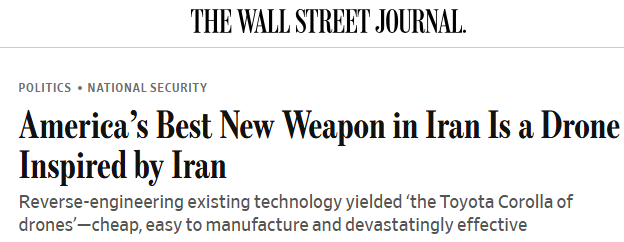
Indeed, the U.S. military now considers lightweight drones as a sort of ammunition.
That designation slashes red tape and shifts the Pentagon from pricey, high-quality munitions toward industrial-grade throughput.
The Department of War’s $1.1 billion Drone Dominance Program calls for 150,000 drones in two years. Though, they will likely need as many as 1 million, and faster.
And every drone part to be made by companies in nations that are not adversaries — like Russia or China. (Ukraine is on track to make 7 million drones this year, in part by using Chinese drone motors.)
High-Stakes Picks & Shovels
Drone stocks rocketed late last month on word the Trump Administration is in talks to fund several domestic companies.
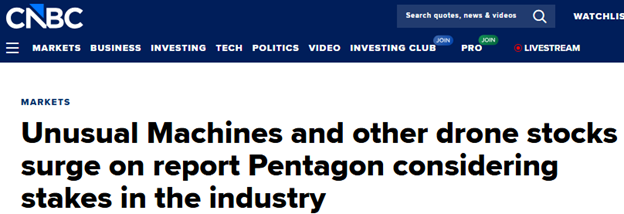
That could include snapping up equity stakes in these picks-and-shovels firms, as it has with critical minerals miners and AI chip makers.
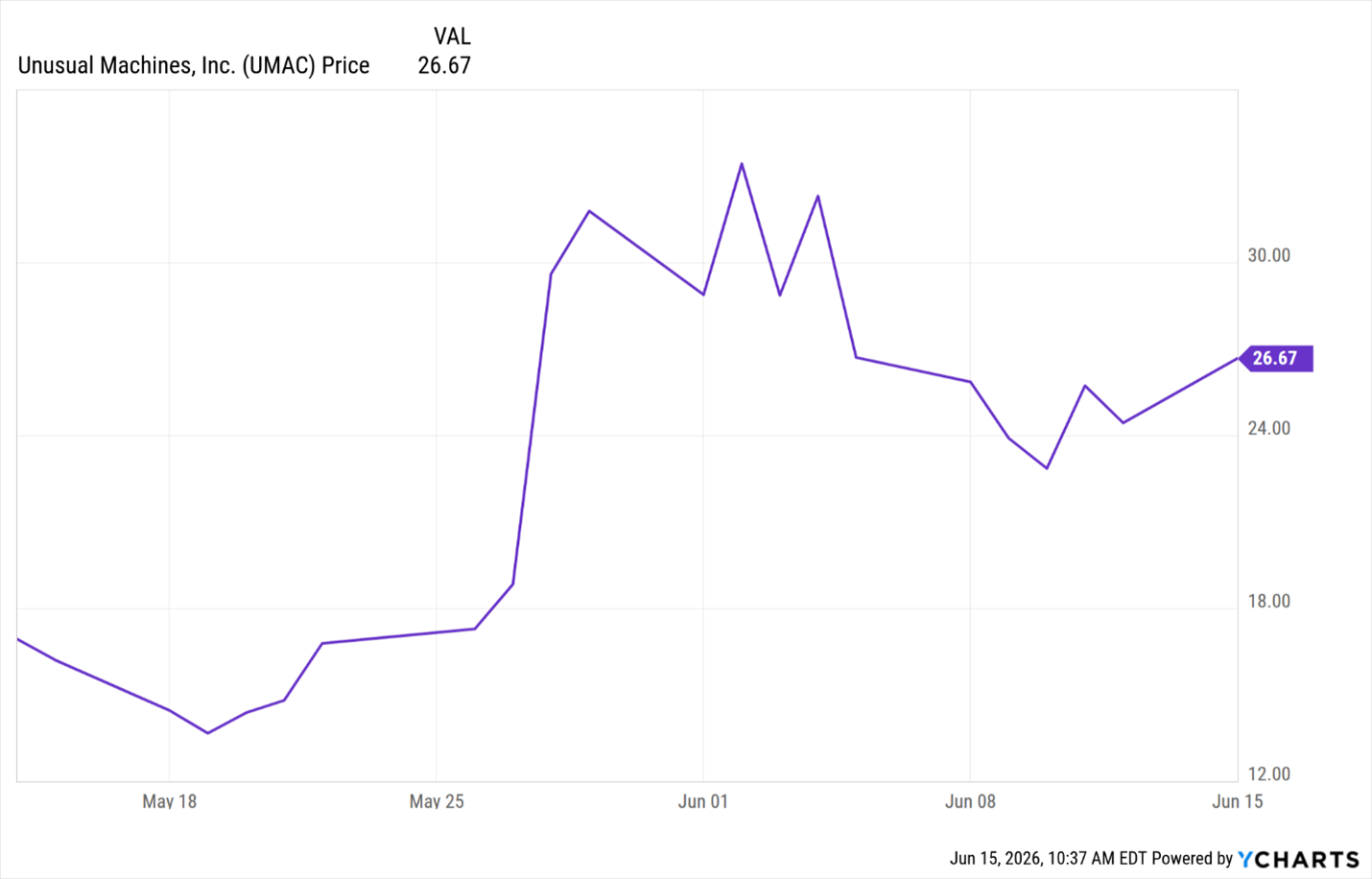
Shares of Orlando, Florida-based drone maker Unusual Machines (UMAC) rocketed 65% on the news, though it’s pared back a bit since then.
The company makes drone motors, batteries and other components.
Donald Trump Jr. is also a shareholder and advisory board member.
Kratos Defense & Security Solutions (KTOS) is a drone-and-propulsion double-play.
The firm’s backlog stands at roughly $2 billion. And the company cites a $14 billion opportunity across hypersonics, drones, engines, microwave electronics and space.
Further down the food chain, Mercury Systems (MRCY) builds critical parts and subsystems used in radar, sensors, computing and much more.
Textron (TXT) is a more under-the-radar drone play, pun intended.
Known more on Wall Street for its business jets, the firm also makes loitering munitions and the Aerosonde drone that just won U.S. Army contracts.
Now, these aren’t official recommendations — many are still volatile and speculative, as you can see from their Weiss stock ratings.
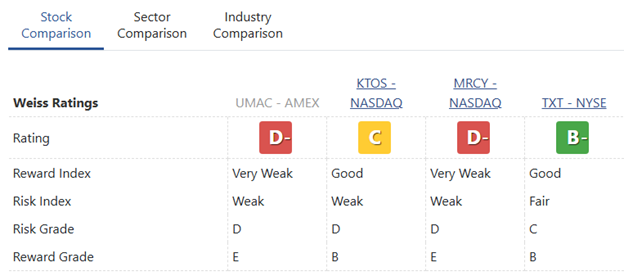
You can also see Weiss Ratings Plus in action here.
While many small drone makers come with serious risk, the “under-the-radar” one gets a “B-” rating.
In fact, you can see here how it was recently upgraded to this “Buy” status:

Only Weiss Ratings Plus members can see and use either of these tools. And these are just two of dozens of useful ways to invest better with our 100-plus years of data.
So, even if the end of the war is here, the long reloading process is just beginning.
And you can count on drones being at the center of that effort.
Sincerely,
Jim Nelson
1 https://polymarket.com/event/strait-of-hormuz-traffic-returns-to-normal-by-july-31
2 https://www.wsj.com/politics/national-security/iran-war-shahed-drone-65d0aced
3 https://www.cnbc.com/2026/05/28/drone-stocks-unusual-machines-donald-trump-equity-stake.html