|
Key Takeaways
|
 |
| By Sean Brodrick Reviewed by: Jim Nelson |
America is in the middle of an energy export boom that could make investors a fortune.
This boom is happening even as the war in the Middle East turns global energy markets upside down. I'm talking about liquefied natural gas — LNG.
The United States is already the world's largest exporter. But if current projections hold, American LNG exports could double by the end of this decade.
That's an enormous expansion in just four years. And it creates a potentially lucrative opportunity for investors who know where to look.
America's LNG Export Machine Hits Overdrive
According to BloombergNEF, natural gas flowing through pipelines to America's LNG export terminals on Saturday, Nov. 14, hit an all-time high of 21.8 billion cubic feet per day. That's more than 12% above the same day last year.
Looking ahead, the Energy Information Administration forecasts that U.S. LNG exports should rise from an average of 17.6 billion cubic feet per day (Bcf/d) in 2026 to 19 Bcf/d in 2027 — an increase of about 8%.
This powerful upward trend has been building for years.
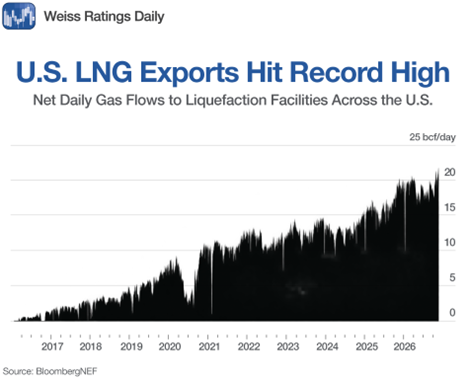
A decade ago, American LNG exports were practically nonexistent.
Today, the country has built an enormous infrastructure network to chill natural gas to approximately minus 260 degrees Fahrenheit, load it onto specialized tankers and ship it around the world.
Two facilities helping drive the latest surge are Golden Pass in Texas and Sabine Pass in Louisiana.
Golden Pass is 70% owned by QatarEnergy, Qatar’s state-owned energy company, and 30% owned by ExxonMobil (XOM).
Sabine Pass is owned by Cheniere Energy Partners (CQP), and Cheniere Energy (LNG) owns a 48.6% limited partner interest in CQP and 100% of the separate legal entity that serves as CQP's general partner.
Related article: “Qatar Loses LNG Crown: This U.S. Stock Set to Take Over.”
Golden Pass recently recorded its highest pipeline gas deliveries ever, while Sabine Pass saw its strongest flows since April.
And there's more capacity coming.
Major LNG developments along the Gulf Coast are being built or expanded, including projects associated with Venture Global (VG), Cheniere Energy and other big players.
From Iran, With Love
The war in the Middle East has severely disrupted global energy supplies, particularly shipments originating in the Persian Gulf.
That includes LNG from Qatar, one of the world's largest exporters.
As a result, buyers in Europe and Asia are scrambling to secure alternative supplies.
Bloomberg reports that Asian natural gas prices have tripled compared with prewar levels. European gas futures have nearly tripled as well. That's a staggering price shock.
And it makes American LNG increasingly valuable.
Unlike LNG supplies from the Persian Gulf, American exports don't have to pass through the Strait of Hormuz.
U.S. Gulf Coast terminals have direct access to Atlantic shipping routes, making them particularly attractive to European buyers.
Here's another interesting twist.
Before the war, analysts were increasingly worried that all the new LNG projects coming online worldwide would create a global supply glut.
But according to the International Energy Agency, disruptions in the Persian Gulf have pushed back expectations for that oversupply by at least two years.
That potentially gives American exporters a longer window to benefit from tight global markets and elevated prices.
A Second Demand Boom Is Building at Home
Meanwhile, a new powerful force is driving American natural gas demand — artificial intelligence. I gave you the scoop on that emerging trend in this article.
AI data centers require enormous amounts of electricity. And natural gas is emerging as one of the most practical ways to supply dependable, around-the-clock power.
Unlike solar and wind, gas-fired power plants can generate electricity whenever it's needed.
That matters enormously to hyperscalers building multibillion-dollar AI campuses.
So American natural gas producers could enjoy two simultaneous demand booms — rising exports to energy-hungry overseas markets and growing domestic electricity consumption.
The long-term demand picture is compelling.
How You Can Play This
A good way to invest in America's LNG export boom is the Global X MLP & Energy Infrastructure ETF (MLPX).
This fund invests in companies that own and operate the infrastructure making America's energy export boom possible — pipelines, processing plants, storage facilities and LNG export terminals.
And as U.S. LNG exports potentially double by 2030, those pipelines and terminals should have plenty of business coming their way.
MLPX holds approximately 30 companies, including some of the biggest names in American energy infrastructure.
Its holdings include The Williams Companies (WMB), which operates an enormous natural gas pipeline network; Kinder Morgan (KMI), another major pipeline operator; and Cheniere Energy, America's leading LNG exporter.
These businesses give investors exposure to multiple links in America's growing energy export supply chain.
There's another attraction — income.
MLPX recently sported a yield of approximately 4.3%, and it makes quarterly distributions.
That gives investors a potential income stream while they wait for America's LNG infrastructure boom to play out.
The ETF has approximately $3.8 billion in assets, trades hundreds of thousands of shares daily and charges an annual expense ratio of 0.45%.
Here’s the chart …
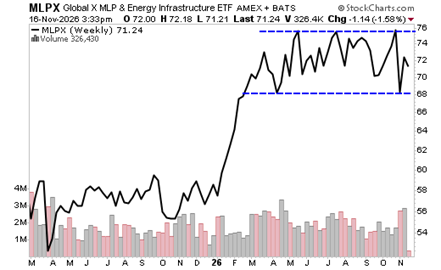
You can see that MLPX has traded in a range all year. I call this an “energy band” because it’s building up energy for its next move.
I believe that move is a breakout to the upside, and it could be a doozy.
Of course, MLPX isn't a pure LNG investment. Some holdings transport crude oil and natural gas liquids, and the fund remains vulnerable to an energy downturn, higher interest rates and project delays.
But I like its combination of growing energy infrastructure demand, relatively predictable cash flows and attractive income.
America’s next energy boom is just starting, and it’s cooking with gas! The MLPX is a great way to play it.
All the best,
Sean Brodrick
P.S. The MLPX offers more than twice the average stock in terms of investment income.
But for something that offers 22 times the income of the average stock, you’ll need your ticket to this rare event.
Only a small group of people have seen what we’re about to reveal.
And the window to see it for yourself will be very small. Grab your seat here.