What the ‘Blue Collar Social Security Fairness Act’ Actually Does

 |
| By Nilus Mattive |
Instead of coming up with ideas and proposals to fix Social Security’s imminent demise, politicians continue to work on new ways to further skew the program’s universality and worsen its finances.
This has been the case for many decades now … but it still blows my mind every single time I see a new example.
Just consider the “Blue Collar Social Security Fairness Act,” which was introduced by Rep. Haley Stevens (D-Michigan) last week.1
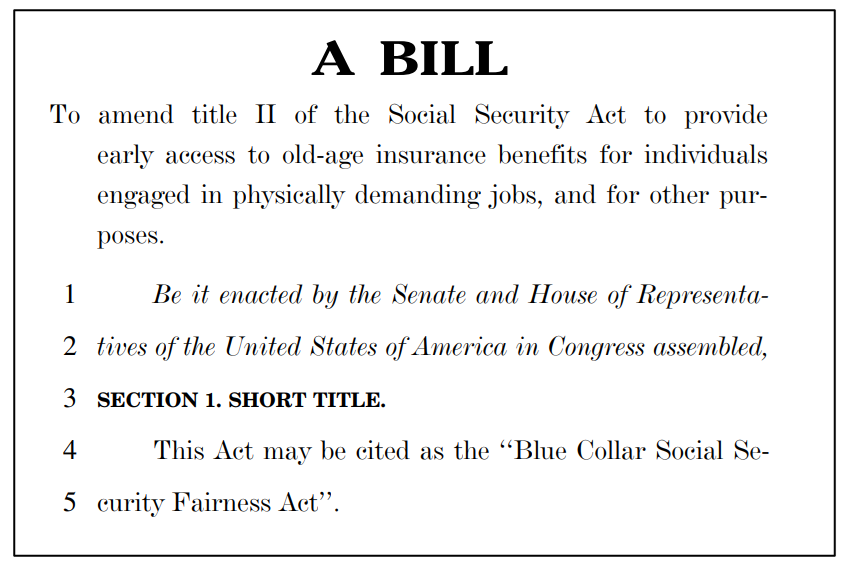
The basic idea is allowing certain people in “physically demanding” jobs to start claiming their full retirement benefits about seven years ahead of everyone else.
Which jobs would qualify?
The actual text says:
“The Commissioner of Social Security, in consultation with the Secretary of Labor and Secretary of Health and Human Services, shall publish, and update every 3 years thereafter, a list of occupations that are physically demanding jobs …
“An occupation shall be determined to qualify as a physically demanding job if the occupation, as a condition of employment, imposes on an individual substantial physical demands that may be reasonably expected to diminish the ability of the individual to perform such occupation, or other occupations imposing substantial physical demands, at an advanced age.”
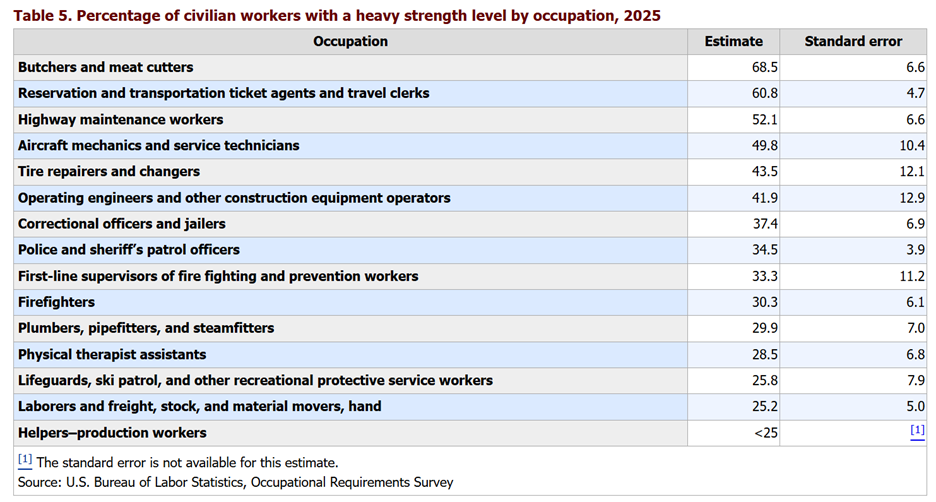
The Bureau of Labor Statistics (BLS) says these are jobs that require certain levels and durations of physical exertion — things like climbing, heavy lifting, pushing, pulling, standing and/or walking.
Based on BLS metrics, about 39.1% of civilian jobs qualify.
And according to its Occupational Requirements Survey, some of the biggest categories would include firefighters, mechanics, roofers, electricians, paramedics and police officers.
Since Stevens is from Michigan, I’m pretty sure she was picturing autoworkers.
The bill also contains formulas to determine overall eligibility.
So, someone can qualify based on the number of years they spent in a given occupation, what ages they performed that occupation or some combination of those factors.
That alone is somewhat problematic.
Since the proposed formula assigns a much higher weighting to performing these functions later in life, someone could take a qualifying job at a more advanced age and get far more credit than a younger person doing the same activity.
However, that’s just the first of many problems.
Another: Some of these occupations already have access to very solid pension plans that allow them to retire earlier — and with more guaranteed lifetime income — than the typical American.
The case for public-sector occupations is very clear here.
Police officers and firefighters both retire around age 55, on average.
While their pension income varies widely, the average is somewhere around $50,000 a year.
What about autoworkers?
They typically retire between 55 and 60. Their pension income averages just under $20,000 a year.
In contrast, the average American retires somewhere around age 62. Only about one-third receive any pension income at all.
An even bigger flaw is the core assumption at work.
The reality is that Social Security was never designed to guarantee anyone a comfortable — or even any — retirement at all.
It was merely intended to be a safety net that guaranteed some minimum level of income for people in the latter stages of their lives.
Large swaths of the population have supported it philosophically because it has been about as universal as a government program can be …
At this point, most Americans pay in. Most Americans collect something back out.
And while it is hardly perfect, there are at least bumpers on both sides of the equation, so nobody gives or takes a wildly disproportionate amount.
Which is why it’s funny to hear someone say a piece of legislation like this is needed for “fairness.”
The more we start carving out special cases and groups, the less objectively fair the system actually becomes.
Defining those categories would be practically impossible in any “fair” way, too.
Is a desk sergeant more physically active than a bank manager?
What about an executive assistant who spends all day running errands for her boss?
A waitress?
A NYSE stock trader who spends all day on his feet for 30 years?
And moving beyond sheer physicality, is a barista’s cumulative emotional stress any less debilitating than the damage done to a delivery driver’s back?
We don’t even have to know the answers let alone agree on them.
The biggest argument against this proposal is basic arithmetic.
As I told you back in August, the Social Security system is already taking in less than it pays out each year. And the reserves it uses to make up the difference will run dry by 2032.
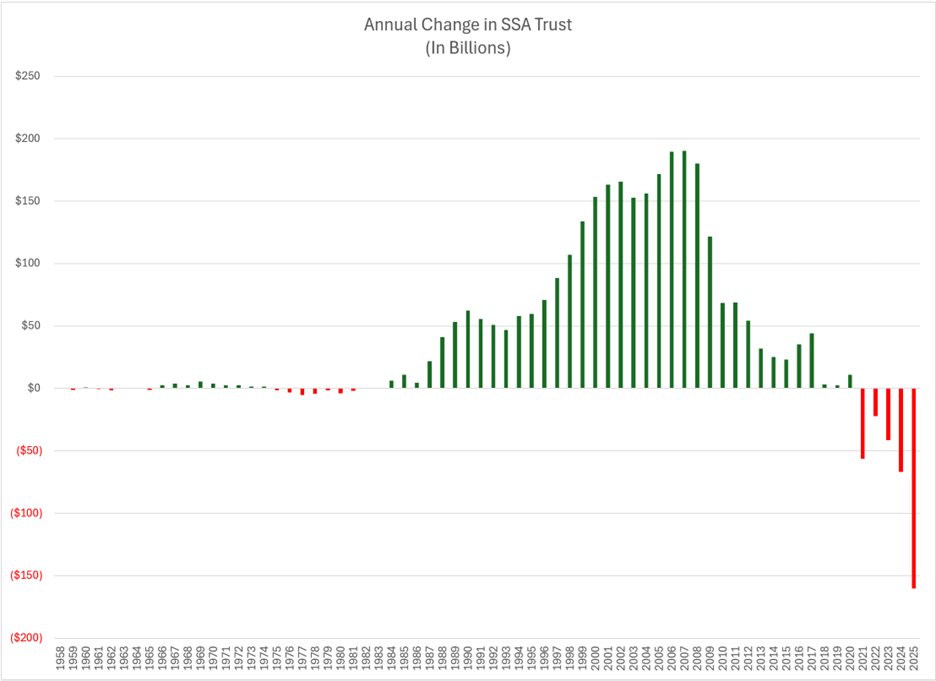
That math alone argues against any initiative that would further strain the system’s finances at this critical juncture.
And make no mistake, the “Blue Collar Social Security Fairness Act” would definitely do that.
Just to use a simple illustration …
A person born in 1960 can begin taking Social Security at age 62.
If they wait until “full retirement age,” which is now 67, they will receive about 42.85% more.
Thus, with this proposal, eligible people would get almost 43% more out of Social Security for seven extra years.
Not only that, but they would actually get those payments for two years more than anyone else in their same age group.
Plus, as cost-of-living increases compounded, their benefit checks would pull ahead even further over time.
And it’s possible that 39% of Americans could qualify based on BLS definitions.
That would result in a massive amount of extra money getting sucked out of the system, especially since we are talking about a younger cohort with longer life expectancies overall.
The good news is I don’t see any way that Congress will seriously consider this proposal.
The bad news is that it provides yet another window into how lawmakers think — only in terms of rewarding their own constituencies and furthering their own political careers rather than tackling the real, imminent, universal financial problems that our country faces.
Best wishes,
Nilus Mattive
P.S. Social Security is only one piece of a retirement plan — and its future is anything but certain. With Weiss Ratings Plus, you can access our independent ratings and research to help identify stronger opportunities and avoid unnecessary risks.
To learn more about Weiss Ratings Plus, click here.