|
Key Takeaways
|
 |
| By Sean Brodrick Reviewed by: Jim Nelson |
Unpopular opinion: America is headed for a recession.
That puts me at loggerheads with the Bureau of Economic Analysis, which says real U.S. gross domestic product (GDP) grew 3.4% in Q3.
Why do I believe we’re headed for a recession? Simple math.
Of that 3.4% GDP growth in Q3, some 1.4% of it was data-center spending.
Another 0.7% is money spent on upgrading and expanding the nation’s power grid. Most of which is being done to serve … you guessed it … data centers.
Take those two things out, and GDP is growing at just 1.3%.
That’s still growth, but it’s low growth that benefits a select few.
Meanwhile, an important sector of the economy that touches every American’s life is keeling over and falling into a ditch.
I’m talking about housing, where a recession seems to be spreading.
The latest evidence arrived with September construction spending.
Private residential construction spending plunged 5.5% in a single month and was down 8.9% from a year earlier.
And it’s hardly the only warning sign.
Housing’s Bearish Numbers Keep Piling Up
Consider what’s happening across the industry:
- Housing starts fell 5.2% in September to a seasonally adjusted annual rate of 1.221 million. That's 7.4% below a year earlier.
- Single-family starts fell 4.6% to an annualized 859,000 units.
- Single-family building permits fell 4% to 845,000. Permits are especially important because they give us a glimpse of future construction activity. They’re now 4.8% below last year.
- Housing completions are down 14% year over year.
- New-home sales fell 0.6% and are down 5.3% from a year ago.
- Existing-home sales are down 2.2% year over year. August and September were the two slowest months for existing-home sales this year.
- In October, 43% of builders cut prices, the highest share since at least 2020. Roughly two-thirds were offering incentives such as mortgage-rate buydowns.
So, weakness is showing up in construction, permits, sales, remodeling and builder pricing.
Take a look at housing starts:
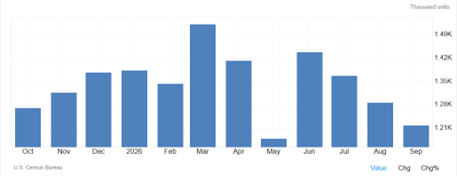
That’s an ugly trend.
The National Association of Home Builders also expects lower single-family production this year, followed by further declines in 2027 if rates remain elevated and construction costs keep rising.
A Recession Without a Housing Crash
There is no official definition of a “housing recession.” The National Bureau of Economic Research isn’t going to declare one.
But if falling sales, construction and permits don’t constitute a recession in the housing industry, what does?
The problem is largely affordability and paralysis.
Existing-home sales clocked an annualized pace of just 4 million in September. Yet the median existing-home price was still $417,500, up 1.3% from a year ago.
In other words, this is a housing-activity recession, not a housing-price crash … yet.
High mortgage rates have frozen buyers out of the market. Meanwhile, millions of existing homeowners have little incentive to give up the low mortgage rates they locked in years ago.
So they stay put.
What Should You Do?
Who benefits as Americans stay put in houses they can’t sell? My choice would be Home Depot (HD).
Sure, the housing slump is a headwind for Home Depot. People spend a lot of money fixing up houses when they buy and sell them, and fewer transactions mean fewer of those projects.
But while you can postpone that $50,000 dream kitchen, you can’t postpone fixing a leaking roof for long.
You can live with an ugly bathroom. You can’t live very long with a broken water heater, failing air conditioner or burst pipe.
Americans are staying in their homes longer, while those homes keep getting older.
The longer the housing freeze lasts, the more money homeowners will eventually have to spend keeping their existing homes in working order.
And we’re already seeing signs of that in Home Depot’s quarterly numbers.
In its fiscal second quarter, Home Depot's sales increased 5.7% to $47.9 billion, while U.S. comparable sales rose 1.3%.
Part of this may be due to the Giant Skeleton Economic Boom.
Yes, I’m partly kidding, but if you want to read about a real phenomenon boosting Home Depot’s sales, click here.
Anyway, Home Depot’s management specifically said customers continue to spend on smaller projects, and its SEC filing pointed to continued engagement with repair and maintenance projects despite housing affordability pressures.
Home Depot expects fiscal 2026 total sales to grow approximately 2.5% to 4.5%, with comparable sales ranging from flat to 2% growth.
Adjusted earnings per share are expected to range from flat to 4% growth.
Those aren't spectacular numbers. But homeowners are staying put, and necessary repairs don't disappear — they accumulate.
That should mean more business for Home Depot.
Let’s look at the weekly chart …
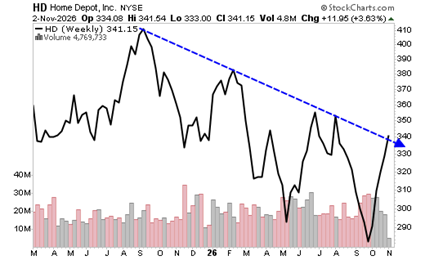
You can see that Home Depot has been in a downtrend for more than a year. Recently, though, it has rallied hard and is now testing that downtrend.
A successful breakout should send the stock to $380, or even higher.
Importantly, HD is marching higher when the broader market is selling off.
The fact that HD sports a 2.7% dividend yield when the S&P 500 isn’t even yielding 1% probably helps.
For these reasons, I believe HD is one of the safer places for your money as housing markets crumble and threaten to drag the rest of the economy into recession.
All the best,
Sean
P.S. The dollar fell after this week’s election results. That’s good news for metals. In fact, that’s great news for a certain metal project. Check it out here.