 |
| By Nilus Mattive |
You’re probably seeing a lot of headlines about the U.S. central bank’s “credibility” after last week’s second meeting under new Fed Chairman Kevin Warsh.
What do people mean by this?
That the Federal Reserve might be saying it cares about inflation but isn’t really doing enough to bring it down.
Well, DUH!
This has been obvious for many years now, and I’ve been saying it consistently the whole time.
Indeed, just last week I showed you how Washington bureaucrats and monetary policymakers have continually changed the underlying formulas behind their inflation gauges … almost always in an effort to make the numbers lower than what we experience in our everyday lives.
We also briefly discussed how they often use whatever yardstick is most convenient at any given time — for example, citing a “core” version of the CPI that excludes the effects of energy and food whenever those prices are rising sharply.
And funny enough, this came up during new Fed Chairman Kevin Warsh’s post-meeting press conference last week.1
Paul Wiseman of the Associated Press basically asked Warsh what specific gauge the Fed was using to see if it was getting inflation back to its stated goal of 2% a year.
Warsh provided a long, rambling answer that started out like this …
“Yeah, so, I'll give two answers.
“First let me give the proper standard answer, the Federal Reserve every January outlines a statement of purposes and strategy.
“And in that strategy document, which I believe was dated January of this year, it describes a measure of PCE inflation as the — as the objective function there.
“I have enough of my — so that's our number, we're sticking with it.”
Then quickly went to this …
“Who knows come after next January what we might say about strategy. I suspect the task forces might have something to add.”
Next were several more paragraphs of metaphysical econo-speak.
Those implied Warsh was actually using a lot of different gauges and didn’t want to tell us everything. That’s because it would change the way markets were acting.
In the middle of all the jargon, he reiterated that “we're going to deliver 2% inflation, and not a whisper more” but also called the whole process “an inexact science.”
To summarize: Warsh said the Fed will get inflation down to 2% a year as measured by the PCE.
But he also said he might start using a different gauge in January of 2027.
That he was already looking at plenty of different yardsticks right now.
And that we shouldn’t expect much information from him going forward.
Bond investors immediately sent longer-term interest rates higher.
Which means they expect more inflation.
Which also means they don’t believe Warsh.
And rightly so.
Because Warsh can say — or not say — whatever he wants.
But what is he actually DOING?
Here’s PCE over the last year …
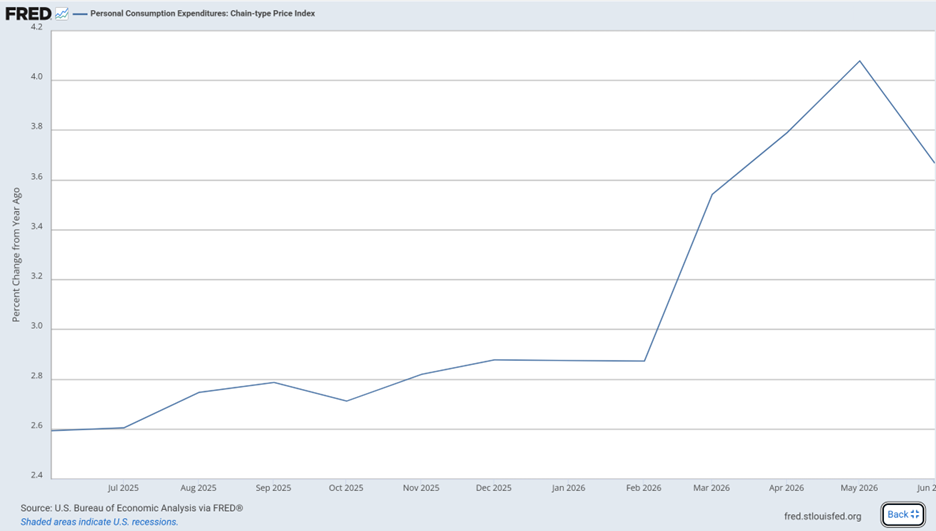
As you can see, inflation has been steadily going UP not down since last year.
Heading into the Fed meeting, it was at 4.1%.
The number we just got after the Fed meeting was down slightly because of the dip in energy prices, but still a way-too-high 3.7%.
And oil prices have been going back up once again.
Yet Warsh still isn’t raising rates.
As I noted last week, inflation as measured by the PCE has been running hotter than 2% for more than five years straight now.
FIVE YEARS!
Right now, it’s almost double the Fed’s target and probably going higher again next month.
So we can only conclude that monetary policymakers don’t really care as much as they say they do.
The Fed was not credible under Jerome Powell. And it is not credible under Kevin Warsh.
Think of it like this …
I told you I was going to start a new exercise routine back in 2021.
In 2022, I bought a pair of sneakers.
In 2023, I started watching some videos about how to lift weights.
In 2024, I finally bought a gym membership.
In 2025, I actually went and took a tour of the gym.
And here I am, right now, in 2026 with an expired membership saying maybe I’ll renew it next month.
How serious do you think I am about that goal of exercising?
I think it’s entirely possible that the Fed is OK with inflation running hotter than 2%.
I wouldn’t even be surprised if at some point they come out and raise their official target to a higher number.
They repeatedly fudge the numbers they use to measure inflation. Why not just change their target under some new premise, too?
Remember, the U.S. government is fine with higher inflation. Washington is sitting on a record pile of debt and inflation makes that debt cheaper to pay back in the future.
It’s the regular people like you and me who suffer from higher inflation.
If the purchasing power of our dollars stayed the same over time, then simply SAVING money might be enough.
We wouldn’t need to take any additional risk.
We wouldn’t need to constantly try to keep our nest eggs growing at — or preferably above — the pace of rising prices.
Medical care during our golden years and college costs for our grandchildren would be the same as they were 100 years ago.
Unfortunately, that’s not the case.
Even using the government’s own manipulated inflation numbers, something that cost $100 in 2000 now costs $194.
That means our money has lost about half of its value over the last 25 years!
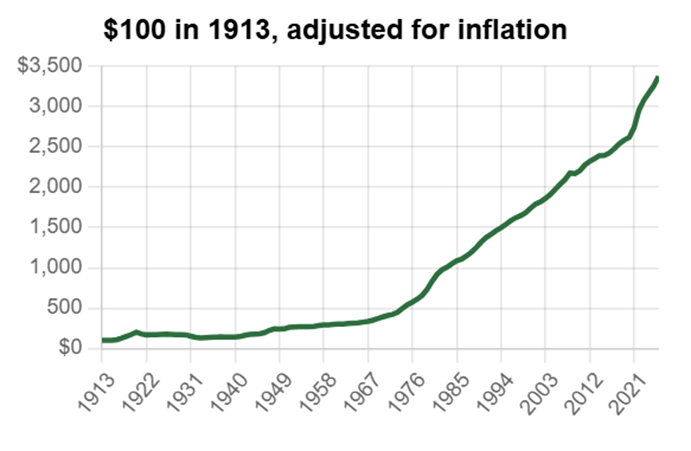
And if you go back to the start of the Federal Reserve in 1913, something that was $100 back then currently costs $3,373!
Meanwhile, the Fed’s credibility issue is also a problem for the markets.
If everyone is constantly guessing what’s coming next, then volatility is going to increase and price swings are going to get more extreme … at the very time you need higher, more stable returns to combat inflation!
So what can you do about it?
Well, there is one strategy that can actually turn increased volatility into constant income.
In that regard, I think it’s the perfect answer to everything we just talked about today.
Of course, you don’t have to take my word for it.
For the past six and a half years — i.e. for the entire time the Fed has been saying it cares about inflation while failing to keep it in check — Weiss readers like you have been using this strategy to generate consistent income from the markets.
The real, actual results speak for themselves … and you can get the full story, plus a complete explanation of how the strategy actually works, in this video we put together.
Best wishes,
Nilus Mattive
1https://stayathomemacro.substack.com/p/warsh-were-sticking-with-it-until