Why the FDA Keeps Saying ‘Yes’ (and What It Sparks Next for Select Biotechs)
 |
| By Michael A. Robinson |
Something big is happening in the world of U.S. pharma and biotech.
The sector lost billions in market cap to regulatory whiplash last year. Now, boring is starting to become the new watchword.
And that’s bullish for biotech’s prospects moving forward. Here’s what I mean by that.
Kyle Diamantas is the FDA's top food regulator. He’s been acting as the commissioner of the entire agency since May 12.
That was when Dr. Marty Makary was forced out.
‘Caretaker Mode’
Makary resigned after a spat with President Trump about approving flavored vapes — which he opposed and Trump supported — and which the FDA wound up approving anyway.
Makary’s departure was notable. But it wasn’t the first.
Vaccine and gene-therapy chief Dr. Vinay Prasad, the man biotech investors blamed for a string of surprise rejections, walked in April.
Their replacement Diamantas is (at least temporarily) now running the place in what analysts openly call "caretaker mode."
Which … appears to be a good thing!
Related Reading:
How to Invest in the Golden Age of Biotech
Right now, we’re looking at a stabilizing FDA. One that clears its backlog faster.
This eases the burden on rare-disease filings.
It also leans into AI-assisted review.
And all this is opening a new window on the sector.
Especially for small-cap biotech.
And after just two months, we’re already starting to see the results.
The FDA Reversals Keep Stacking Up
In mid-June, uniQure (QURE) said the FDA will now accept a filing for its Huntington's disease gene therapy.
That’s based on three-year Phase 1/2 data for its AMT-130 treatment.
The company now plans on filing for accelerated approval by the FDA this quarter.
This is the same agency that refused that exact path late last year.
This tanked the stock.
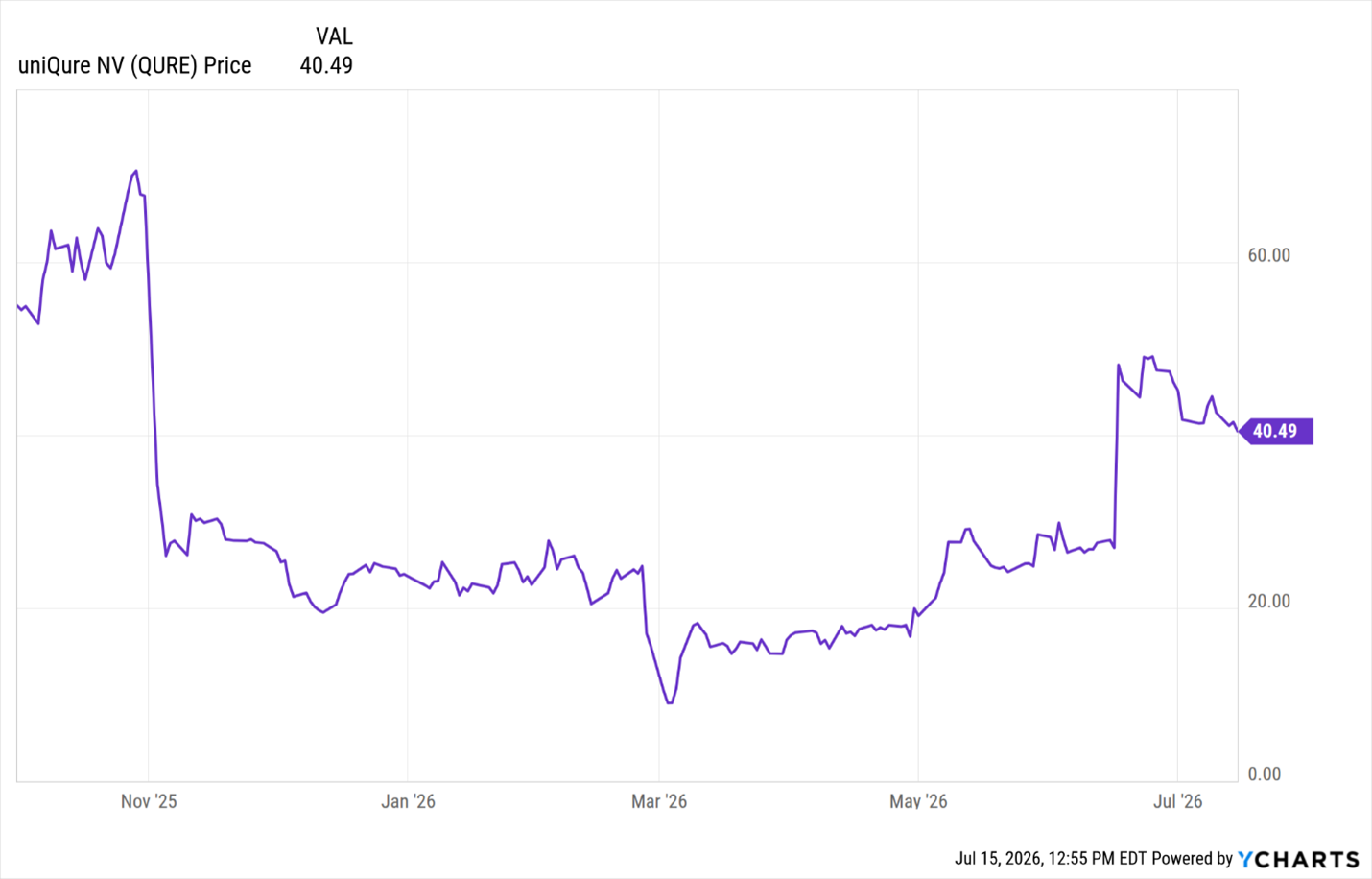
It got worse. Earlier this year, Makary appeared to trash the program on CNBC. That sent shares down again.
But now, you can see the recovery.
The nerve disorder Huntington's has no approved treatment for roughly 41,000 U.S. patients.
For uniQure, its treatment represents a clean shot at a market inside a global gene-therapy space.
A market that’s projected to more than triple from $5.5 billion in 2023 to $18.2 billion by 2030.
Time to ‘Get in Line’
UniQure isn't alone.
- Disc Medicine (IRON)says the FDA now agrees its ongoing Phase 3 trial can support a re-filing for bitopertin, the rare blood-disease drug rejected in February.
- Sanofi (SNY) recentlywon accelerated approval for its new type-1 diabetes treatment, Tzield.
- Replimune Group (REPL) is resubmitting its twice-rejected melanoma immunotherapy, RP1, after "collaborative dialogue" with the FDA.
- And Regenxbio (RGNX) is now betting on FDA flexibility to file its Duchenne gene therapy, RGX-202, in the third quarter.
As one former FDA reviewer put it on LinkedIn: "Get in line."
He’s referring to how the FDA is now moving to approve treatments for rare diseases as it has in the past or re-consider recent rejections.
‘A Breath of Fresh Air’
Diamantas is doing it by getting out of the way.
He met with rare-disease groups to mend fences. One attendee called it "a breath of fresh air.”
He’s let career staff finish reviews without interference.
And the FDA is hiring 2,200 people to rebuild the workforce gutted by last year's DOGE cuts.
The moves couldn’t come at a better time for bringing more predictability into the drug approval process …
Global Competition Is Moving Fast
But the FDA’s urgency and change of heart isn't only about oversold biotech charts.
The reality is the U.S. is starting to lose its grip on the biotech pipeline.
That’s little wonder when it can take 15 years or more and cost up to$2.6 billion to get a drug onto the market in the U.S.
China now runs more clinical trials than the U.S. And they do so at as little as half the cost and 20%-40% shorter timelines.
A recent McKinsey study found China can recruit for clinical trials at 2x to 5x faster than in the U.S. or Europe.2
A Georgetown University study found China’s global share of early drug-development programs jumped to over 32% from 8% in 2015. Meanwhile, the U.S. slid to about 37% from 48%.
One-third of the molecules large U.S. pharma now licenses come from China. And a Stony Brook analysis argues the two countries have reached parity in drug development.3
But the U.S. can still turn things around.
Starting with the fact that the U.S. still makes up 53% of the global drug market by sales.
But an FDA that spent a year saying "no" to its own innovators while China compresses timelines is an unforced error.
A faster, more consistent U.S. regulator is a must-have to get things back on track.
Choosing the Next FDA Leader
As acting commissioner, Diamantas can't stay in his current role for too long.
Under the Federal Vacancies Reform Act, his acting term runs about 210 days through early December … past the midterms, but not much further.
Here are a few of the top contenders for the FDA role, per media reports …
- Dr. Heidi Overton. A White House domestic-policy aide and physician is reportedly the front-runner. Analysts call her biotech impact "uncertain," as so far, she’s neither a champion nor an opponent of the pro-innovation programs.
- John Crowley. An industry insider, he’s CEO of the Biotechnology Innovation Organization (BIO) and the former CEO of Amicus Therapeutics. Crowley supports FDA modernization, faster drug approvals and regulatory relief to maintain the U.S.’s competitive edge over China.
- Dr. Stephen Ferrara. The radiologist is currently the Principal Deputy Assistant Secretary of Defense for Health Affairs at the Pentagon, following a 25-year Navy career and a stint as the CIA's chief medical officer.
- Other potential picks include ex-National Cancer Institute chief Dr. Norman Sharpless and Alkermes (ALKS) chairman and CEO Richard Pops.
A Crowley-type FDA head could go a long way in bringing more stability to the agency. But at this point, it’s still anyone’s guess.
However, the time to prepare for a new bullish phase the FDA has arrived … before the market has fully priced what a more stable leadership looks like for the sector.
The Cleanest Way to Play It
For the most part, this is a small-cap biotech story, not a large-cap one.
After all, it’s biotech’s smaller, more nimble players that can make a real impact on innovation in the space and see shares soar as a result.
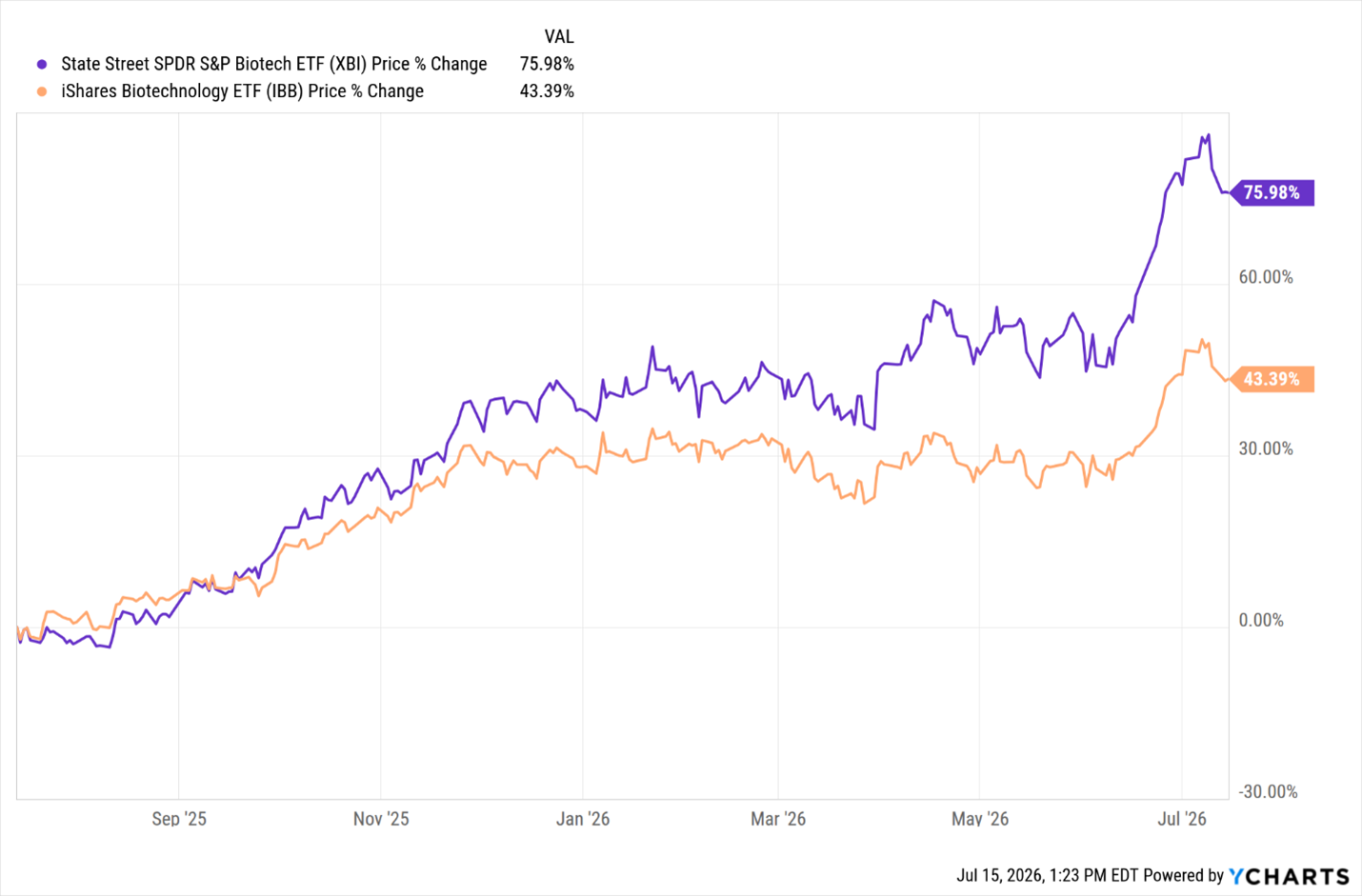
The obvious first stop is the SPDR S&P Biotech ETF (XBI).
It's roughly equal-weighted. Which means it's stuffed with the exact beaten-down small- and mid-caps that move most on FDA sentiment. Like the uniQures and Disc Medicines of the world.
When the regulatory mood flips to risk-on, XBI historically outruns its large-cap cousin.
That cousin is the iShares Biotechnology ETF (IBB). This one is market-cap weighted and top-heavy with Amgen, Gilead and Vertex.
IBB gives you steadier exposure but far less upside on a rare-disease re-rate, as you can see in their recent performance:
For the gene-therapy angle specifically, the ARK Genomic Revolution ETF (ARKG) and the Global X Genomics & Biotechnology ETF (GNOM) concentrate on the cell- and gene-therapy names most directly leveraged to the FDA shakeup underway.
None of these are official recommendations at this point. But the short-term logic is clear …
A caretaker FDA reversing rejections is a tailwind. And diversified small-cap biotech ETFs capture it without single-stock binary risk.
The catch is that if the permanent pick spooks the market, these same funds could unwind the fastest.
For now, the biotech window remains open.
Best,
Michael A. Robinson
P.S. Another important angle to this story if you want to try and find individual winners is AI.
The biotechs and drug developers using AI could have a huge advantage in an environment like this.
Of course, there’s a lot more you should know before buying any of them. Dr. Martin Weiss has the full story.