 |
| By Sean Brodrick |
Most stocks took it on the chin over the past couple weeks as the war with Iran wreaked havoc with global supply lines.
Meanwhile, oil stocks shifted into overdrive.
If you didn’t listen to me in the Feb. 18 edition of Weiss Ratings Daily when I told you oil stocks were “The Biggest Bargain on Wall Street,”1 you might be kicking yourself.
Don’t worry. Energy shares are still cheap — and some of the best names can still be picked up for a song.
Global investors remain materially underweight in the sector even after its recent rally.
Bank of America’s Global Fund Manager Survey shows that as of Feb. 2026, institutional portfolios were still running significant underweight in energy relative to long-term averages — continuing a pattern already evident in December 2025.
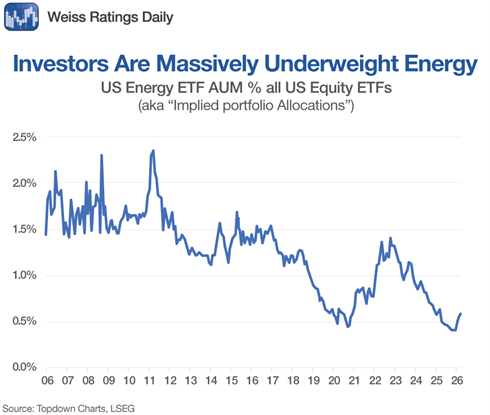
The same story shows up in the index data.
In mid-January 2026, the entire energy sector accounted for only about 2.9% of the S&P 500’s market capitalization.
That’s near historic lows.
For perspective, energy made up roughly 15% of the index at the 2008 peak.
In other words, even after oil’s rally, the biggest pools of institutional money are still structurally underexposed.
If oil prices remain firm — or rise further — those investors will eventually have to buy more energy simply to rebalance their portfolios.
And that buying pressure can push prices much higher.
Meanwhile, because investor interest has been so low for so long, energy remains the cheapest sector in the entire S&P 500.
Here’s an updated version of a chart I showed you last month.
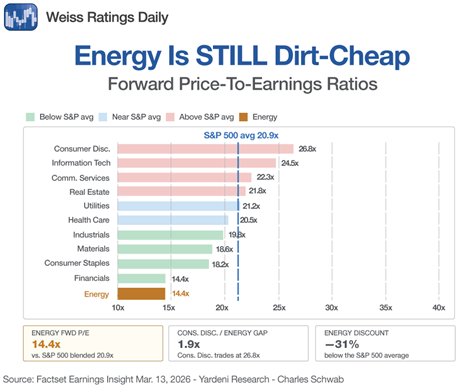
As you can see, the energy sector currently trades at a forward price-to-earnings of about 14.4 — the lowest in the S&P 500.
But that valuation assumes oil prices will soon return to “normal.”
That assumption may already be wrong.
The U.S. Energy Information Administration expects that once the current price spike settles down, Brent crude will average about $79 for the rest of 2026, while West Texas Intermediate averages in the mid-$70s.
And that may prove conservative.
The reason is simple: The war with Iran and the subsequent disruption around the Persian Gulf have scrambled global oil logistics.
Tankers are being rerouted, shipping costs are rising and inventories are tightening.
Even if the conflict cools tomorrow, it will take months for global supply chains to untangle.
If we assume a slightly stronger pricing environment — say $75 WTI and $3.50 natural gas for the rest of the year — the energy sector’s valuation looks even more attractive.
At those prices, the sector trades closer to 11x to 12x forward earnings. That’s absurdly cheap.
The Squeeze Is On
Several structural forces are tightening the oil market.
Years of capital-spending restraint mean global supply simply cannot ramp up the way it did in the 2010s.
U.S. shale basins are maturing, spare production capacity is limited and non-OPEC supply growth is slowing.
That means even modest demand growth can keep oil markets tight — supporting higher-for-longer prices.
Natural gas markets are tightening as well.
New LNG export terminals are linking U.S. gas prices more closely to global markets, while electricity demand is surging thanks to AI-driven data centers and the broader electrification of the economy.
The result is a market that is far more sensitive to supply disruptions than it was a decade ago.
Higher prices will eventually trigger more drilling, which will eventually increase supply and bring prices back down.
But the ride in between could be wild — and extremely profitable.
How to Play It
Upstream exploration and production companies are the most leveraged to higher oil prices.
My recommendation last month was the Energy Select Sector SPDR (XLE).
It’s up 6.5%, while the S&P 500 is down 2%.
Now, I have a pick for you that is even more leveraged to higher oil prices: the SPDR S&P Oil & Gas Exploration & Production ETF (XOP), which holds roughly 50 E&P companies.
Here’s a weekly chart …
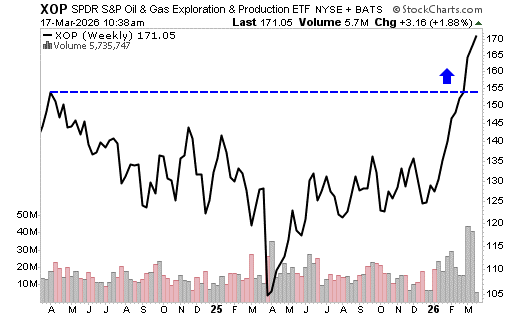
With that kind of breakout, XOP is probably on its way to $260 … or higher. A lot depends on the price of oil.
To be sure, you can potentially do even better by owning the strongest individual companies — the strategy we use in Wealth Megatrends.
That’s where the real potential outperformance is.
But ETFs like XOP are still a perfectly good way to ride what is shaping up to be a powerful and long-lasting energy bull market.
And remember — if energy still represents less than 3% of the S&P 500, when we’ve seen a previous peak of 15%, this party may only be getting started.
All the best,
Sean
Editor's Note: An earlier version of this article incorrectly referenced the Feb. 11 edition of Weiss Ratings Daily. It should have referenced the Feb 18th edition. The article has been updated accordingly.
1https://weissratings.com/en/weiss-ratings-daily/buy-the-biggest-bargain-on-wall-street-right-now