Your Home Insurance Is Skyrocketing! Here's How to Lower It — And How to Profit!

 |
| By Sean Brodrick |
You’re probably feeling inflation bite — hard! Especially if you own a home.
Now, would you like to do something about it? Maybe even profit from it?
More on that below.
Property taxes are rising around the country. Your electric bill is probably higher. Repairs cost more.
But one expense is outrunning nearly everything else: homeowners insurance.
Since 2021, the average cost of home insurance has surged 46% — nearly three times the 16% increase in overall consumer prices.
That works out to roughly 10% annualized premium inflation.
After jumping another 12% in 2025, the average annual premium is set to rise another 4% to $3,057 by the end of 2026, according to Insurify estimates.
That's the national average. Depending on where you live, the numbers can be downright frightening.
Florida homeowners paid an average $8,292 last year after an 18% increase.
Florida’s homeowners insurance is its own special circle of hell, as Weiss Ratings detailed in a recent article: “More Than 4 out of 10 Florida Homeowners Wait Over 60 Days for Insurance Claim Payments, the Worst in the Nation”
It’s not just Florida. Minnesota premiums jumped 34% last year. Colorado rose 33%, Iowa 28%, Nebraska 25% and Oklahoma 24%.
During the first half of 2026 alone, homeowners insurance rates rose in nearly 1,900 U.S. counties. More than 130 suffered double-digit increases.
In two-thirds of U.S. counties, homeowners now spend more on home insurance than they do on property taxes.
That isn't just inflation. It's an insurance crisis.
Why Your Insurance Bill Is Exploding
The obvious culprits are hurricanes in Florida and the Gulf Coast and wildfires in California and the West.
But there's another weather threat causing enormous damage.
Severe convective storms — thunderstorms producing hail, tornadoes and high winds — have become one of the biggest sources of insured catastrophe losses in America.
Annual insured losses from these storms exploded from less than $10 billion in 2015 to $52 billion in 2025, according to Insurance Information Institute data.
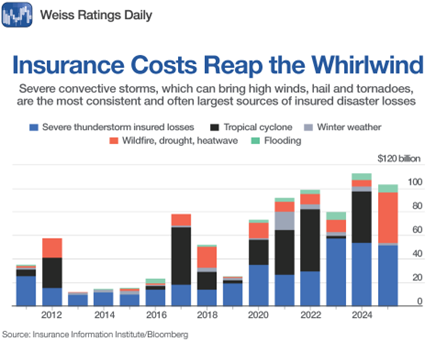
That's why insurance pain is spreading into places such as Minnesota, Nebraska, Oklahoma and Colorado.
Meanwhile, it costs much more to fix what Mother Nature destroys.
Construction labor costs are higher. Roofing is more expensive. Building materials have risen sharply, and tariffs can push some imported materials higher still.
Insurers are getting hit with more claims, and those claims cost more to settle. So, they're raising prices.
The U.S. Treasury reported that the national weighted-average homeowners insurance rate increased 10.4% in 2024.
And there’s an ugly trend of insurers delaying or denying payments, as this Weiss Ratings article reveals: “Home Insurers Often Collect When Consumers Are Safe But Retreat When Disaster Strikes.”
Insurers are also raising deductibles and, in some high-risk markets, refusing to write policies.
Insurance Is Becoming a Housing Problem
This has implications far beyond the insurance business.
Take a family that stretches its budget to buy a house.
A $500 monthly increase in the mortgage payment would obviously affect what that family can afford.
Well, an extra $3,000 a year in insurance costs amounts to another $250 a month — without buying one additional square foot of house.
In some locations, insurance has effectively become a second property tax.
Bloomberg Intelligence reports the average county-level “climate” insurance premium is $3,160 annually, versus $2,423 in property taxes.
In parts of the Deep South and Plains, insurance premiums can be FOUR TIMES property taxes.
That can depress home affordability, reduce the pool of potential buyers and ultimately hurt property values.
Homeowners are feeling the squeeze.
In an Insurify survey, 57% said they'd already made financial sacrifices to afford home insurance.
Some delayed home repairs. Others cut discretionary spending.
Fifteen percent said they'd actually taken on debt to pay their insurance bills.
Unfortunately, simply going without coverage isn't a realistic option for most people. If you have a mortgage, your lender generally requires it.
So, what CAN you do?
3 Ways to Fight Back Against Rising Insurance Costs
- Harden your house against disaster. Insurers increasingly price policies based on how likely a house is to suffer serious damage. In hurricane country, that means impact-resistant windows or shutters, a hardened roof and more. Elsewhere, it can mean fire-resistant roofing.
- Raise your deductible. Taking on more of the small-loss risk yourself can substantially reduce premiums. Moving a deductible from $1,000 to $2,500 or $5,000 can sometimes cut premiums by 10% to 25%. Just remember that a 5% hurricane deductible on a home insured for $500,000 means you're responsible for the first $25,000.
- Shop around. Insurance companies price risk differently, so the same house and homeowner can receive surprisingly different quotes from competing carriers.
Those moves may help you fight back. But there's another approach to skyrocketing insurance rates.
And that is, if you can't beat 'em, join 'em.
Turn Your Insurance Bill into an Investment
Insurers are raising prices as claims become more frequent and more expensive. And that pricing power is fattening bottom lines.
An easy way to play this is the State Street SPDR S&P Insurance ETF (KIE).
KIE owns a broad basket of insurers spanning property and casualty, life and health, insurance brokers and reinsurance.
More than half of the portfolio is property and casualty insurance, giving us plenty of exposure to the companies benefiting from higher pricing.
At the end of September, it held 54 stocks, with even its largest position accounting for only a little over 2% of assets.
Its three largest holdings are Baldwin Insurance Group (BWIN), Reinsurance Group of America (RGA) and SiriusPoint (SPNT).
KIE also gets a “B-” from Weiss Ratings.

Let’s look at the daily chart …
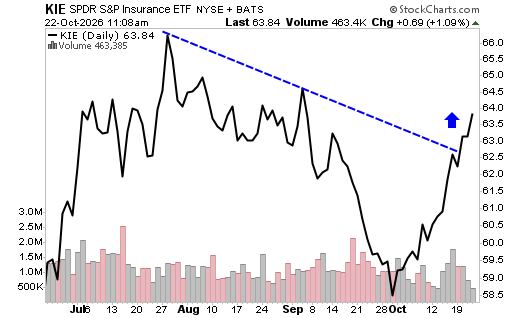
You can see KIE recently broke its downtrend. It now will go on to challenge its peaks from early September and July.
Insurance companies still face plenty of risks: hurricanes, wildfires and multibillion-dollar storms. But those disasters are also exactly why insurers keep raising rates.
You see the evidence every time your renewal notice arrives.
So, take steps to cut your own insurance bill. Harden your home. Raise your deductible if you can afford the additional risk. And shop around.
Then consider putting some of those savings to work in KIE.
Because if America's homeowners are going to keep paying hard-earned money to insurance companies, you might as well own a piece of the companies cashing the checks.
All the best,
Sean
P.S. And if you do shop around, I recommend starting with our Weiss Insurance Ratings here.