REPORT: Chip Stocks Fell 20% in a Month, but Big Tech Hasn't Cut Its Spending. Weiss Still Rates the Chip Fund a Buy.

|
Key Takeaways
|
 |
| By Al Qureiyeh Reviewed by: Leo Tavolaro |
If you own an S&P 500 fund, which tracks America's largest companies, more than a third of your money sits in tech stocks.
Chip stocks fell hardest.
The VanEck Semiconductor ETF (SMH), an exchange-traded fund holding Nvidia (NVDA) and Broadcom (AVGO), lost about 20% from Oct. 9 to Tuesday's close.
Yet the big tech companies that buy those chips have not cut their spending plans since the Nov. 3 vote.
So far, the drop is in the price investors will pay, not in the business. We'd buy the chip fund while that gap lasts.
What Happened
The selling began in early October, as investors moved money from tech funds into steadier ones like consumer staples.
By Nov. 3, before any votes were counted, the chip fund had already fallen about 14%.
Then voters favored limits on new data centers in 40 of 41 local ballot measures, Ballotpedia reported.
Data centers are the giant computer buildings that run artificial intelligence (AI), and they are filled with chips.
On Thursday, Nov. 5, the chip fund fell about 11%.
Funds that use borrowed money to magnify their bets sold more than $60 billion of stocks into that close, JPMorgan estimated.
Those funds trade by formula as prices move, not because they changed their view of the companies.
Why the Skeptics Are Only Half Right
The crowd is split, and more of the commentary we tracked saw a buying chance than a lasting problem.
First, the political worry is real, and new limits could slow where data centers get built.
Second, a warning we could not confirm with hard data: chip demand may be near a peak, and chip stocks often turn before profits do.
We grant both. But the biggest buyers of chips, such as Microsoft (MSFT), Alphabet (GOOGL) and Amazon (AMZN), have not cut their plans.
Morgan Stanley kept its forecast for their 2027 spending unchanged after the vote.
Their spending is the chipmakers' sales.
What Weiss Is Saying
Weiss rates the VanEck Semiconductor ETF B-, a BUY.
Nvidia, about a fifth of the fund, is rated B, a BUY.
Eight of the fund's ten largest holdings are rated BUY, Broadcom among them.
The two that are not, Taiwan Semiconductor Manufacturing (TSM) and Advanced Micro Devices (AMD), are rated C+ and C, both a HOLD.
The chips' biggest buyers carry BUY ratings too: Alphabet and Amazon are B, and Microsoft is B-.
The Nov. 8 Weiss piece "Data Centers Lost on the Ballot. Here's Why You Should Buy Today" called the votes a short-term setback.
We agree, and big tech's unchanged spending plans back that view.
The Nov. 10 Weiss piece "Nvidia's CEO Scandal: Why Our Ratings Still Say 'Buy'" said Nvidia's rating stays in the BUY range.
It added that any change would come after earnings, and we agree that report is the next test.
Related story: Data Centers Lost on the Ballot. Here's Why You Should Buy Today
Related story: Nvidia's CEO Scandal: Why Our Ratings Still Say 'Buy'
The Market's Price Fell. Its Profit Forecasts Didn't.
A stock's price is its expected profit times what investors will pay for each dollar of it.
On Oct. 9, investors paid 19.1 times expected profits for the S&P 500, according to the data firm FactSet.
By Nov. 5, they paid 17.7 times.
Over that stretch, the index's profit forecasts for the year ahead did not fall.
So, the whole drop showed up in what investors pay for each dollar of profit, not in the forecasts.
As of Nov. 5, tech stocks traded at 17.3 times expected profits, FactSet says.
That is below their average over the past quarter century, 20 times.
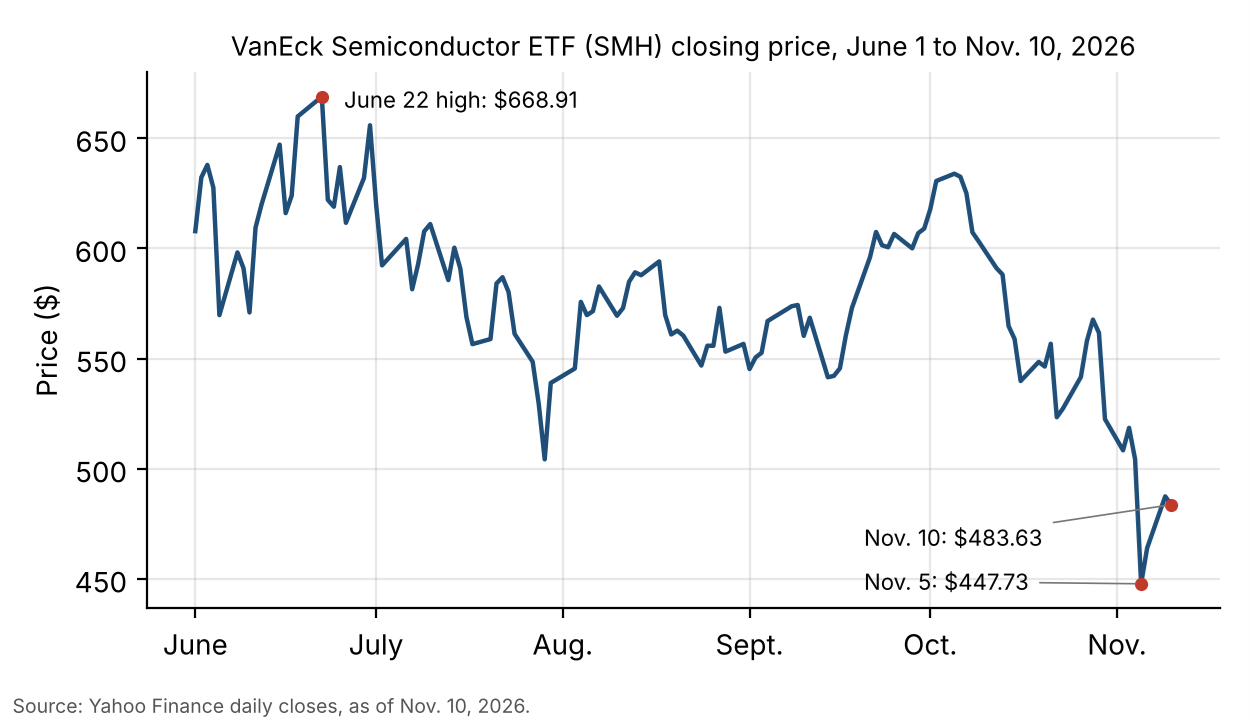
The chart shows the fund's slide from early October to its Nov. 5 low, and Monday's partial bounce.
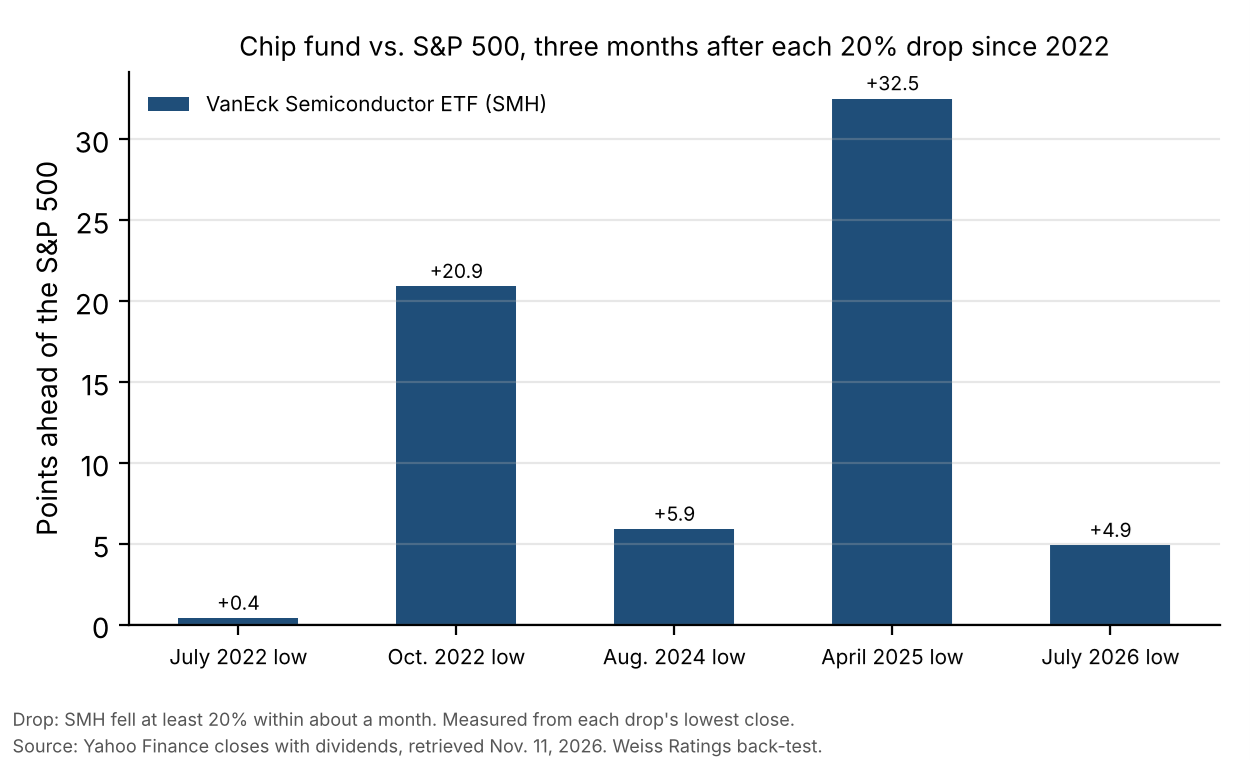
In our own back-tests, we looked at every time since 2022 that the chip fund fell 20% or more within about a month.
It happened five times.
Each time, the fund beat the S&P 500 over the following quarter.
We measured from each drop's lowest close, which no one knows in advance.
Buyers at this year's July low are still behind, so the record is evidence, not proof.
Buy the Chip Fund While Big Tech Keeps Spending
Buy the VanEck Semiconductor ETF (SMH), rated B-, a BUY, at the next close; it closed Tuesday at $483.63.
The fund holds the chipmakers that fill data centers, and their biggest customers have not cut their spending plans.
Its Risk sub-grade is D+, weaker than its Reward grade of B+.
Expect big swings: the fund has moved about twice as much as the market.
What could work against it: if big tech cuts its data-center budgets, chip orders would shrink.
It also trades below its long-term average price, a sign the selling may not be over.
Our target is the fund's Oct. 9 close, before the worst of the selling.
Tuesday's close is about $120 below it. From Tuesday's close, that is a potential gain of about 25%.
The fund pays a small dividend once a year, a yield of about 0.2% at Tuesday's close, so this is a bet on price.
Our time frame is within a year, with the first check at Nvidia's Nov. 17 report.
Our call assumes chip profit forecasts hold up after that report.
What We're Watching
First, Nvidia's Nov. 17 report. If Nvidia cuts its outlook, we would sell the chip fund and tell you.
Second, the Nov. 5 low. If the chip fund closes below $447.73, its Nov. 5 close, we would sell and say so.
Third, spending plans. If Microsoft, Alphabet or Amazon cuts its data-center budget, we would sell and tell you.
Bottom Line
Chip stocks fell about 20% in a month, but their biggest customers have not cut spending, and Weiss still rates the chip fund a BUY.
So, the tech stocks that fill your index fund are where we see the opportunity. Buy the VanEck Semiconductor ETF (SMH), rated B-, a BUY, which closed Tuesday at $483.63, at the next close.
Take care,
AL Qureiyeh