REPORT: Shoppers Are Paying More, Not Buying Much More. Here's Why We'd Buy Ross Stores, Rated A, Before It Reports.

|
Key Takeaways
|
 |
| By Al Qureiyeh Reviewed by: Leo Tavolaro |
If you own a retail fund, the past month felt like proof that American shoppers are unstoppable.
The SPDR S&P Retail ETF (XRT, ”C-“), which holds dozens of store chains, rose about 8% from Oct. 13 to Friday.
Your S&P 500 fund, over the same month, fell about 3%.
But the shopping data tell a different story: card spending per household rose 5.8% from a year earlier in October, Bank of America reports.
After inflation, real retail sales are growing at less than half that pace.
Shoppers are paying more, not buying much more. We'd own the chain that wins when they go hunting for value.
What Happened
Retail sales grew 6.3% from a year earlier in September, the latest month reported.
Strip out inflation, and the real gain was about 2.5%.
Gasoline stations supplied most of September's monthly gain, and gasoline is a price, not a shopping spree.
In September, spending after inflation was flat, and real income after taxes fell, the Commerce Department reports.
Average hourly earnings rose 0.4% in October, exactly what consumer prices rose, so real pay was flat for the month.
Meanwhile, households put the odds of missing a debt payment at 13.8%, the highest since last December, in the New York Fed's survey.
Housing is frozen: existing home sales fell in October to their slowest pace since 2010, with mortgage rates near 7%.
And the two-year Treasury yield jumped more than a third of a point in a week, so borrowing is getting dearer, not cheaper.
So why did retail stocks rise? The two big days were not about shoppers.
Two days did most of the work: Oct. 15, when a hot wholesale-price report sent money out of chip stocks and into value, and Nov. 4, the day after the election.
The Retail SPDR gives its chains close to equal weight, so no single store drove it.
The next test comes Tuesday morning, when the government reports October retail sales.
Economists expect a flat to slightly higher headline, which after October's price rise implies fewer actual purchases.
The measure to watch is the control group, the core of sales that feeds into economic growth.
Why the Worriers Are Half Right
The crowd is gloomy: more than half of the investors in the American Association of Individual Investors (AAII) survey call themselves bearish.
First, the rate worry is real. The Federal Reserve (Fed) is expected to raise rates at its Dec. 9 meeting, and one governor has said a half-point move should be considered.
Second, the "borrowing to keep up" worry is overstated. Card balances are a record $1.29 trillion, but the share of balances turning seriously delinquent is lower than a year ago.
Card interest rates are above 20%, so carrying a balance is costly, which pushes shoppers toward cheaper stores.
Third, the bulls have a point too: employers kept hiring in October, and unemployment stayed low.
The National Retail Federation expects holiday sales to grow 4.2%.
But the retail trade group itself says about half of that growth will come from higher prices.
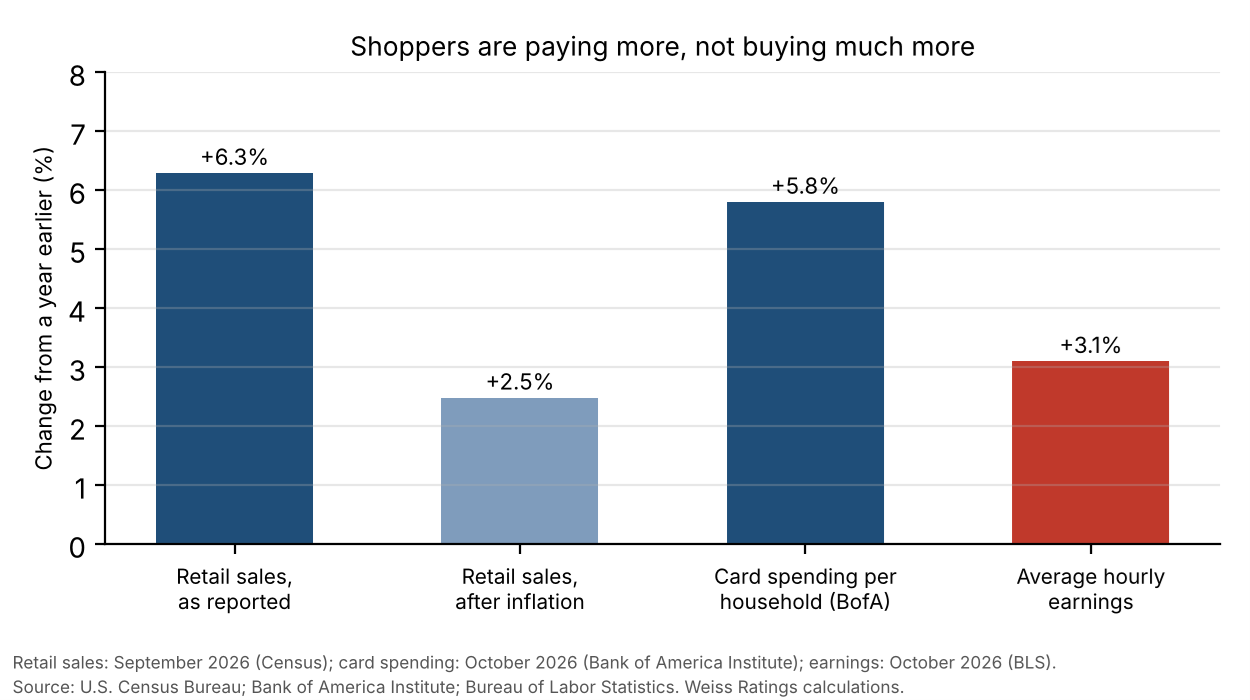
The chart shows the gap: sales as reported grow fast, sales after inflation grow slowly, and pay barely keeps up.
What Weiss Is Saying
Weiss rates Ross Stores (ROST) A, a BUY, the only A-range grade among the big store chains we checked.
Walmart (WMT) is rated B-, a BUY, and TJX (TJX) is rated B, a BUY.
Weiss rates the Retail SPDR C-, a HOLD, and Home Depot (HD) C, a HOLD.
On Oct. 28, we told you to buy Ross after confidence jumped, and you are now about three points ahead of the S&P 500.
On Nov. 9, we told you to buy Walmart, and it has risen about 2% since, a touch behind the S&P 500.
We'd hold it, but at 43 times expected profit, with analysts' targets just above the price, we would not add.
Related story: REPORT: Consumer Confidence Jumped to 91.7, Far Above Forecasts. Here's Why the Fed and the Bond Market Shrugged.
Rate Jumps Have Sunk the Retail Fund, but Not the Value Chains
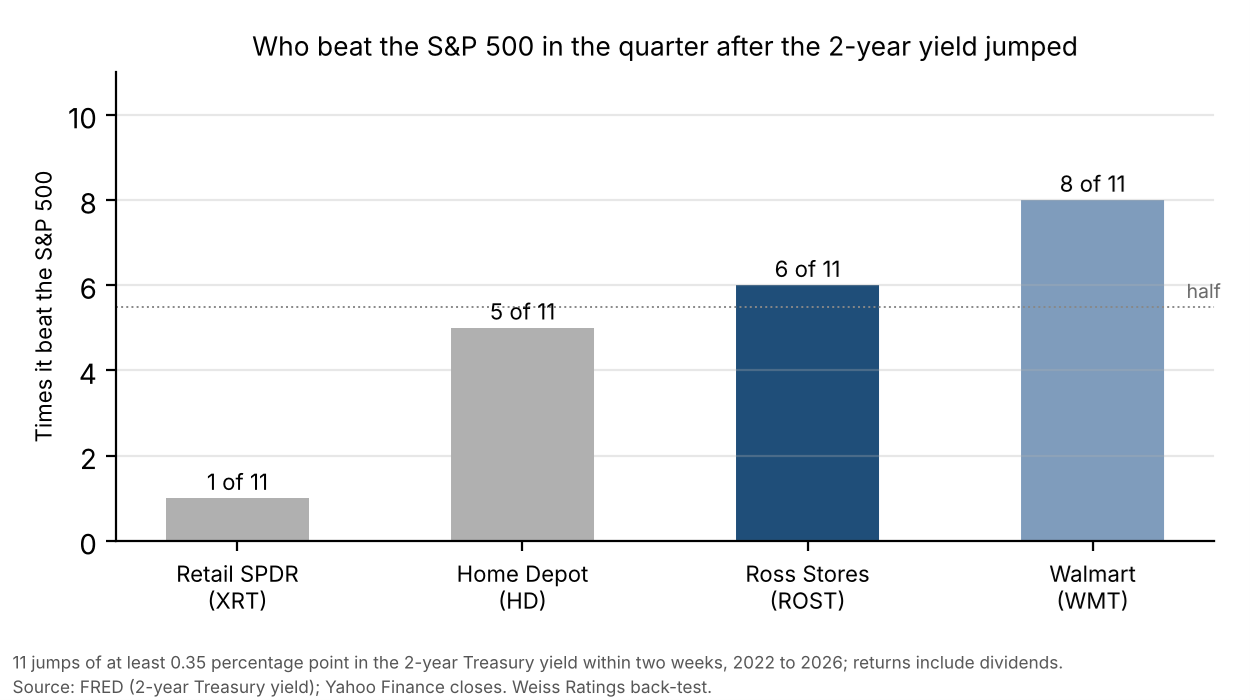
In our own back-tests, we looked at the biggest jumps in the two-year Treasury yield since 2022, 11 of them old enough to measure.
Over the following quarter, the retail fund beat the S&P 500 only once.
Home Depot beat it less than half the time; big home projects tend to wait for cheaper mortgages.
Ross Stores beat the index six times, and Walmart did better still.
The sample is small, so this is evidence, not proof. But the pattern fits: when borrowing costs jump, shoppers keep buying, but cheaper.
Ross runs thousands of off-price stores, which sell brand-name clothing and home goods below department-store prices, all in the U.S. and its territories.
Sales at stores open more than a year rose 10% last quarter, driven mainly by more customers walking in.
That is the mechanism we think the crowd is missing: a shopper who is paying up at the grocery store trades down for clothes.
Buy Ross Stores While Shoppers Hunt for Value
Buy Ross Stores (ROST), rated A, a BUY, at the next close; it closed Friday at $231.68.
We think Ross wins share when shoppers trade down, and every one of its stores is in the U.S. and its territories.
In our back-test, it beat the market after more than half of the rate jumps we checked, which is evidence, not proof.
What could work against it: investors pay about 27 times expected profit, well above its 10-year average, so a weak Thursday report would hurt.
Its last results also included one-time tariff refunds, which flattered profit.
Our target is the average Wall Street price target, $273.21 as of Nov. 16.
Friday's close is about $42 below that target. That is a potential gain of about 18%.
Ross pays a quarterly dividend of about 45 cents a share.
At Friday's close, that is a yield of under 1%, so this is a bet on price, not income.
Our time frame is within a year, with the first check at the Nov. 19 report.
What We're Watching
First, the retail sales report. If the control group rises more than 0.4%, shoppers are buying more than we think, and we would say so.
Second, Ross's Nov. 19 report. If sales at existing stores grow less than 6%, the low end of its forecast, we would review the call and tell you.
Third, TJX, rated B, a BUY, which reports Wednesday. Its main U.S. division grew only 1% last quarter, so a rebound there would confirm the trade-down story.
Fourth, Home Depot, rated C, a HOLD, which reports before Ross does. Its customers made fewer trips last quarter, and we would want to see more trips before we looked at it.
Bottom Line
Shoppers are paying more, not buying much more, and the rate jump makes cheaper stores the winners.
So, if the past month felt like proof that shoppers are unstoppable, remember what they can stop: paying full price. That is where we see the opportunity.
Buy Ross Stores (ROST), rated A, a BUY, at the next close; it closed Friday at $231.68.
Take care,
AL Qureiyeh