Aave's $17 Billion Lending Platform Could Get a Bitcoin Boost

 |
| By Mark Gough |
A few weeks back, I explained Bitcoin’s (BTC) productivity problem.
The short version is BTC is great as a store of value. But it cannot give you access to the wider on-chain financial ecosystem — staking, lending, borrowing, etc. — that many altcoins can.
And that creates tension when BTC holders get squeezed.
If you’ve held Bitcoin for years, selling it to fund another investment or cover an expense can be a difficult decision.
You might need the money now. But you still want to own the Bitcoin.
Borrowing against your coins offers one way around that. The problem is that decentralized finance (DeFi) platforms that allow you to borrow against your BTC … generally requires a wrapped version of Bitcoin. Or they rely on an intermediary.
That’s a trade-off that many users don’t like. It fundamentally changes the calculated risk of these strategies.
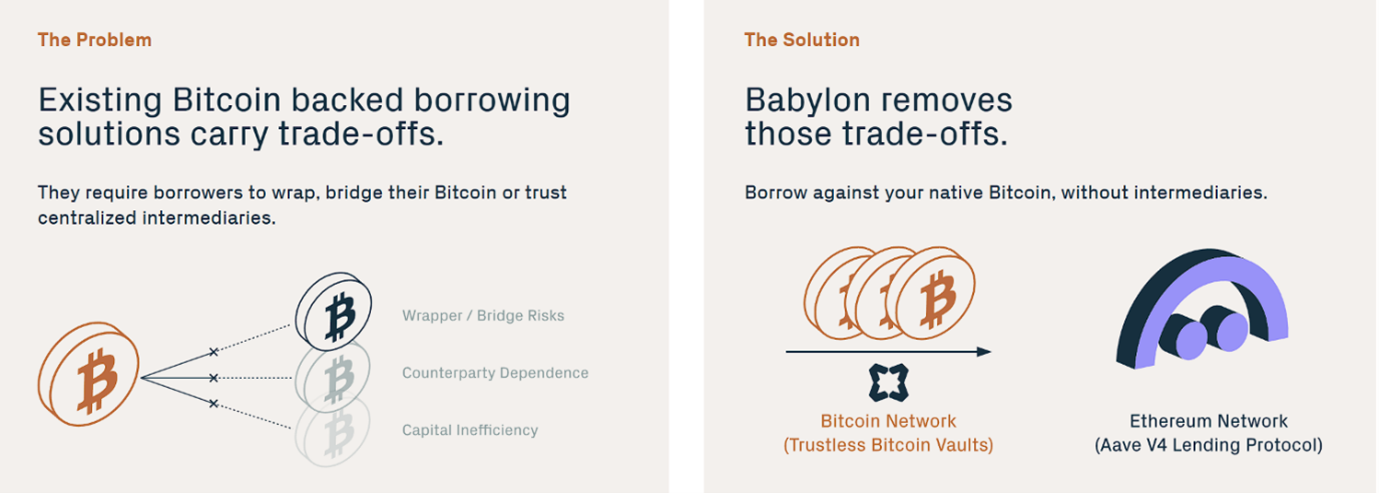
Babylon Labs (BABY) wants to give Bitcoin holders another option: lock their BTC on the Bitcoin network and use it as collateral to borrow through the DeFi lending platform Aave V4.
The proposal is still working through governance. But it could give Aave (AAVE) access to a substantial new source of lending demand.
That’s what investors should pay attention to. Because it strengthens the long-term case for Aave, the DeFi lending leader that already boasts considerable activity.
Aave’s Lending Business Continues to Grow
Aave’s business is fairly straightforward.
Users deposit assets to earn interest. Other users provide collateral and borrow against it. Smart contracts handle the transactions, with borrowing limits and liquidation rules designed to protect lenders.
The latest version, Aave V4, is beginning to attract meaningful capital.
Aave Labs reported that V4 deposits passed $1 billion during September, alongside $310 million in active loans. V4 also launched on Arc and Base during the month.
Across the wider protocol, the latest Defillama data at the time of writing shows:
- $17.4 billion in total value locked (TVL).
- $12.41 billion in active loans.
- $37.7 million in fees over the previous 30 days.
- $4.9 million in protocol revenue over the same period.
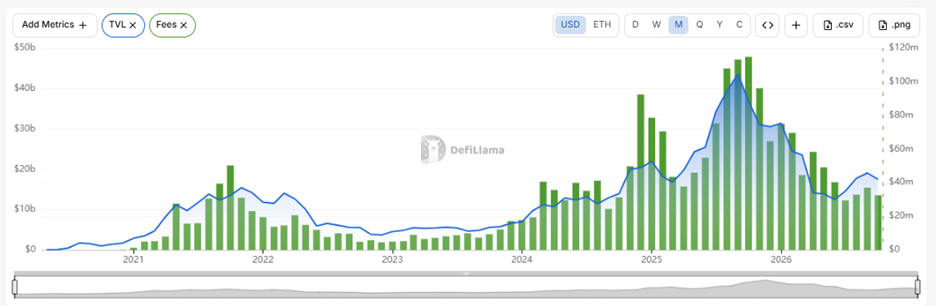
I highlight fees and protocol revenue separately because they tell us different things.
Fees show what users pay, but most of that money goes to the lenders supplying the funds.
Protocol revenue is the share Aave retains.
For me, the key is whether borrowing demand and revenue continue to grow alongside deposits. The proposed Bitcoin integration could support both by bringing more borrowers to Aave.
How Bitcoin Holders Could Use It
Under the proposed model, a holder would lock BTC inside a vault on Bitcoin.
A restricted accounting token on the Ethereum (ETH) network — which is where Aave lives — would allow Aave V4 to recognize those coins as collateral. The holder could then borrow an approved asset, with stablecoins as the initial use case.
After repayment, the vault’s redemption process would allow the BTC to be released on the Bitcoin blockchain.
The accounting token would remain restricted to the integration, rather than circulating as a standard wrapped asset.
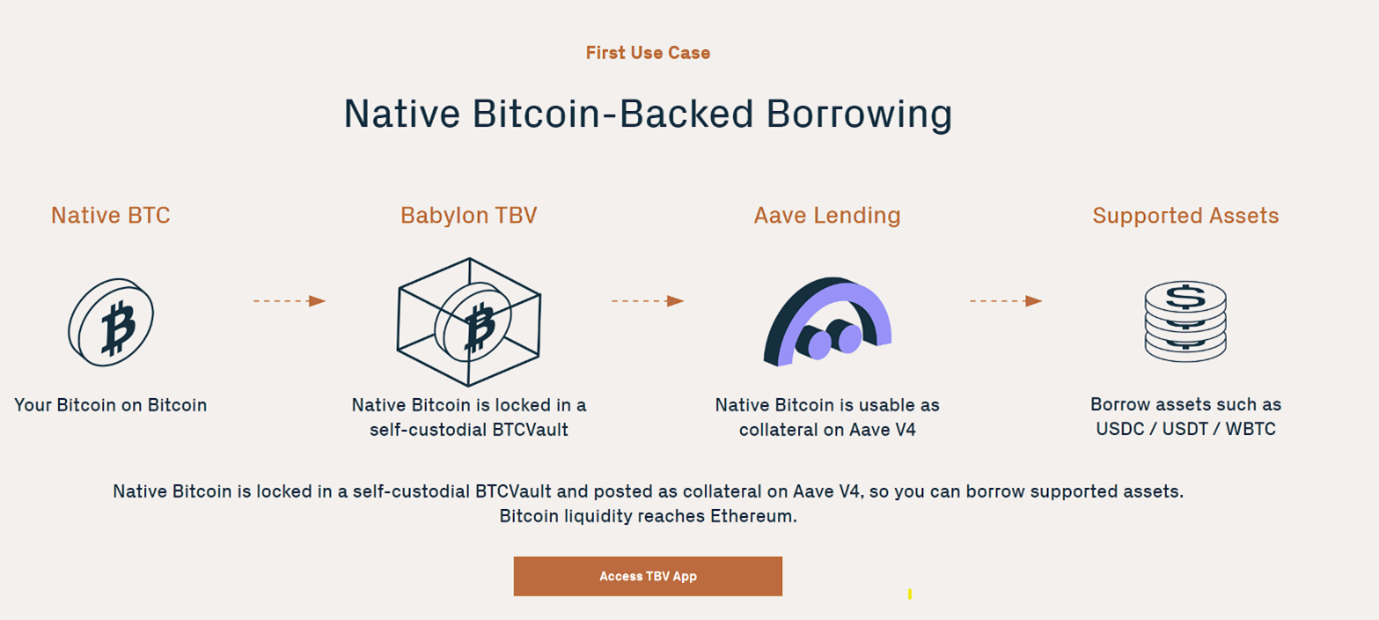
Here’s what this means in practice …
Think of a long-term Bitcoin holder who wants funds to expand a business.
They could borrow against part of their holding, use the stablecoins, and repay the loan later. Throughout that period, they would retain exposure to Bitcoin’s price.
Of course, they would pay interest and need enough collateral to withstand a decline. Borrowing too heavily against a volatile asset can quickly become expensive.
But for conservative borrowers, the flexibility could be useful.
Aave’s opportunity is to provide the lending infrastructure for those transactions. It already connects borrowers with capital, and V4 lets dedicated markets operate with their own collateral and risk settings.
What This Could Mean for AAVE
As investors, we also need to ask how the additional activity could benefit Aave DAO — that is, its decentralized autonomous organization, which makes decisions by consensus for the project — and the AAVE token.
The proposed agreement gives Aave DAO the first $500,000 in annual qualifying revenue. Above that, revenue would be divided between Aave, Babylon Labs and an allocation for token purchases.
Those purchases would be weighted 85% toward AAVE and 15% toward Babylon’s BABY token, with the acquired tokens divided equally between the two organizations.
Qualifying revenue includes specified protocol and liquidation fees. It does not include all interest paid by borrowers.
That gives the integration a potential route to generate both DAO revenue and open-market demand for AAVE.
How much it contributes will depend on adoption. A successful launch needs borrowers to use the service regularly and generate enough revenue to matter.
Where the Risks Sit
The biggest practical challenge is handling liquidations across two networks.
Aave needs to close unhealthy loans quickly. However, redeeming the underlying Bitcoin vault can take several days.
The proposed system addresses this by paying liquidators immediately in wrapped Bitcoin. Approved arbitrageurs would then acquire the seized vaults and complete the slower redemption on Bitcoin.
That requires sufficient wrapped BTC liquidity and participants who are willing to handle settlement, even during a sharp market decline. Liquidations also seize whole vaults, with excess value potentially returned to the borrower in WBTC.
Security and governance deserve attention too.
Follow-up audits are underway, and final risk parameters still need to be provided. The public integration remains on testnet.
Before putting much weight on projected revenue, potential investors will want to see the system successfully handle real borrowing, repayments, and liquidations reliably.
Best,
Mark Gough
P.S. Even a strong crypto can turn into a losing position if you buy in at the wrong time. That’s why Juan Villaverde has dedicated years to understanding and mapping crypto’s cycles. His Crypto Timing Model uses key levels to track what Bitcoin will likely do next … and when you should act.
To learn how this data can help improve your market timing, click here.