 |
| By Jurica Dujmovic |
For years, Big Tech sold investors, regulators and the public a specific narrative …
The digital economy could scale nearly without limit because clean energy, carbon offsets and clever accounting would keep emissions tidily under control.
The pitch was elegant. The message reassuring and optimistic.
The math, it turns out, was not.
And AI is throwing the miscalculation into the spotlight.
The Evidence of a Problem
In 2021, Microsoft (MSFT) set a goal to match 100% of its hourly electricity use with renewable energy purchases by 2030.
“Renewable matching” is when a company buys enough clean power to offset its electricity use. Microsoft already reached annual renewable matching and set what ranked among the most ambitious clean-energy targets in the industry.
So, moving to match hourly electricity use was the natural next step.
But today, the tech giant is weighing whether to delay or even abandon that milestone altogether.
While no final decision has been made yet, the indecision alone is worth taking note of.
This internal review reveals something important: AI has turned data centers into a form of heavy industry.
And heavy industry has a way of ignoring brand-level virtue signaling.
Why Hourly Matching Actually Matters
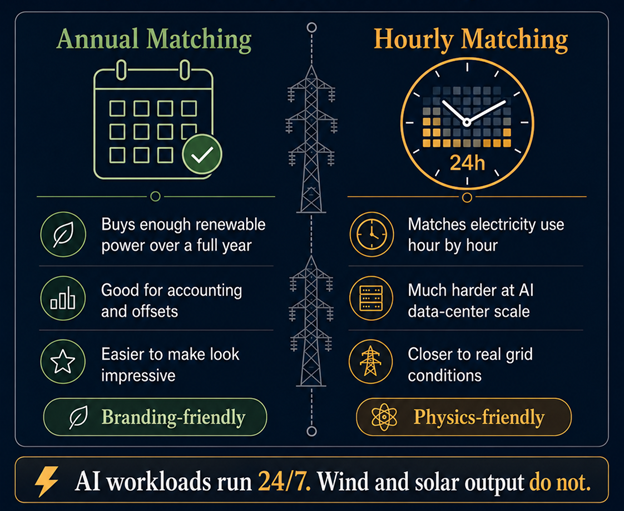
The distinction between annual and hourly matching is not a detail for the science geeks among us.
It is the difference between a genuine commitment … and a rounding exercise meant to pad the public’s goodwill.
Let me explain …
Annual renewable matching allows requires a company to buy enough clean power over the course of a year to offset its total electricity use. By that measure, the math works as long as you sign enough power purchase agreements and file the right paperwork.
But hourly matching is trickier. It means the company has to align real clean electricity supply with actual consumption.
In real time.
On the same grid.
At the same hour the servers are drawing power.
In other words, annual matching is easier to accomplish and easier to put in a good light on a sustainability report.
Hourly matching is the more effective clean-energy solution. But it’s considerably harder to fake and much more difficult to implement.
Now, AI is stress-testing this harder version.
Training runs, inference workloads and cooling systems do not schedule themselves around periods of favorable wind or solar output. They run continuously and at scale, regardless of what the weather is doing in West Texas or Arizona.
The Scale of the Problem
The numbers are important here. Because they reframe what is usually presented as an Environmental, Social, and Governance (ESG) story …
Into something closer to a macro-infrastructure problem.
The International Energy Agency projects that global data center electricity consumption will more than double by 2030 to reach roughly 945 terawatt-hours.
That’s just about equal to Japan’s entire current electricity consumption!
AI is described as the most significant driver of this jump. Electricity demand from AI-specific data centers is projected to more than quadruple over the same period.
In the U.S., data centers are on course to account for nearly half of all electricity demand growth between now and the end of the decade.
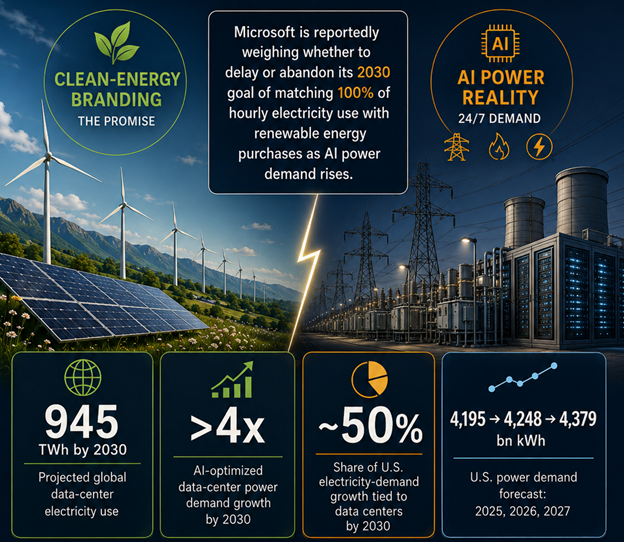
According to the U.S. Energy Information Administration's Short-Term Energy Outlook, U.S. power demand is expected to rise from 4,195 billion kilowatt-hours in 2025 to 4,379 billion kWh in 2027.
The EIA expects the commercial sector to surpass residential electricity use for the first time on record in 2027.
Goldman Sachs Research is even more pointed about what comes next. The bank models a scenario in which that global data center power demand will rise 165% by 2030 compared to 2023 levels. And it suggests that that 60% of the incremental demand not covered by renewable growth will be filled by natural gas.
That last figure is worth pausing on — 60% natural gas. From companies that spent much of the last decade positioning themselves as leaders of the clean-energy transition.
It would be easy to construct a case for corporate hypocrisy here, and there is certainly material for one.
Regrettably, however, the reality of our situation does matter. The grid does not run on virtue signaling or brand values. It does not care about prior promises.
It does, however, run on high-density energy sources.
When a tech company launches a product, experienced investors know to look past the keynote and read the spec sheet.
The same discipline applies here: The sustainability report is the keynote. The gas turbine orders, the delayed coal retirements and the quietly shelved hourly-matching targets are the real spec sheet.
The Investment Thesis
Corporate hypocrisy aside, the productive question is not whether tech companies will hit their green-energy targets. The evidence suggests they will not, at least not on the original schedules or terms.
So, the question we do need to ask is who will get paid to solve the physical problem this demand is creating.
The answer runs through every layer of the power stack.
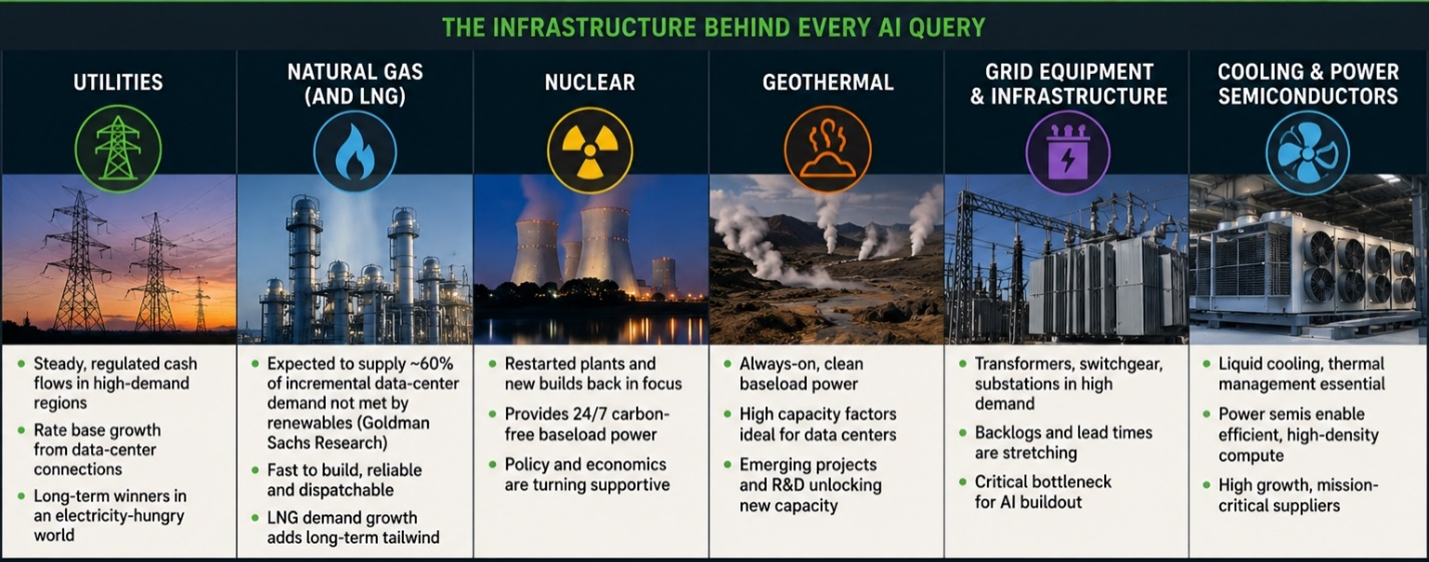
- Utilities with grid access and favorable regulatory positions will be first in line for long-term hyperscaler agreements.
- Natural gas remains the most immediately dispatchable bridge between intermittent renewables and always-on AI demand — unglamorous, carbon-intensive and indispensable.
- Nuclear is undergoing a genuine commercial rehabilitation: Microsoft's 20-year power purchase agreement with Constellation Energy to restart the former Three Mile Island plant in Pennsylvania is a serious capital commitment. Not to mention a socially and politically charged one.
- But it fits within the Trump Administration’s more pro-nuclear approach. Just last year, the President signed an executive order to reignite the U.S.’s domestic nuclear programs.
- Geothermal is attracting similar interest for the same reason. Grid infrastructure is already a chokepoint, as I examined in a previous Weiss Crypto Daily. Goldman Sachs estimates $720 billion in global grid spending may be needed through 2030 just to accommodate data center load. Cooling systems and power semiconductors complete the picture.
What started as the coolest new tech to play with on your phone is now a massive hardware story.
AI needs high-output physical data centers. Which will rely on physical infrastructure for power.
The companies that control the inputs — power, grid access, firm capacity — are positioned to extract value from the AI boom regardless of which model wins or which hyperscaler dominates.
That is the opportunity the market is only beginning to price in.
To help narrow the list of AI picks-and-shovels plays, I encourage you to check out our Weiss Ratings Plus tool.
It unlocks the power of the Weiss ratings and all our independent research. And special stock screeners and real-time reports can help you scout the highest-rated picks in several top-performing sectors, including AI.
The Lesson
Despite all this, I do not believe the clean-energy transition is finished. But it does mean we shouldn’t look to Big Tech to lead it.
Their renewable pledges were easy to make when data centers were modest, before the AI gold rush hadn't yet arrived. The moment serious money entered the picture, the sustainability decks got quietly shelved and the gas turbine orders went in.
Big Tech will keep funding solar farms, signing power purchase agreements and publishing sustainability reports with cover photographs of wind turbines. These things are cheap relative to the capital budgets involved.
And they are useful for the next Davos panel.
What it will not do is let clean-energy accounting get in the way of building the infrastructure it needs to win the AI race.
The good news is the market is beginning to understand that AI does not run on virtue signaling. It runs on electricity.
And the companies that can secure that electricity reliably, cheaply and at scale — green or not — may prove to be some of the most consequential infrastructure investments of the AI era.
Savvy investors have already noticed this shift.
And they’ve already begun to quietly find their picks for the energy and infrastructure plays that will power AI into the future.
Now, it’s your turn.
Best,
Jurica Dujmovic