 |
| By Beth Canova |
Imagine buying a stock for $100 … only to find out afterwards that Wall Street’s brightest think it’s only worth $7.
That's the kind of gap now facing one of the biggest IPOs of the year.
The company is Anthropic, the firm behind ChatGPT’s top rival, Claude. And it could soon go public at a price of $2 trillion.
But one research firm says Anthropic may be worth just $150 billion.
That's a gap of more than 90%!
So, who's right?
The answer could shape how much you pay for the next wave of artificial intelligence (AI) stocks.
And it shows why a great new tech trend doesn't always make a great stock buy.
Here's what you need to know.
From $2 Trillion to $150 Billion
AI is growing at a pace few could have seen just a few years ago.
More firms use it each day. And more people now rely on tools like ChatGPT and Claude to work, learn and save time.
To put real numbers to the trend, Statista claims the global AI market is expected to hit an incredible valuation near $707.48 billion by the end of this year.
And it expects the market to grow at a steady annual growth rate 18.52% through 2032.
That growth has made AI firms some of the hottest names on Wall Street.
And it created the first notch in the gap of Anthropic’s valuation.
In May, the firm raised new funds at a value of $965 billion. Now, as it nears its initial public offering (IPO), its listing valuation has been recorded at $2 trillion.
That’s a big figure. And it’s raised some big questions. Many from our own team (but more on that in a bit).
But the most recent claims that Anthropic may be overvalued by roughly 93%.
New Constructs senior investment analyst Kyle Guske II released a new report last week. In it, he said his model calculates that Anthropic may be worth just $144 billion.
Why such a huge gap?
It comes down to what each side thinks the firm can earn in the years ahead.
The bulls see vast growth narrative.
They believe AI will change how we work and live, and nothing will stop that future reality. And they expect Anthropic to earn a large share of that new business.
The bears see a firm that still has a lot to prove.
In 2025, Anthropic brought in about $4.6 billion in sales. But it also posted an $8 billion operating loss.
That means the cost of running its business was far more than it made.
Its total reported loss was even larger, though much of that came from a noncash accounting charge. And the firm has made huge pledges to spend on the chips, power and data centers needed to run AI.
New Constructs says a $2 trillion price tag would require years of rapid growth and vast profits. In one model, the firm would need sales to grow by 56% a year from 2028 through 2035.
That's a high bar.
But the bears could be wrong, too.
Anthropic's sales have surged this year. And recent reports point to a sharp rise in revenue and signs of better profits.
So, the key issue isn't whether AI can grow.
It's how much growth is already built into the stock price. And whether Anthropic can meet those high hopes.
Weiss Saw the Risks Early
This debate may be new to much of Wall Street.
But readers of Weiss Crypto Daily have been hearing about these risks for weeks.
On Aug. 20, tech expert Jurica Dujmovic took a closer look at Anthropic's planned $2 trillion IPO. And he found a risk that many investors had missed …
What if the firm can't sell its AI tools to all the customers it hopes to reach?
He pointed to U.S. trade rules that had forced Anthropic to halt access to two of its AI models for 19 days.
That's a big deal for a firm whose value rests on years of strong sales growth. And for potential customers expected to pay top dollar for reliable access to the AI.
Jurica also warned that a recent jump in Anthropic's sales pace might not tell the full story.
A sales run rate takes a short span of sales and uses it to guess what a full year could look like. But a few strong weeks don't prove that growth will last.
In short, he explained the valuation wasn’t pulled from thin air … but it also wasn’t an accurate reflection of the whole story.
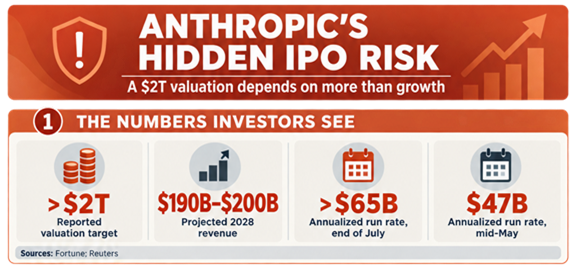
Weiss Editorial Director Dawn Pennington walked away with a similar understanding when she reviewed Anthropic’s filing.
Sales were soaring. But so were costs.
But here’s the kicker: Crypto traders had already placed bets that pointed to a value near $2 trillion. That meant the market was trying to set a price for Anthropic before most investors had a full view of its books.
Those early bets are worth watching. But Dawn made clear that they should not be taken as proof of what the firm is worth.
Then, two weeks later, Jurica turned his eye to OpenAI.
The ChatGPT maker had raised $122 billion at a post-money valuation of $852 billion earlier this year. Immediately after, it submitted paperwork to initiate the process to go public, though it didn’t state a target date.
But Jurica saw a new risk the filing brushed over: Top leaders were leaving.
OpenAI has struggled this year to retain some of its most important personnel. Many of whom held key roles in sales, products and data centers.
That matters.
A firm can have great tech. But it still needs a strong team to turn that tech into lasting profits. Especially as it transitions from a private company to a public one, complete with a new responsibility to shareholders.
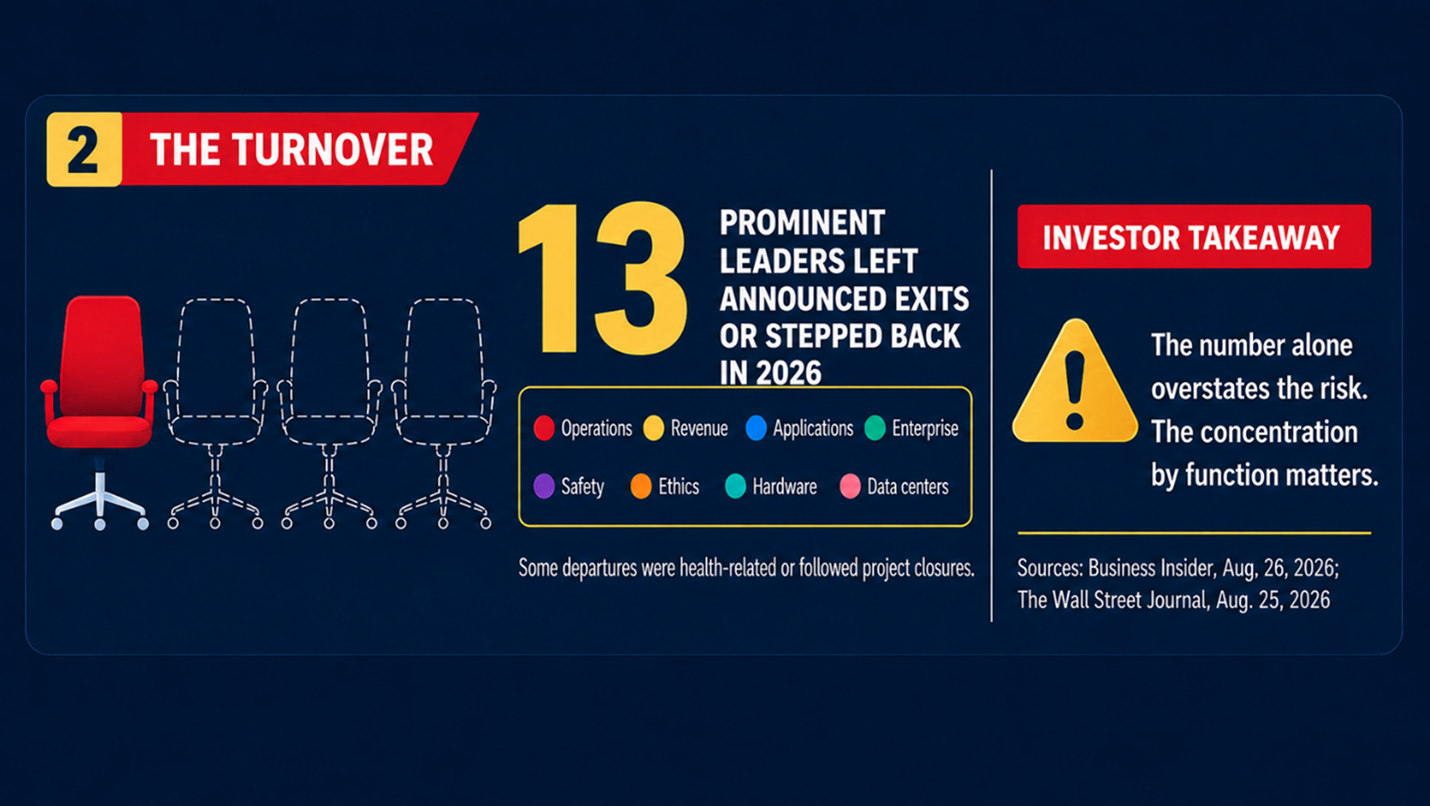
And this revolving door doesn’t just hurt OpenAI. It helps competitors who gain that newly available key talent and know-how.
Together, these updates gave Weiss readers a head start on the very issues shaking up the AI IPO narrative right now.
How to Invest Without Paying Too Much
So, what should you do if you want to buy shares in Anthropic, OpenAI or another AI IPO?
First, don't let the hype set your price.
A hot new stock can rise fast. But even a great firm can be a poor buy if you pay too much.
In fact, 90% of IPOs don’t reward first-day investors.
Rather than rush to get immediate exposure, you may want to let the market settle and tell you what price it’ll support for any new AI listing.
Second, look at sales and costs.
Is the firm making more money each year? Are its losses shrinking? And how much must it spend to keep growing?
One number alone can’t justify an investment thesis. You’ll need to see the bottom line once everything has been accounted for.
Third, read the IPO filing — that is, the company’s S-1 document — when it is made public.
That's the report firms must publish before they sell shares to the public. It lays out key facts on sales, debt, risks and the people in charge.
Bottom Line
AI could still be one of the best long-term growth trends of our lives. And its top firms may create vast wealth.
But the price you pay will play a big role in how much of that wealth you get to keep.
The goal isn't to buy the most hyped stock. It's to buy a great business at a price that gives you room to win.
And that starts with knowing what the business is really worth.
Best,
Beth Canova