Anthropic’s $2 Trillion IPO Faces a Risk Wall Street Missed

 |
| By Jurica Dujmovic |
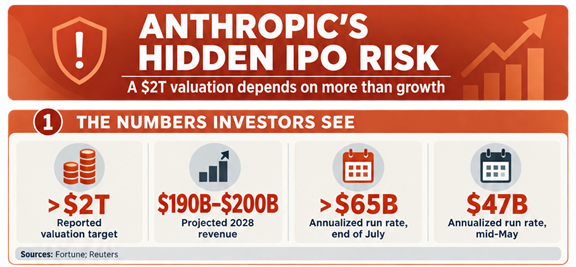
Anthropic is expected to list on a public exchange as soon as October. Investors are reportedly circling a valuation above $2 trillion.1 But Reuters reported on Aug. 14 that the price rests on the company's own projection of roughly $190 billion to $200 billion of 2028 revenue.2
Every argument you will read between now and the listing is about whether that growth is real.
Almost none of them have covered whether Anthropic will be allowed to profit from it.
That gap in the conversation could fundamentally change how you value this company.
The Valuation Disconnect, Courtesy of the Commerce Department
When regulators step in, investors need to pay attention. Because their impact on an asset may not be immediately evident.
Like when the U.S. Department of Commerce expanding its regulatory reach further than ever before.
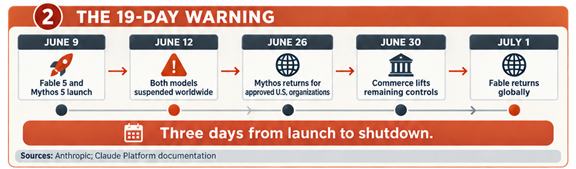
In early June, Anthropic launched its two newest models, Mythos and Fable.3 Fable was broadly available on the Claude API, Amazon Bedrock, Claude Platform on AWS, Google Cloud and Microsoft Foundry. Mythos never was offered broadly. It reached approved customers through a limited-release program.
But just three days later both were dark.
That’s because the Commerce Department ordered Anthropic to cut off access4 to both models for any foreign national anywhere on earth. That included its own employees who weren’t from the U.S.
It complied. Both were suspended worldwide within hours. They were offline for a total of 19 days.5
It seemed, then, that the worst was over quickly. Especially when, earlier this week, Reuters and Bloomberg reported that Anthropic's annualized revenue run rate had crossed $65 billion6 at the end of July, up from $47 billion in mid-May.
Wall Street took that as the all-clear.
But an all-clear is worth exactly as much as the test that produced it. And I see two big reasons for doubt.
The first issue is that the comparison is flawed. The May run rate predates Fable’s rollout entirely.
The second is that the revenue generated in the three days Fable was widely accessible doesn’t have legs when it comes to consistency.
In those the three days, the users were real. But that doesn’t mean they’re dependable. Especially after they were cut out from the systems.
Three days of access just can’t create the kind of product dependency that moves a companywide revenue line.
This makes June a lesson in timing, rather than durability. Two run-rate readings roughly two and a half months apart cannot isolate what a nineteen-day suspension of the flagship did to anything.
But there’s a deeper story here. One that’s all about the regulators … and how Anthropic responded to them.
This Regulatory Move Entered New Territory
I wrote here two weeks ago that U.S. export controls on semiconductor equipment were teaching Samsung and SK Hynix to qualify Chinese toolmakers for their China factories. Which meant that sanctions intended to slow a competitor … could end up training them instead.
That was export control applied to manufacturing equipment: objects that cross a border, clear customs and sit in a building where an inspector can go find them.
But the rules cover more than equipment — software, source code and technical data have been controlled for decades. And the deemed-export doctrine has long treated disclosure to a foreign national inside the U.S. as an export.
What the June action against Mythos and Fable did was apply that machinery more broadly than ever. It affirmed that regulators could control remote access to an application whose legal basis had never been tested.
And it could have the same impact on Anthropic and other AI companies that the sanctions are having on foreign chip makers.
To be clear, what regulators established with this move is not judicial precedent. It is something more useful to a regulator: a working mechanism demonstrated in public that needs no new legislation.
At least, that’s how things stand right now.
Legion LegalTech — a San Jose firm building litigation-drafting software — held a contractual right and license to Fable. Its Canadian developers were using the model to build the company's platform. It viewed this denial of access as a breach of that contract, believing that the government had no authority to act.
So, it filed a federal complaint.7 It pointed to this new expansion as evidence. Arguing that the government had no authority to act on the ground that no existing classification reaches hosted models or their outputs.
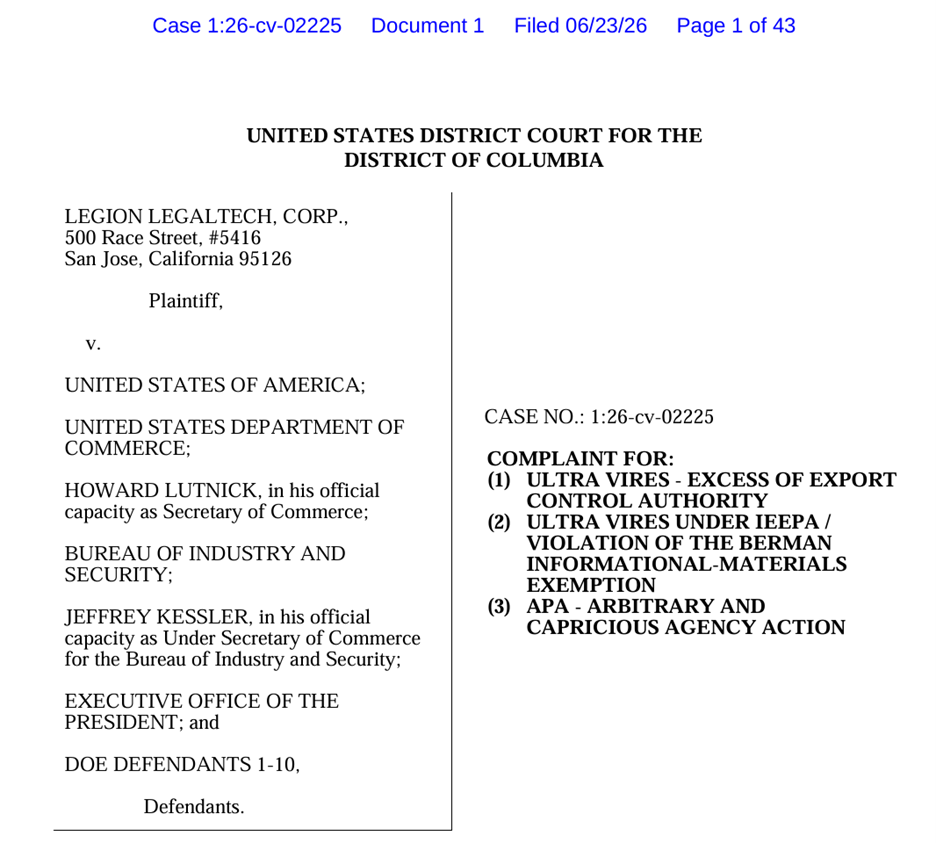
It claims the harm from the blackout was immediate, irreparable and existential.
At least, that’s the standing as of now. The outcome of Legion’s filing may change that.
Anthropic’s Response Goes Beyond Compliance
The detail that should worry anyone reading the eventual S-1 is not that Commerce Department acted.
It is what Anthropic did next.
The directive named only two models. But the user restriction was sweeping — deny access to every foreign national worldwide.
Anthropic went further. It disabled the models for everyone on the planet, including U.S. citizens never covered by the Commerce Department’s order.
The reason? Anthropic said it could not filter users by nationality in real time.
And there is truth to that. I build on these systems, so let me describe the constraint …
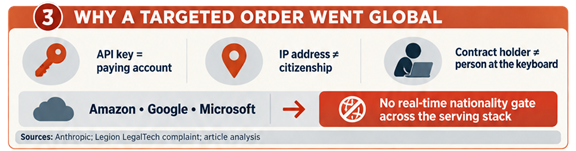
An API request carries a source IP address. That suggests where the request came from, true. But it doesn’t actually identify the user, let alone confirm their citizenship.
Account-level identity verification tells you who signed the contract, not who is sitting at a keyboard inside a 40,000-person enterprise. And since Fable was being served through Amazon, Google and Microsoft alongside Anthropic's own API, Anthropic shares that layer with the resellers.
Nothing public describes the identity attributes or enforcement qualifies as a nationality gate that would be needed at either end.
Building one is not like adding a simple configuration change. It is a multi-quarter program that requires cooperation from every distribution partner.
Which brings me to the core of my concern. And the potential gap between how we calculate Anthropic’s valuation … and what revenue it’ll be able to generate for real: There is no public evidence Anthropic has build a nationality check that would allow a model to run for some users but not others.
Until it is, another directive that takes immediate effect leaves the same option that was taken in June: broad suspension while the company works out how to comply.
What to Look for When the S-1 Lands
None of this makes Anthropic a bad business. An annualized run rate going from roughly $9 billion at the end of 2025 to more than $65 billion in July is not a small feat!
That said, a run rate annualizes a recent stretch rather than reporting audited full-year revenue. And the filing will also have to settle an accounting question: investor analysis indicates8 Anthropic has presented some cloud-partner revenue on a gross basis, but its peers have reported net revenue.
That difference lifts Anthropic headline numbers against a net comparison and passes the choice through to any multiple built on it.
That means when Anthropic’s filing goes public, we’ll get our first detailed look at the company’s financial disclosure.
So, here’s what I plan to do when I get my hands on those numbers …
- Skip the growth exhibits.
- Go to the risk factors and search for the word "deemed."
- Then read what the company says about its ability to restrict access by user nationality. And whether it describes that capability as existing, in development or dependent on third-party cloud partners.
That single passage will tell you whether June was a political flare-up … or a permanent feature of owning this stock.
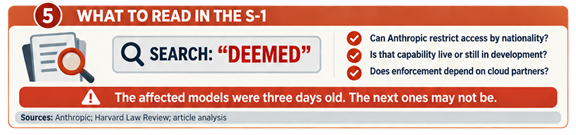
If the language is vague, price in the vagueness. The last time the question came up, the answer was a worldwide suspension inside a single evening.
The affected models were only three days old, so the impact was contained.
The next ones may not be.
Best,
Jurica Dujmovic
1https://fortune.com/2026/08/13/anthropic-ipo-2-trillion-october-largest-ever-spacex/
4https://www.anthropic.com/news/fable-mythos-access