 |
| By Mark Gough |
The decentralized perpetual exchange market remains one of the most important areas in DeFi.
Perps are contracts on the blockchain that execute “if/then” functions. If your bet that the price rises or falls is right, then you earn.
Think of them like options in the traditional market, but without the monthly expiration date.
And the numbers alone should make any crypto enthusiast stop and pay attention. Decentralized perp exchanges saw trading volume cross above $6.7 trillion in 2025.1
That represents 78% of all crypto trading volume!
Centralized exchanges still dominate crypto derivatives, but the direction of travel is clear: Traders increasingly want it all — speed, liquidity, transparency, self-custody and access to a wide range of markets.
All without relying entirely on centralized platforms.
Hyperliquid (HYPE, “D”) proved how powerful this narrative can become. It showed that a perp DEX can attract serious trading volume, build a strong community and become one of the most closely watched protocols in the market.
That’s how HYPE managed to hit a new all-time high … even as the broad market corrected.
But HYPE isn’t the only DeFi perp play that should be on your radar. A smaller disruptor has made itself known. And it’s recently received a serious upgrade that can boost its long-term potential.
Introducing: Aster
Aster (ASTER, “D+”) is also a decentralized perpetuals exchange. But unlike Hyperliquid, it supports for spot trading and exists across multiple blockchains — BNB Chain (BNB, “C+”), Ethereum (ETH, “B+”), Solana (SOL, “B-”) and Arbitrum (ARB, “D+”).
This means there’s no need for users to struggle with bridging assets just to use the platform. And it expands Aster’s addressable liquidity.
In addition, Aster had key support early on from Binance founder Changpeng Zhao, known in the community as CZ. His public endorsement poured fuel on Aster’s adoption and ignited appeal for the over 100 million retail investors already on Binance.2
But it’s ASTER’s recent token upgrade that matters more in the long run. Because it recently rolled out its buyback-and-burn model.
Under the new structure, 99% of daily platform fees are used to buy back ASTER from the market. Those bought-back tokens are then distributed to ASTER stakers through the loyalty rewards system.
At the same time, the protocol burns an equal amount of ASTER from team and reserve allocations.
For all intents and purposes, this works the same as a corporate buyback. The kind that powers the S&P 500, except automated and funded by live fees.
The long-term goal is to reduce total supply from 8 billion ASTER to 3 billion ASTER.
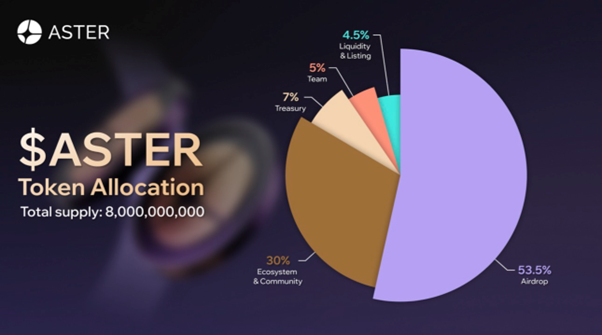
That is not a small adjustment. It is a major shift in how the token is designed to capture value.
In plain English, Aster is trying to do three things:
- Use real platform fees to create recurring token demand.
- Reward longer-term holders who lock ASTER.
- Reduce future supply from team and reserve allocations.
This latest update gives more confidence that Aster is trying to build a stronger connection between platform activity and token value.
That is important in DeFi.
A lot of protocols generate usage. But few manage to turn that usage into meaningful value for the token. That has been one of the biggest weaknesses across the sector for years.
Related story: 3 Tests to Separate Crypto’s Winners from the Rest
Investors eventually got tired of owning tokens that had no clear link to the success of the underlying protocol.
Aster is now trying to address that problem more directly. And with a cleaner model than what we have seen from many older DeFi tokens.
If trading volume remains strong, the platform can generate fees. Those fees can then support the buyback model. And, if users continue to lock their ASTER, liquid supply can tighten. Together, these measures can help ease the concern of future supply overhang.
What the Data Shows
The data reveals that Aster is already doing meaningful numbers.
According to the latest from DefiLlama,3 the protocol has around $722 million in total value locked, more than $469 million in cumulative fees and roughly $170 million in 30-day perpetual volume.
Open interest sits around $1.97 billion, while the token trades near 60 cents, with a market cap of approximately $1.62 billion.
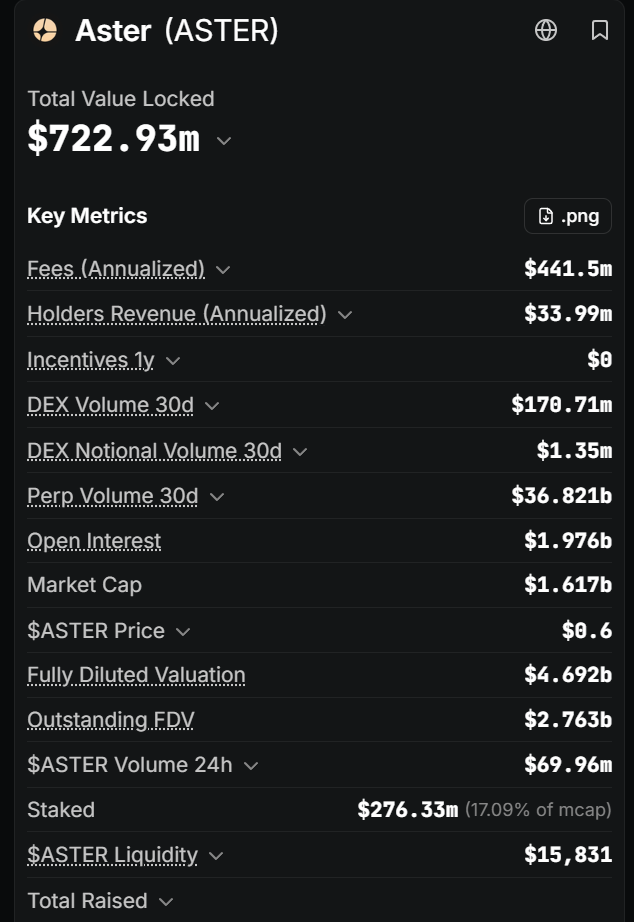
Those numbers put Aster in a different category than the smaller DeFi projects that are still running mostly on incentives, promises and marketing.
The platform already has liquidity, trading activity and fee generation. That is why the buyback model matters. Buybacks only become meaningful when there is actual revenue behind them.
However, the TVL and fees chart also shows why we need to stay balanced.
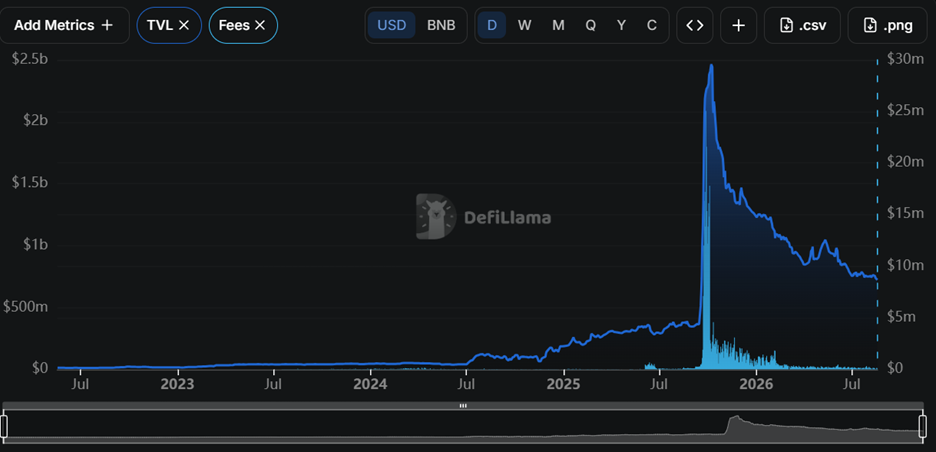
Aster saw a major spike in activity, followed by a cooling period. That is not necessarily a problem, but it does mean sustainability is the key question from here.
Risks
To be clear, none of the above means Aster is guaranteed an easy road ahead. In fact, there are still four main risks that could trip up traders …
- Competition: Hyperliquid, Jupiter (JUP, “D+”), dYdX (DYDX, “D-”), Drift (DRIFT, “E+”) and others are all fighting for volume. Weak projects won’t survive for long, no matter its tokenomics.
- Volume dependency: If trading activity drops, fees drop. If fees drop, the buyback model powering the ASTER token becomes less powerful.
- Broader market weakness: ASTER can have a strong internal story and still struggle if Bitcoin (BTC, “B+”), Ethereumand risk assets in general remain under pressure.
- Token perception: Investors have become more skeptical of tokenomics updates. The market wants execution.
Bottom Line
Perpetual trading is one of the few areas of DeFi where there is already proven product-market fit: Users trade, fees are generated, liquidity matters, execution matters.
The protocols that can hold market share in this category have the potential to become meaningful businesses.
Aster does not need to win the entire market to justify your interest. All it needs is to prove that its updated token model can turn platform activity into real token value.
For a DeFi token, that’s the type of value-accrual mechanism investors should look for.
Best,
Mark Gough
P.S. ASTER isn’t just a token on my watchlist. It’s in my Next Crypto Superstars portfolio. Members following that strategy have already grabbed an impressive 173% gain on Aster. Now, they’re waiting on round two.
That said, as a small-cap disruptor, ASTER may not be the right approach for the risk adverse.
Investing in growth opportunities like this is an entirely different market approach than trading the big boys on the blockchain.
For that strategy, I recommend you check out our monthly Weiss Crypto Investor newsletter.
In it, Juan Villaverde uses his Crypto Timing Model to identify the most opportune time to load up or grab gains on crypto’s strongest blue-chip assets. Then in my column, I dive deeper into the market to highlight what’s going on in the world of altcoins.
To see our latest updates, click here.
1https://yellow.com/news/dex-perp-volume-explodes-to-dollar67-trillion-in-2025-coingecko-data-shows