Bet on the Gatekeepers Shaping the AI Agent Marketplace
 |
| By Jurica Dujmovic |
When I’m not writing columns for financial publications, I work as a full-stack and AI developer. Put simply, that means I build software systems that use AI in practical workflows.
These models are fast, private and surprisingly capable, with each generation closing more of the gap with the large commercial ones. That progress should be good news for users.
But a divide within the industry has muddied the waters.
AI’s Two-Tiered System
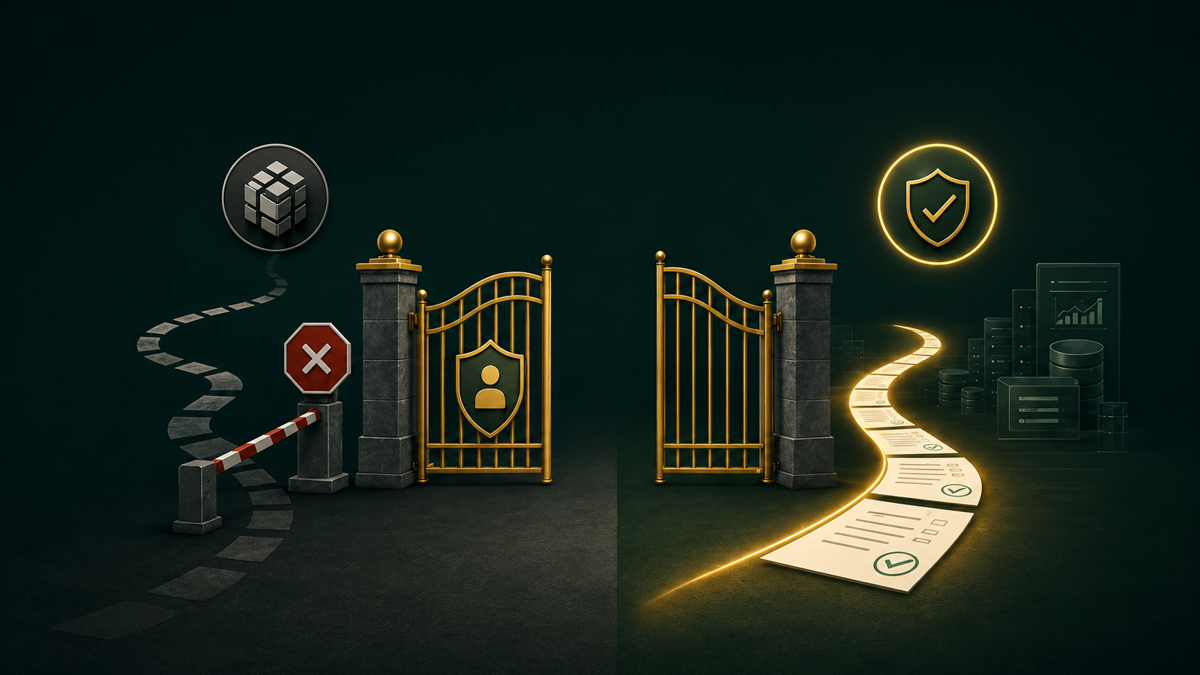
AI was pitched as democratization: a capable model in every set of hands. The enterprise market is building the opposite: a permission system.
That has split AI into two tiers: enterprise-approved models and everything else.
The approved tier is being drawn to reward a short list of state-of-the-art models from a few large vendors.
That means, whatever model you run yourself, however capable, gets put in the second tier and boxed out of the work that pays. Your own model may be smart enough to read a contract and summarize it. The approved model gets to open the matter, draft the motion, route it for review, file it, approve the payment and leave behind an audit trail compliance will accept.
For investors, it means the pool of long-term successful AI bets is shrinking.
Capability and quality are no longer the defining trait. Permission is, and the gap between what a model can do and what it is allowed to do is becoming one of the most important trades in AI.
That means investors now must ask: does my investment have what it takes to get into the approved tier?
So, let’s go through the two gates AI needs to pass to get approval. Then, you can check it against your own AI holdings.
The First Gate: The Entrance Badge
For most of the past two years, “AI” meant a chatbot: You asked, it answered, and nothing happened unless a human carried the answer into the real world.
Agents are different. They are AI systems built to act across software and platforms. Companies are now giving them the ability to move money, change records, submit filings and trigger workflows.
Once AI can act, it forces the same question a company asks about any new hire: who is this, what is it allowed to touch and how do we limit access where necessary?
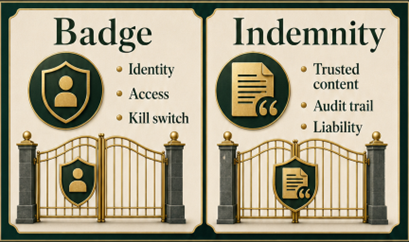
The cybersecurity industry has decided that question is its next big market, and it is consolidating fast.
Palo Alto Networks (PANW) completed its roughly $25 billion purchase of CyberArk1 in February, pitching one system to secure every identity inside a company: the human staff, the machines and now the AI agents.
CrowdStrike (CRWD) announced plans to acquire a startup called SGNL2 for about $740 million. Then in June launched a product3 that gives each AI agent its own verifiable digital ID and can grant or pull its access in real time.
Okta (OKTA) sells the dashboard on top,4 built around a problem every security chief now has to solve: Agents are proliferating faster than anyone can count them. Its pitch is discovery and control, finding the “shadow” agents nobody registered and giving administrators disable-and-revoke controls when one needs to be cut off.
Zscaler (ZS) announced plans to acquire Symmetry Systems to build a live map of which people and programs can reach which data,5 then routes every agent through a checkpoint that enforces the rules. An agent with a badge is treated like staff. One without a badge is treated like an intruder and shut out.
In short, to even make it to the second gate — and the economic opportunity on the other side of it — AI companies needs a way to keep their AI on-task and honest regarding the rules and limitations assigned.
The Second Gate: Indemnity
The first gate is about access. The second is about blame.
The enterprise work that’ll earn big for AI all come with severe legal ramifications if things go wrong. In which case, you need someone who can be held accountable.
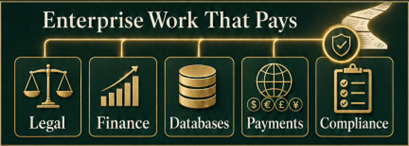
Which is why this gate is the harder of the two for AI to cross.
Regulated professions do not just buy software. They buy someone to point to when the software fails.
When a lawyer files a brief or an accountant signs a return, the licensed human still carries the risk. That’s because companies need sources, logs, controls, warranties and a vendor large enough to sue.
A local model may produce the same work. Sadly, it is not equipped to produce the institutional alibi.
Thomson Reuters (TRI) has put a name to the bar: Fiduciary-Grade AI.6 It describes AI used where a professional’s license is on the line, and it demands two things general chatbots rarely offer.
- The system must be built on authoritative, vetted content rather than the open internet,
- And it must leave a trail a regulator, court or auditor can follow back to the source.
The company likens it to a professional license, the kind a certified public accountant or a lawyer carries. It says the holder is qualified to do the work and can be held responsible when it fails.
This is a moat made of proprietary content dressed up as trust.
The firms that already own the law libraries, tax codes and audit standards, including Thomson Reuters, RELX (RELX) and Wolters Kluwer (WTKWY), are not merely adapting to the new standard. They are helping define it.
That is convenient: If “safe AI” means AI grounded in the databases they control, then the compliance problem becomes a licensing problem.
Thomson Reuters says about a third of legal, tax and audit professionals already use unapproved AI on the quiet, and it estimates as much as $143 billion in U.S. client revenue is at risk7 at firms that fall behind or get it wrong.
Read that less as a public-service warning than as the sales pitch for the gate.
Here is where the story turns. The indemnity gate gives Big AI labs a side door that local models struggle to compete with.
Thomson Reuters, for example, rebuilt the next generation of its flagship legal assistant CoCounsel around Anthropic’s Claude Agent SDK and connected CoCounsel Legal into Claude workflows.8
That is the bargain. The frontier lab supplies the model. The incumbent supplies the content, citations, workflow and institutional cover.
Together, they become acceptable in rooms where a standalone model, however capable, would be treated as a compliance problem.
A model running on a law firm’s own servers may be able to produce the same first draft. That is not the part firms are really buying. They are buying permission: Thomson Reuters’ legal corpus, traceable citations, familiar workflows and a vendor contract the risk committee can recognize without learning anything new.
A free alternative exists9 from the nonprofit Free Law Project, whose CourtListener tools serve lawyers, journalists, academics, public-interest advocates and self-represented litigants.
CourtListener broadens access to law. CoCounsel turns legal AI into an approved institutional purchase, wrapped in roughly 1.9 billion legal documents and enough paperwork to make the risk feel owned by someone else.
What This Means for Investors
Earlier, I said you can use an understanding of these gates to act as a litmus test for your AI investments. And you can.
But that’s not the real takeaway here.
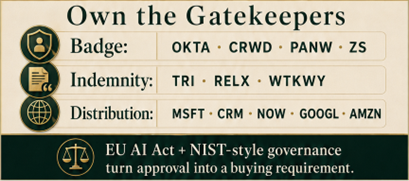
For savvy investors, the strategy isn’t to chase whichever lab posts the best test scores. It is to own the companies that control the gates.
At the Badge Gate, Okta, CrowdStrike, Palo Alto Networks and Zscaler act as gatekeepers.
At the Indemnity Gate, Thomson Reuters, RELX and Wolters Kluwer stand guard.
And because approved agents will live inside the software companies already pay for, the distribution winners are Microsoft (MSFT), Salesforce (CRM), ServiceNow (NOW), Alphabet (GOOGL) and Amazon (AMZN).
This needs to be said: I am not predicting that open or local models will be banned; for the most part, they will stay legal and capable. And for private, lower stakes work they are often the smart choice.
The narrower, more durable point is that regulated work will demand an identity, a paper trail and someone to blame. Any project missing even one of those capabilities gets shut out no matter how clever it is.
None of this means investors should buy every company with an AI-agent deck and a security booth at a conference. These stocks are not cheap, and some of the moats I just described are still being bolted together through acquisitions.
The direction of travel is clear. However, the price you pay for it still matters.
If this feels familiar, it should.
Crypto arrived promising to democratize finance, to cut out the banks and middlemen and hand control back to the individual. A decade on, and a corner of crypto — the centralized entities and real-world assets (RWAs) — has gatekeepers, too: the exchanges, custodians and asset managers crypto was built to bypass now sit at the center of it, regulators in tow.
AI is walking the same road, only faster. The tool pitched as everyone's edge is being rebuilt into a toll road. And the few large vendors who decide which models and datasets are approved will set the toll.
The winning AI agent may not top the benchmark chart. It will be the one with credentials — a badge, a paper trail, a liability wrapper and a buyer willing to let it touch the expensive systems.
For investors, the question is not which model is smartest. It is who gets to decide which models are allowed to work.
Best,
Jurica Dujmovic
4 https://www.okta.com/products/identity-governance/