Better Tech Doesn’t Always Win. Here’s How to Find What Will

 |
| By Beth Canova |
Look down at your keyboard. Specifically, check out the top line of letters.
You’ll notice they sit in a strange order: Q, W, E, R, T, Y.
No one picked that layout to help you type faster.
In fact, it was built in 1873 to slow you down.
Early typewriters jammed when the metal arms flew up too fast. So, common letters were spread apart. Fewer jams. Slower hands.
The typewriter died decades ago. But the layout survived.
Here’s the kicker though: A better one exists.
In 1936 — yes, 90 years ago — a man named August Dvorak built a keyboard layout designed to be quicker. Tests backed that claim up.
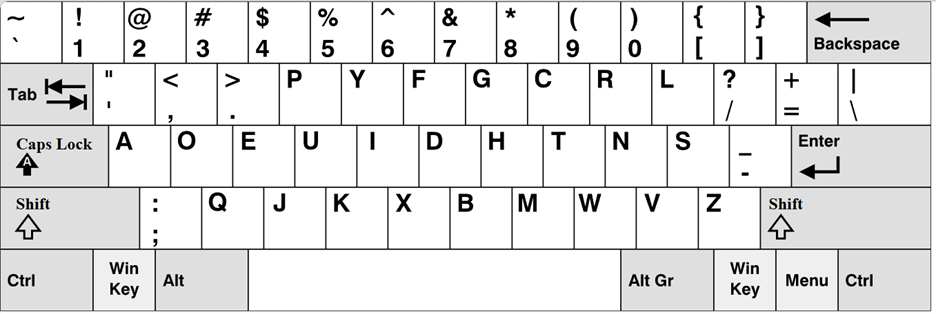
It went nowhere. By then too many people had learned QWERTY, and too many machines shipped with it.
The worse design had the crowd. That was enough.
Crypto works the same way.
On the blockchain, the network with the most money on it tends to beat the network with the better engine.
It’s why you’ll hear crypto talking heads focus so much on “first mover advantage.”
This means investors can’t just focus on the cutting edge. They also must consider who got there first. And whether what’s new can offer enough to draw away the crowd.
Here are three examples in crypto you’ll want to note.
The Slow Chain That Holds the Cash
Ethereum (ETH, “B+”) is the old one. It went live in 2015 and it is not fast.
Ethereum settles somewhere between 15 and 30 trades per second. Each one costs a dime or two.
Solana (SOL, “B”) launched five years later and blows past it. Solana is built to clear thousands of trades per second, and each one costs a small slice of a penny.
That is not a close race. On raw speed, Solana wins by a mile.
But look at where the money sits …
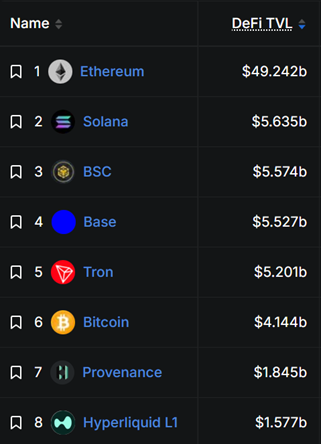
About $87.7 billion is parked in decentralized finance today. That is the pool of crypto lending, trading and savings apps that run without a bank in the middle.
Ethereum holds $49 billion of it, or just over 55%. Solana holds $5.6 billion.
Big institutions made the same call.
Roughly 65% of tokenized real-world assets — that is, stocks and bonds issued on a blockchain — live on Ethereum. The tokenized cash fund run by BlackRock (BLK) was built there, as well.
This doesn’t mean Solana is dead in the water.
In fact, Juan Villaverde shared with his Weiss Crypto Portfolio members that he expects SOL to outperform Bitcoin (BTC, “A-”) by roughly 50% in the next 320-day cycle upswing.
What it does mean is that Ethereum’s dominance should enter the equation when you decide how much of your portfolio should be dedicated to each altcoin.
A 2018 Design Nobody Has Beaten
Uniswap (UNI, “C”) is a decentralized crypto trading platform with no company behind the counter. You swap one coin for another against a shared pool of assets. A simple formula sets the price.
The design dates to November 2018. It has barely changed. And the code is public, so anyone can copy it.
Plenty did. One rival cloned it line-for-line in 2020 and paid users to defect.
The bet didn’t pay off.
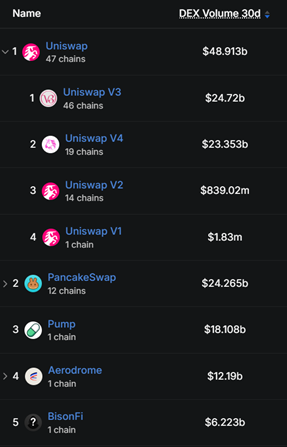
Over the past 30 days, Uniswap handled about $49 billion in trades. That is nearly one out of every four dollars traded on a venue of this kind.
The next name on the list handled $24 billion.
The Digital Dollar That Should Have Lost
Here’s the case that makes people wince.
A stablecoin is a token pinned to one dollar. It is a digital dollar you can send in seconds.
There are two that run the market.
- Tether (USDT) arrived in 2014.
- USD Coin (USDC), from Circle (CRCL), arrived in 2018.
On paper, USDC is the cleaner product. It’s issued by a public company, Circle. It files reports. It was built to fit U.S. rules from day one.
Tether is the messier one. It’s been haunted by its lack of transparency — regarding both its reserves and leadership.2
But the competition isn’t even close.
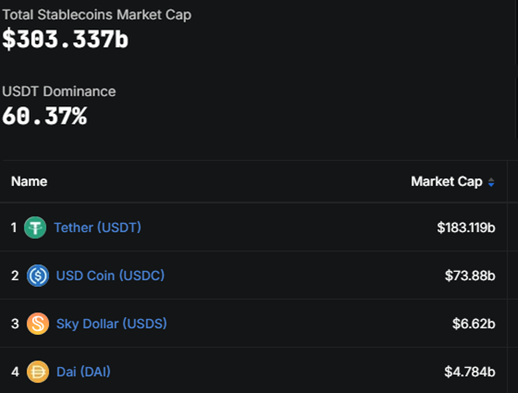
Tether is two and a half times bigger, with 60% of the market against USDC's 24%.
Why?
Tether got to the exchanges first. And in countries where the local currency loses value fast, it became the dollar people actually use.
Once that habit set in, a cleaner rival showing up four years after is just too late to the game.
Like with SOL, this doesn’t mean USDC is irrelevant. But it does face headwinds that its competitor doesn’t, despite the better tech and transparency.
Where the Rule Breaks
Being early buys you time, not safety. And where we have rules, you can bet you’ll find an exception.
And the latest one came from the privacy coins narrative.
These digital assets are designed to hide the personal details of transactions — who paid whom, if you will.
Monero (XMR, “C+”) got there first, in 2014. Its privacy is always on.
Zcash (ZEC, “B-”) came two years later. And its tech upgrade was to make privacy optional.
Think of it like a numbered Swiss account. The bank proves your balance to the regulator. The customer record stays private.
Related Story: Wall Street Is Buying the One Crypto It Swore It’d Never Touch
By age and by design, Monero should be the clear winner in this battle. And for most of the past decade, it was.
Now, though, it’s fallen behind. By a lot.
Zcash carries a market value of $13.6 billion. Monero sits at $8.3 billion. And the gap has been widening over the past year.
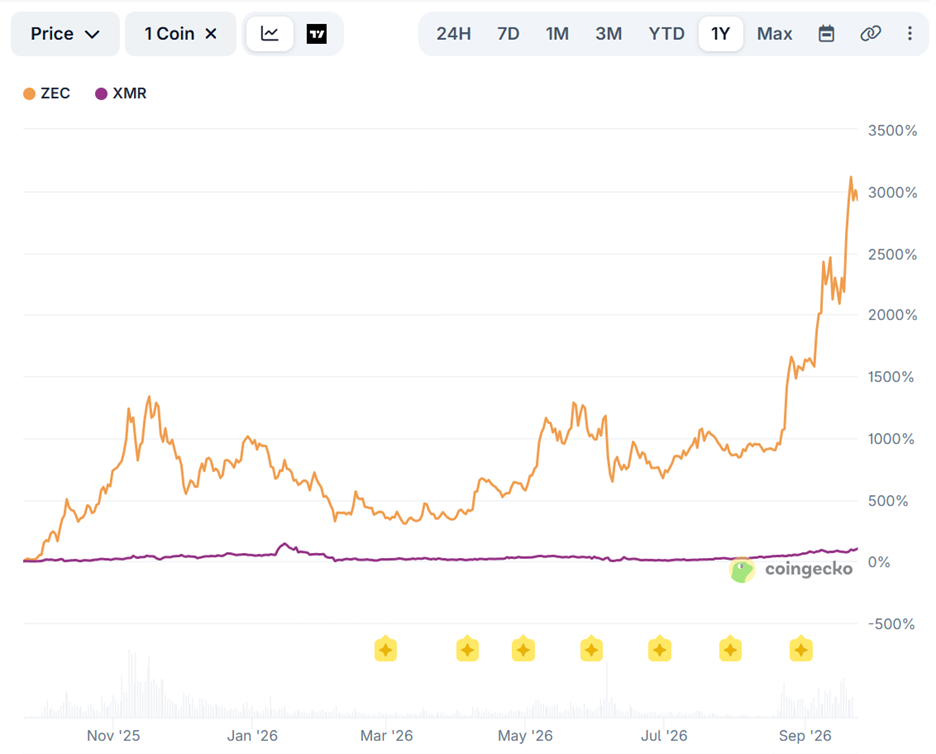
Here where the rule broke: Zcash eventually won because the game changed.
As institutional adoption of crypto grew, privacy became a sticking point. Regulated entities need transparency to comply with the law. So, regulated venues kept ZCash and dropped Monero.
Better tech alone can’t undo a head start. You need the goalposts themselves to shift for a disruptor to gain its own edge.
How to Check It Yourself
The pitch you will hear from a new project is always the same. Faster. Cheaper. Newer.
None of that tells you whether anyone is using it.
Three checks settle it, and all three are free thanks to DeFi Llama.
First, pull up the money. Go to defillama.com/chains4 and find the network's total value locked. Then look at the trend, not just the number.
Second, follow the dollars. Go to defillama.com/stablecoins5 and see how many digital dollars settle on that network.
Stablecoins have increasingly become the tool of choice for TradFi institutions taking their first steps onto the blockchain. Follow the digital cash to find where the business is.
Third, ask who it is taking share from. Growth during a hot market or against other disruptors means little. Growth against the leader is everything.
If the all the hot new project promises is better tech … but all three checks suggests users are still happy with the old dominator, then you have your answer.
The crowd isn’t going to move away any time soon.
QWERTY has had 150 years to lose. It is still under your fingers.
As an investor, you should respect that kind of staying power. And be selective when it comes to disruptors that really deserve your dollars.
Best,
Beth Canova
P.S. Juan Villaverde’s Weiss Crypto Investor Members are already sitting on a nice 78% gain on their ZCash position! That’s what happens when Juan’s expert analysis gets a boost from his Crypto Timing Model,
To learn how you can benefit from both in your long-term crypto portfolio, click here.
1https://commons.wikimedia.org/wiki/File:KB_United_States_Dvorak.svg?uselang=en#Licensing
2https://www.icij.org/investigations/coin-laundry/the-200-billion-company-you-cant-look-inside/