Bitcoin Bear Market Nearing an End? One Signal Could Confirm the Bottom

 |
| By Juan Villaverde |
For months, my Crypto Timing Model has identified a significant cycle low in late July. So significant, in fact, I said it could be a 320-day-cycle low.
A confirmation of that would signal the official end of the bear market.
But there’s another cycle in play right now. And it cannot be ignored: The long-term, 4-year cycle.
With so few repetitions, this cycle pattern is tougher to analyze and pin down. And yet, doing so matters more than almost anything else I write about.
Why? Because one pattern in the 4-year cycle is clear as day …
Bitcoin has never — not once in its trading history — broken below its prior 4-year cycle low. Every single 4-year cycle, Bitcoin bottoms out at a price higher than the bottom of the cycle before it.
That's not a coincidence. And it's not a soft pattern that occasionally breaks. It has held every time.
What that means in practice is this: The moment we can confirm a 4-year cycle low has been made, we know the lowest price Bitcoin will trade at for the next four years.
Likely longer. Possibly ever, depending on how the adoption curve continues to play out.
That's why I keep coming back to this question, week after week: Did Bitcoin already make that low in late June or early July? Or is it still ahead of us?
Cycles’ Synchronicity
The cool thing about cycles is, if you watch them long enough, you start to see the way they sync.
Like nesting dolls, smaller cycles tend to fit themselves into larger ones. So when we get a significant, long-term low — like the 4-year — you’re likely to see smaller cycle lows — 80-day, 320-day — balanced within it.
So, with my model telling me a significant low will take place by the end of this month …
And the last 4-year cycle low recorded in 2022 …
That means there is a possibility that we are almost at the next major long-term cycle bottom.
But we don’t have confirmation yet. Which means there are two potential paths for the rest of 2026 …
- If July’s low proves to be the 4-year low, then we know our price floor. That gives investors the chance to size positions accordingly, deploy capital with confidence and stop worrying about downside risk in any meaningful sense.
- If July isn’t the 4-year low, then Bitcoin could still be vulnerable to another leg down.
This isn't just an academic exercise. It's the single most important question for crypto investors right now.
And annoyingly, the two tools I rely on most to pinpoint cycle peaks and troughs … have conflicting signals.
Conflicting Analysis
My Forecasting Model — the one built to track the cycles, not liquidity — points to the 4-year-cycle low forming right around now, in June or July. (Remember, I’ve been calling for a double-bottom pattern to form in this timeframe for weeks.)
This model has been remarkably accurate at pinpointing turning points throughout this entire bear market. So, I don't take this signal lightly.
But I also know that overconfidence is a trader’s biggest weakness. And I always want more evidence to support my analysis than just my own model.
Which is why I rely on global liquidity. It acts as a powerful indicator for Bitcoin’s price within a three-month window.
For our current question, the important takeaway is that global liquidity — particularly Japanese M2 (JpM2) — is telling a different story from my model.
As I said on Monday, JpM2 has been weak, showing no real signs of the kind of pickup that typically precedes a durable Bitcoin bottom. Instead, it's pointing to a more significant low forming later, around October.
Two respected tools, two different timelines.
So how do we reconcile the disconnect? How do we filter out the noise to find BTC’s real path?
The tiebreaker will be price action itself. Specifically, the downtrend line — shown in green below — that I've been tracking on Bitcoin's chart for months now:
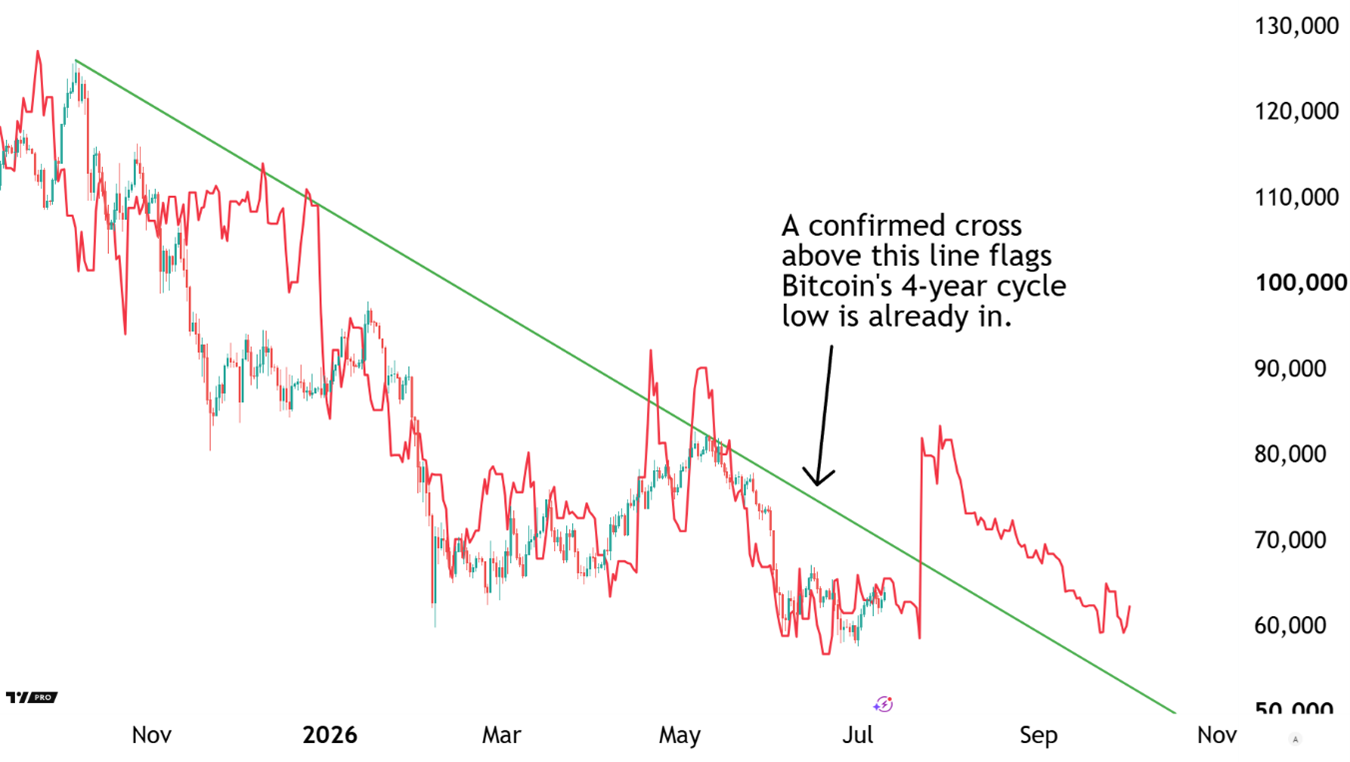
This line connects Bitcoin's prior 320-day cycle tops. According to my Timing Model, a confirmed close above it will give us the price-based confirmation that a 4-year cycle low has, in fact, already taken place.
That green line currently sits at about $68,000.
In other words: If Bitcoin crosses and holds above that level after the July low, that's our answer.
That’ll confirm the June/July low as the 4-year-cycle floor. And it’ll confirm we have at least four years of higher lows ahead.
If Bitcoin fails to cross it, or crosses briefly and rejects lower, that tells us the liquidity read is likely correct. (Note how the red Japanese M2 line falls to the right of this chart, highlighting another August-September leg down.)
That means we’ll likely have to wait until October before the real low is in. And in the meantime, we can’t rule out further downside volatility.
Bottom Line
Either way, the outcome is the same. Eventually.
Both my model and liquidity indicators say that the 4-year low will come before the end of the year.
So, why discuss the differences in the journey?
Because what changes impacts investors on an individual level in the near term. Namely, how much patience we’ll need, and how we should position between now and then.
Overall, until we get confirmation, all investor optimism should come with a healthy dose of caution.
To see how I and my Weiss Crypto Investor members are getting ready, click here.
Otherwise, I'll be watching that downtrend line as closely. When it breaks, I'll let you know immediately. Because it will be one of the most important signals we get all year.
Best,
Juan