Bitcoin Tops $80K After Midterms: 3 Things Crypto Investors Should Know

|
Key Takeaways
|
 |
| By Beth Canova Reviewed By: Dawn Pennington |
Bitcoin (BTC, “A-”) didn't waste much time bouncing back from the midterm elections.
After Democrats won control of Congress on Tuesday, Bitcoin fell below $76,000. Some feared the results could slow plans for new crypto laws.
But by Wednesday, Bitcoin had surged past $80,500. That's a gain of more than 6% from its election-night low.
True, it has since given back some of those gains. But it continues to trade near $76,000.
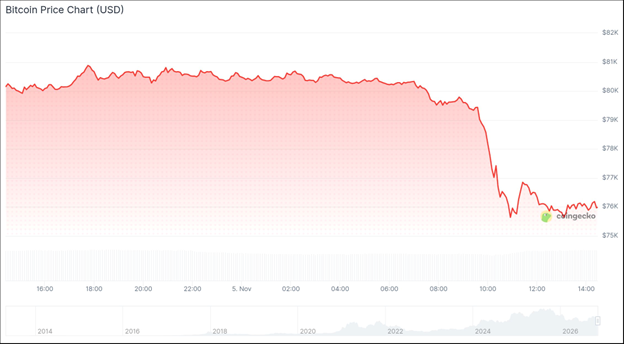
BTC is currently sitting right at support … also in the window for an 80-day-cycle low cycles analyst Juan Villaverde has called for weeks.
And the good news didn't stop there.
Bitcoin and Ethereum (ETH, “B+”) ETFs in the U.S. drew a combined $128 million in fresh cash on Wednesday, according to Cointelegraph.

That’s a welcome shift after days of investors pulling money from crypto funds. It also shows that buyers haven’t lost faith in crypto’s future.
But don’t mistake one strong day for a sure sign of a new bull run.
After all, Democrats now control both houses of Congress. And that could change the path of crypto laws for the next two years.
So, what’s changed for your crypto holdings and future chances to invest? And what stays the same?
The answers may surprise you.
Because while Washington has a new balance of power, many of the forces that drive crypto’s long-term growth are still in place.
Expect Near-Term Noise, Nothing More
Markets don’t like surprises.
And while Election Night gave the crypto market plenty to think about this week, it also eased the overhang of uncertainty.
We saw the impact of both forces on the market almost right away.
Bitcoin fell as the results came in. It briefly touched a six-week low before it began to recover. By Wednesday, Bitcoin had climbed back above $80,000 for a spell.
That’s quite a swing in less than a day.
But it also tells us something useful.
Elections can move crypto prices fast. That doesn’t mean those can fundamentally change select cryptos’ long-term value.
In fact, history gives us some cause for hope.
As I pointed out earlier this week, Bitcoin has gained an average of about 54% in the 12 months after the last three midterm elections.
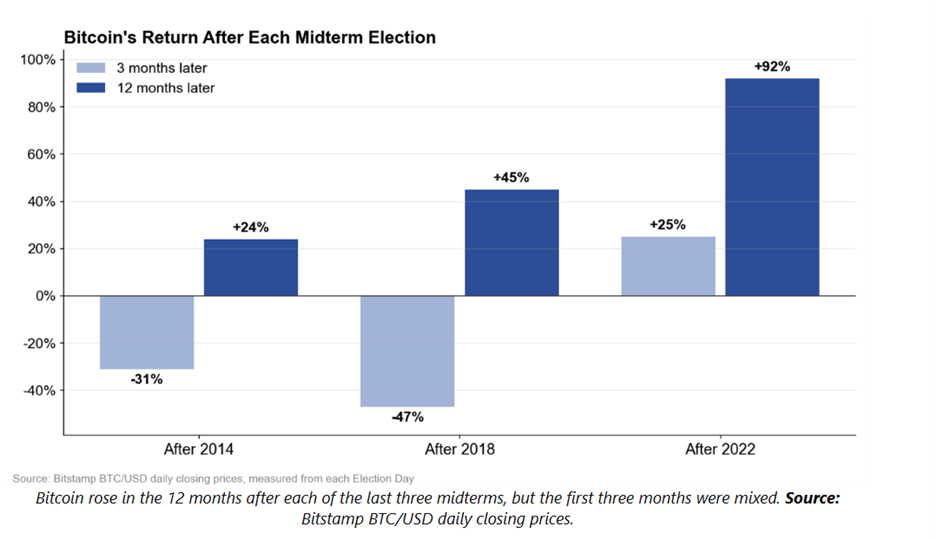
Those gains are striking. But don’t forget …
Bitcoin was also moving through its own cycle.
Each of those midterms — much like this one — came at the tail end of a bear market.
Just as Bitcoin was gearing up for a scheduled shift back into bull mode.
So, we can't say the elections caused those gains. And three past elections are far too few to promise a repeat.
Still, the record shows why it's wise to look past the first wave of news. Because crypto prices depend on much more than Washington.
Think about interest rates, the flow of money into Bitcoin funds and demand from large buyers.
Those forces can have a much greater impact than a single vote. Indeed, that’s why macro levels are the basis for many of Juan’s forward-looking indicators.
Sound, sustainable crypto projects should continue to build momentum. The only difference here is …
The Midterms Changed Who Makes the Rules
Crypto supporters spent a reported $200 million to help elect candidates who support digital assets.
Many of those candidates won their races. But some key contests went the other way.
In Ohio, Sherrod Brown — who has long called for tighter regulation on digital assets — won his Senate race despite more than $60 million in spending by crypto groups that tried to defeat him.

But pro-crypto regulation does not necessarily mean anti-crypto.
Support for crypto crosses party lines. It’s clear that crypto is here to stay.
That’s important to remember when the Congressional guard changes come January.
Some Democrats want clear rules that help the industry grow. Others want more checks to guard against fraud and protect buyers.
After all, the GENIUS Act was able to pass in 2025. And CLARITY — which stalled in the Senate this year — had notable Democratic support.
That same range of views exists among Republicans, as well.
The Changing Face of Congress
The ballots continue to be counted, so we don’t yet know exactly how many brand-new representatives and senators will take their oath in January.
What we do know, from a September Pew analysis, was that 74 House members either retired, ran for other offices or lost their primaries.
Not only did Pew say that figure (17%) was the most before any election since 1992, but that also doesn’t include incumbents who won’t be returning.
Time will tell how the changing face of Congress will impact the cryptoverse.
We expect the broad bills that once had a good shot at passing could face more debate, more changes or long delays.
But we are hopeful that fresh faces also come with fresh, and potentially better, ideas than the ones that stalled during previous sessions.
How the Next Two Years Could Reshape Crypto Rules
This is where the election may have its greatest impact.
With the power shift in Washington, regulation is where the landscape can change the most for crypto. And there are two key laws to watch.
First, the CLARITY Act.
This bill aims to settle a basic question: Who makes the rules for crypto?
Today, the Securities and Exchange Commission (SEC) and the Commodity Futures Trading Commission (CFTC) both play roles in the market.
But the lines between them are not always clear.
The CLARITY Act seeks to define those roles and give crypto firms a clearer path to follow.
The bill failed to advance in the Senate in September. If the lawmakers in the room are to be believed, the biggest hangup was the ethics clause.
- Democrats wanted clearly defined boundaries regarding what counts as a conflict of interest for federal employees — including those in the White House.
- Republicans pushed for more broad wording, with the goal of filling things in as they go.
That doesn't mean a new deal is out of reach.
There’s still a pro-crypto president in the White House.
Plus, lawmakers could work on a new version with more rules to guard buyers and curb conflicts of interest.
The key here is for pro-crypto legislators to build more bipartisan support.
Second, the GENIUS Act.
This law is already in place.
It sets federal rules for payment stablecoins. These are digital tokens built to hold a steady value, often one U.S. dollar.
Unlike the CLARITY Act, the GENIUS Act does not need to pass again.
But federal agencies still have to put its rules into practice.
And the new Congress can review how they do that.
That may lead to more debate over who can issue stablecoins, how firms back them with safe assets and what banks can offer.
From Washington to Your Wallet
So what does this mean for your holdings?
For Bitcoin, the direct impact may be small. Its supply and core network rules don't depend on Congress.
For Ethereum and other networks, the stakes may be higher.
Clear rules could make it easier for firms to build apps, offer new services and bring more assets onto blockchains.
But tighter rules could also raise costs or limit some products.
The same goes for crypto exchanges, stablecoin firms and decentralized finance, or DeFi.
Some may face new hurdles. Others may gain trust as they meet higher standards.
And that could create a gap between strong projects and weak ones.
For investors, that gap is worth watching closely. It may be where the next big chances emerge.
Your Next Move: Focus on What You Can Control
The next two years will bring plenty of debate about crypto.
Some headlines will sound dire. Others will promise a new boom.
Rather than wait to see where crypto falls in the 120th Congress’ priorities, you should make your portfolio YOUR priority now.
- Review what you own. Make sure each coin still has a clear purpose, a sound long-term case and captures protocol revenue.
- Keep some cash ready. Sharp swings may give you a chance to add to strong holdings at better prices. You’ll want to be able to act on those fast.
- Watch the rules, not just the votes. Pay close attention to the CLARITY Act, stablecoin rules and how federal agencies treat crypto firms.
Above all, keep your eyes on the bigger picture.
Crypto has grown through many changes in Washington. And its future will depend on far more than which party holds Congress.
The next two years may bring slower laws and more debate.
But they may also help build a market with clearer rules, more trust and new ways to invest.
The election changed the path. It didn't end the journey.
And for investors who stay patient and prepared, that may be the most useful lesson of all.
Best,
Beth Canova
P.S. No matter what rules come out of Washington, Bitcoin still marches to its own internal beat. And that’s a rhythm Juan Villaverde has trained his Crypto Timing Model to follow.
Juan’s Timing Model called every significant reversal this year. It also called the past three bear market bottoms, almost to the day.
Now, Juan’s model says a big buying opportunity is dead ahead. And he plans to tell you all about when he plans to act, and which coins are on his radar, at his crypto briefing on Tuesday, Nov. 10 at 2 p.m. Eastern.
That insight could give you the head start you need to get the most out of this bull market. And it’s free to attend.