Crypto Trading Is Booming. Here’s Who’s Getting Paid

 |
| By Marija Matic |
As my colleague Beth Canova told you this morning, Bitcoin (BTC) had a rough start to its weekly trading.
Most of that downside pressure comes from the climbing U.S. Treasury yields.
But it’s not just crypto alone that struggled to start the week with strength. The Nasdaq and S&P 500 also dropped today.
That shows positioning is being reduced across all liquid assets.
Across major economies, borrowing costs are now at levels last seen before or around the 2008 period:
- U.S. 10-Year ~5.2%
- UK 10-Year ~5.4%
- Japan 10-Year ~3.1%
- Germany ~3.6%,
- France ~4.7%,
- Italy ~4.5%
Capital is getting more expensive everywhere at once, and markets are still adjusting to that reality.
Interestingly, the U.S. Dollar Index did not trade in the opposite direction, defying typical flight-to-safety flows.
Simply put, that tells us this is a broad-based deleveraging, not a flight to safety.
Bitcoin Buyers Still Active
After rallying to resistance near $87,000 last week, Bitcoin’s latest pullback is less a concern and more the market taking a technical expected breather.
After all, healthy assets don’t soar higher in a straight line.
Last week’s close above $84,000 is constructive. It suggests that a new trading range is forming. Critically, even a drop back down to the $80,000–$81,000 would fit into that without changing the structure.
And here’s a key factor to keep in mind: Buyers are still active.
Strategy (MSTR) added another ~1,665 BTC (around $143 million at current prices) to its balance sheet. That brings it total to 847,666 BTC.1
It’s not the only company collecting coins, either. Strive also picked up roughly $94 million in BTC2.
But what really stands out to me isn’t the big buys by public companies. It’s the build-up in leverage …
Perpetual futures open interest is now the highest in about 11 months.3
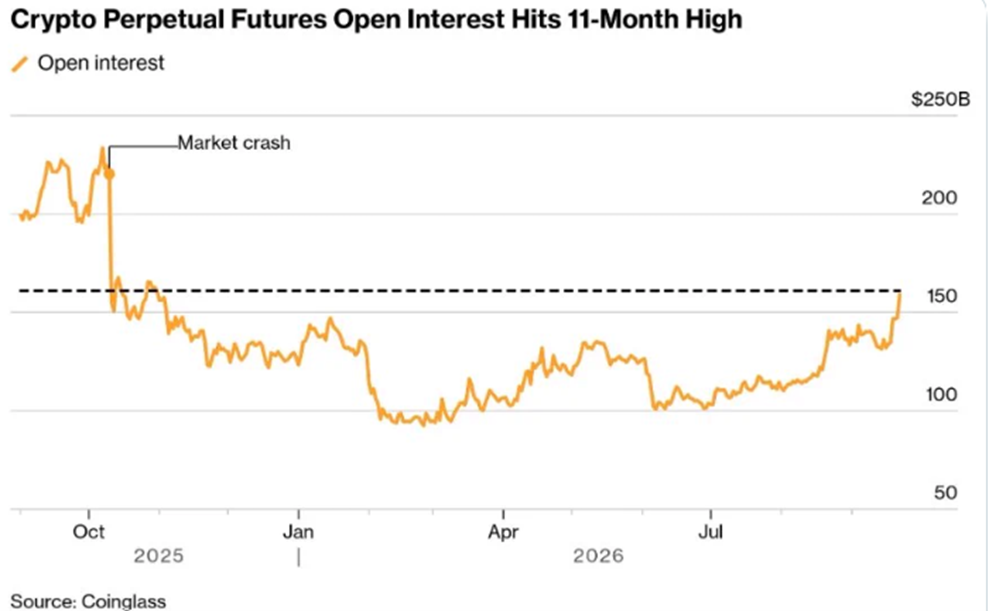
When positioning gets this crowded, the market usually forces a reset before continuing higher.
It looks like that’s exactly the situation we’re seeing set up right now.
Follow the Money: Crypto's Top Earners
Record open interest in perpetual futures is also a reminder of who wins no matter where price goes: The platforms taking a cut of every trade.
The latest CoinGecko data4 on on-chain revenue this year (Jan. 1 – Sep 15, 2026) makes it plain: The money is in trading.
Here are the platforms that caught the most of that activity. And the fees generated by it …
Hyperliquid (HYPE), a decentralized platform for perpetual futures, sits at the top with roughly $429 million in revenue.
That’s well ahead of everything else.
Perpetual futures keep traders active in both directions, and the platform takes a cut regardless of whether the market is going up or down.
In a year where price action has been uneven, that model has held up.
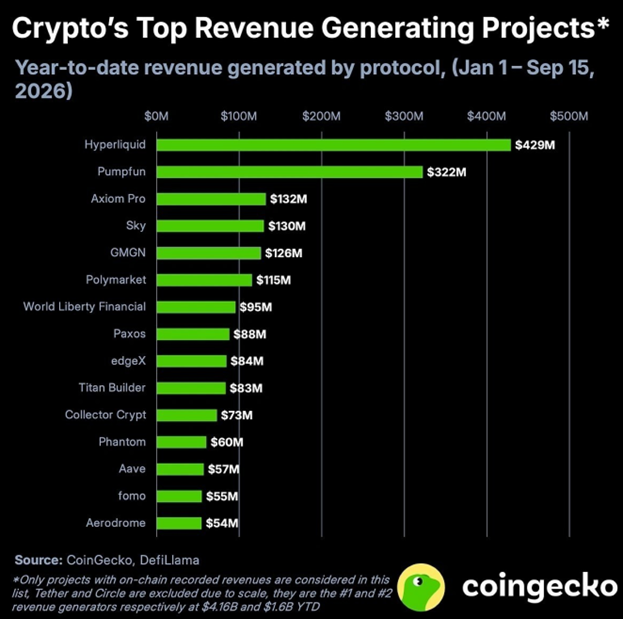
Pump.fun (PUMP) — a platform that allows users to launch and trade memecoins — comes next with $322 million, which says a lot about where retail attention is flowing.
Even in a tougher market, new token launches and speculation didn’t slow down much.
Combined, Hyperliquid and Pump.fun account for a large share of total revenue across the list.
Right behind them is a group that doesn’t get much attention outside of active traders: the execution layers.
That’s mostly because they don’t have their own tokens. But for investors who want to keep their thumb on the pulse of the market, they’re important to understand.
Axiom Pro, GMGN, and fomo don’t run their own markets. They sit on top of them. These are the interfaces people actually trade through, and they charge per transaction.
Fees aren’t small either, often ranging between 0.45% to 0.95% depending on the platform. And one trade can generate fees for multiple layers at once.
(For example, a user who trades perps through Axiom still routes into Hyperliquid underneath.)
That stack effect shows up in the numbers. And fomo gives us a good example of how fast …
Weekly revenue moved from roughly $150K in late 2025 to over $1.3M by mid-2026. Then, it pushed close to $10M at the start of September before settling around $6M recently.
All of that happened without a token.
Stablecoin issuers are another consistent presence on the list.
Sky (SKY), World Liberty Financial (WLFI), andPaxos all rank near the top. Their model is simple — hold reserves, earn yield.
Tether and Circle (CRCL) aren’t even included here due to size, but they still dominate the category by a wide margin. Tether alone earned nearly ten times as much as Hyperliquid.
Here’s the takeaway: Price speculation generates the most activity. But simply holding people's dollars is still crypto's most profitable business by far.
What This Lineup Means in Plain English
A few things come out of this clearly …
First, revenue followed trading: perpetual contracts, memecoins and the apps used to trade them made up most of the list.
Solana (SOL) shows up heavily on the consumer side, with Pump.fun, Axiom, GMGN, fomo, Phantom, Collector Crypt (CARDS) all built on its network.
Meanwhile. Ethereum (ETH) is more visible in infrastructure and older DeFi like Aave (AAVE).
A Shift in September
Like most things in crypto, the year-to-date rankings don’t stay static for long.
In fact, just looking at the top revenue generators over the past 30 days brings new names into the mix, including Robinhood Chain in fourth place and Tron (TRX) in eighth.
Despite not having a token of its own, Robinhood Chain stands out as one to watch.
It launched on July 1 as an AI-native Layer-2 blockchain built to focus on tokenized equities. The goal is to bring digital asset trading in-house for Robinhood users.
That said, its early days have seen most of its activity coming from memecoin trading.
Revenue spiked into early September, lining up with the broader increase in speculative activity.
Still, access to Robinhood’s 27 million funded accounts is a major tailwind.5
On the other hand, Tron’s position comes from something more consistent. It continues to capture fees from stablecoin transfers — mainly USDT.
And, as I mentioned above, that remains one of the most reliable sources of on-chain activity.
Bottom Line
Things may feel unstable in the near term as the markets react to every piece of data that could shift expectations around rates.
But the broad, bullish outlook isn’t shaken. Bitcoin is holding its structure, despite trading into a mix of macro pressure and geopolitical noise.
That said, positioning is crowded right now. Which opens the door for sweeps before BTC continues its climb.
This is where support levels matter.
Savvy investors should keep them at the forefront of their analysis to help filter out any noise.
Many are watching the $79,000 area for entries. If that gets tapped and absorbed, there isn’t much overhead resistance after $87,000 to slow things down.
And as we all know, new highs can open quickly in crypto.
Don’t let this pause lull you into inattention. The time to prepare for the next leg higher is here.
Best,
Marija Matic
P.S. If you want to remove the guesswork around entry levels even more, I encourage you to watch this briefing from my colleague Juan Villaverde.
In it, he explains how his Crypto Timing Model filters out the noise to find the right moment for long-term investors to load up and grab gains.
And how it can help you fine-tune your crypto investments, as well.
1https://finance.yahoo.com/markets/crypto/articles/strategy-sets-btc-holdings-record-124541442.html
2https://finance.yahoo.com/markets/crypto/articles/strive-buys-94-5-million-181602832.html
3https://x.com/Cointelegraph/status/2104614853780361438
4https://www.coingecko.com/learn/top-onchain-revenue-crypto-projects-2026