Prediction Market Regulation: What the Nov. 18 CFTC Deadline Means for Kalshi, Polymarket and Investors

 |
| By Beth Canova Reviewed By: Dawn Pennington |
Donald Trump Jr. just walked away from one of the hottest firms in prediction markets.
He had served as a paid adviser to Kalshi, a site where users can trade on the odds of real-world events.
But this week, that partnership ended.
Why? His investment firm, 1789 Capital, had raised its stake in Kalshi's chief rival, Polymarket.
That's quite a switch.
But while it’s certainly a headline-grabbing drama, it’s not the story investors should be following.
Because there's a much bigger fight brewing behind the scenes. One that could decide the fate of both firms — and reshape a market Wall Street has poured billions into.
It all comes down to one simple question: Is trading on the odds of future events a form of investing ... or just another way to gamble?
The answer could change how these markets work, who gets to use them and who gets to make the rules.
And we may soon get a clearer picture.
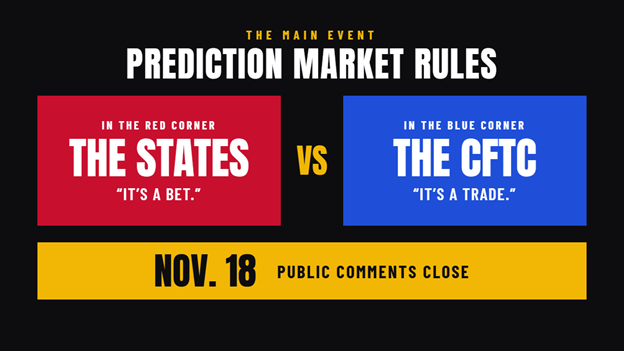
Nov. 18 marks a key deadline in the fight over how prediction markets should be regulated.
That's when the public comment period closes on two federal rules that could help settle where trading ends and gambling begins.
For crypto investors, the stakes go well beyond Kalshi and Polymarket.
Because no matter which side wins, these markets may hold a key to making smarter investment calls.
And you don't have to place a single bet to use it.
What Are Prediction Markets?
Think of a prediction market as a place where people trade on what they think will happen next.
Will the Fed cut rates?
Will a new law pass?
Will a sports team win the big game?
Sites like Kalshi and Polymarket let users buy contracts tied to those events.
Here's a simple example …
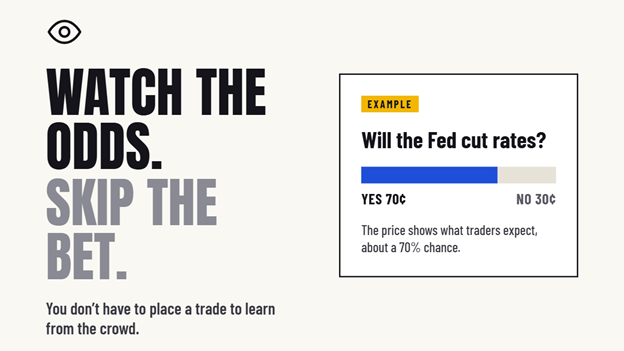
Say a contract on a Fed rate cut trades at 70 cents. That price suggests the market sees about a 70% chance of a cut.
If the event takes place, a winning contract pays $1. If not, it pays nothing.
So, you can gain or lose real money.
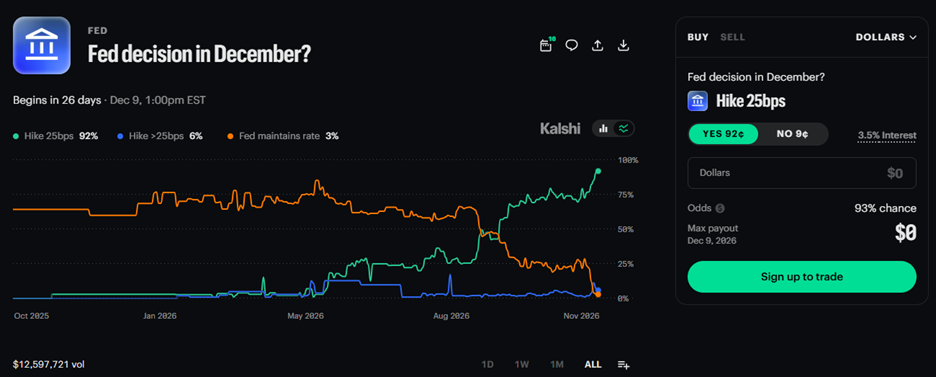
But there's a twist: The price of each contract also gives us a live view of what traders think will happen.
And those odds can change in real time as news breaks.
That's what makes these markets so useful. Unlike a poll, where people share their views for free, traders put cash behind their calls.
That doesn't mean they're always right.
Big traders can skew the odds. Crowds can get swept up in hype.
But when used with care, these markets can offer a fresh view of the future.
And Wall Street has taken note.
Last year, Intercontinental Exchange (ICE, “B-”), the firm that owns the New York Stock Exchange, agreed to invest up to $2 billion in Polymarket.
The prize wasn't just the trades.
It was the data.
Trading or Gambling? The Fight Heats Up
Here's the big question.
When you put money on an event, are you making a trade … or placing a bet?
The difference isn’t just nuance. The answer could decide who gets to set the rules.
On one side is the Commodity Futures Trading Commission, or CFTC.
It’s the federal agency that oversees markets where people trade contracts tied to future events or prices. And it says that many prediction market contracts are financial tools known as derivatives.
That's a broad term for contracts whose value comes from something else.
A contract tied to the price of oil is one example. A contract tied to a future event may be another.
Under this view, prediction markets belong under federal rules.
And that could make it far easier for firms to serve users across the country. Because it gives them just one set of rules to follow.
But states see things in a different light.
They argue that a contract on a football game looks a lot like a sports bet. And sports betting has long been subject to state laws, not federal.
States want to keep the power to set age limits, grant licenses and protect users from harm. They also fear that firms could use federal rules to get around state gambling laws.
Neither side has a weak case.
And courts have not reached one clear answer.
That’s why the CFTC is now trying to draw a sharper line.
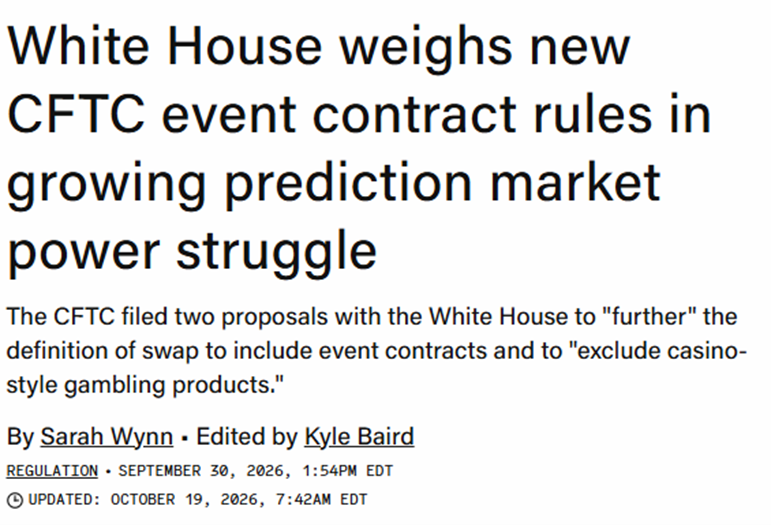
On Oct. 19, it put forward two key rules.
- One makes it clear that event contracts — even those tied to sports and politics — can count as federally regulated financial contracts.
- The other excludes certain casino games and state-licensed sports bets from that same class.
The first is still a proposal, but the second rule is already in force, though the agency is still taking public comments.
Both have a Nov. 18 comment deadline.
After that, the CFTC can weigh the feedback and decide what comes next.
One path could give federally approved prediction markets more room to grow. Another could bring tighter limits on which events users can trade.
But it’s the courts that may still have the last word.
In fact, the fight is already heating up.
On Nov. 12, the Justice Department and CFTC sued Arkansas to block the state from using its gambling laws against federally regulated prediction markets …
After Arkansas had already filed a suit against Kalshi, claiming it offered illegal gambling without a state license.

The federal government’s argument relies on that Oct. 19 rule putting those contracts under federal law.
Which means the agency’s rules after the Nov. 18 deadline … will directly play into how this court case shakes out.
And it’s not the first time the CFTC has gone to court to defend what it sees as its domain. It already sued Arizona, Connecticut and Illinois earlier this year as each tried to control how predictive markets operate in their respective states.
But don’t mistake the federal fight for control as reason to believe Uncle Sam will give the markets free rein to operate.
Just this week, the CFTC said it may bring charges against Kalshi over how it filed notice of new contracts.
Kalshi says the issue is a filing error that it is fixing.
Whether that’s true or not, the deeper message here is that even if governed by federal rule and not by individual states, firms will still face close review.
For now, the future is far from set.
But that doesn’t mean you have to wait to benefit from predictive markets. In fact, there’s a way to do it without spending a cent.
How to Gain an Edge Without Placing a Bet
The best use for most investors is to watch the odds, not trade them.
Related story: How the Prediction Markets Offer an Investment Edge the Pollsters Often Don’t
Prediction markets can give you a useful second view when news, polls and Wall Street forecasts don't agree.
Take interest-rate cuts, as an example.
If the odds of a rate cut rise fast, that could hint at a shift in how traders see the economy.
That matters for stocks, bonds and crypto.
Lower rates can make risk assets like Bitcoin more appealing, though the link is far from certain.
The key is to use the data as a clue, not a promise.
Start with three simple steps:
- Watch the odds. Check how they shift around big news, Fed meetings or key votes.
- Look for a gap. Compare those odds with polls, news reports and other market data.
- Do your own research. Use what you find to test your investment view, not to make a rushed trade.
And keep one thing in mind: If the crowd says it believes there’s 70% chance it’s right, that also means there’s a 30% chance it’s wrong.
No market can see the future.
But prediction markets can show you where people are putting their money today.
That's a tool worth having.
So, as the Nov. 18 deadline nears, keep an eye on the rules.
You can also give the government your own 2 Satoshis on the matter before public comments close.
The legal fight may change how these markets work. But their value as a source of insight could last long after the courts have their say.
You don't have to bet on the future to learn from those who do.
And that may be the smartest way to use prediction markets of all.
Best,
Beth Canova