Spot the Best Cryptos Before Bitcoin Rallies Again

 |
| By Juan Villaverde |
Last week, I told you Bitcoin (BTC, “A-”) sets the rhythm for the entire crypto market.
Want to know if your favorite altcoin will perform well in the upcoming bull market? Simply look to see if it moves when BTC does in these early days.
Because Bitcoin pulls the broad market along with it. So, if BTC rallies and pulls the top projects with it, but your coin doesn’t move …
Then you know you’ve got a dud.
That’s the One Question test. And it can do more than just keep you out of trouble. It can also help you spot chances to make money, too.
Simply put …
Whatever goes up most during the uptrend goes down least during the downtrend. And whatever goes up least during the uptrend goes down most.
It's a simple rule. And also quite logical.
On the way up, the market tells you in advance what it intends to do on the way down.
Which means exceptions to the broad trend aren't a matter of opinion, narrative or which project has the best roadmap. They're observable.
You just have to look at what the asset has already been doing.
2 Altcoins that Pass the One Question Test
This concept can be tricky to grasp in the abstract.
So, let’s look at two altcoins that have passed the One Question test in very different ways.
The first is Zcash (ZEC, “B-”). This privacy coin has outperformed Bitcoin for a while. I’m not just talking over the past week or two, when everything was rallying.
ZEC has been showing its strength when compared to BTC since September 2025.
Now, let’s look at its chart and apply the One Question test …
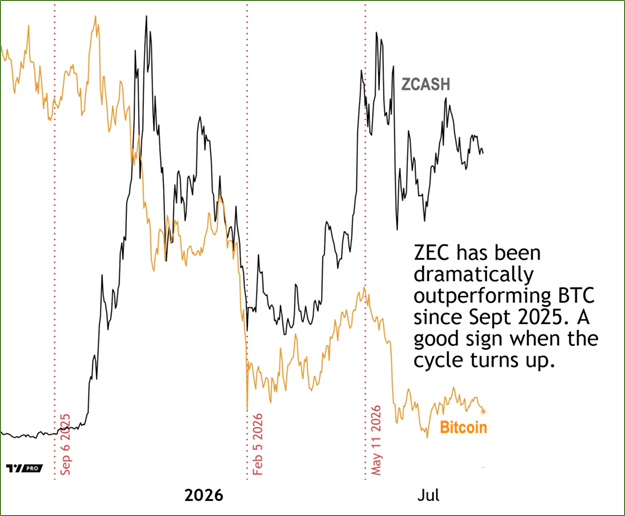
The red dotted lines show Bitcoin’s big highs (Sept. 6, 2025 and May 11, 2026) and the low established in February of this year. And you can see how ZEC’s own cycle lines up alongside it. Not perfectly, but enough to see it’s moving to the beat Bitcoin sets.
And you can also see how ZEC has outperformed on the way up. And on the way down — with a series of lower lows that still show more impressive bullish support than the OG crypto got.
So, it was no surprise to anyone using the One Question test that ZEC’s June-July low — near $362 — was higher than its February-March low near $197.
Unlike BTC, which retested its Q1 support at about the same level, if slightly lower, this summer.
And because this outperformance has been ongoing for the better part of a year — rather than a few days — I expect it to continue.
The second coin to pass the One Question test is Hyperliquid (HYPE, “D+”).
HYPE is now crypto’s ninth largest coin by market cap and best known for its decentralized exchange (DEX) that trades perpetual futures.
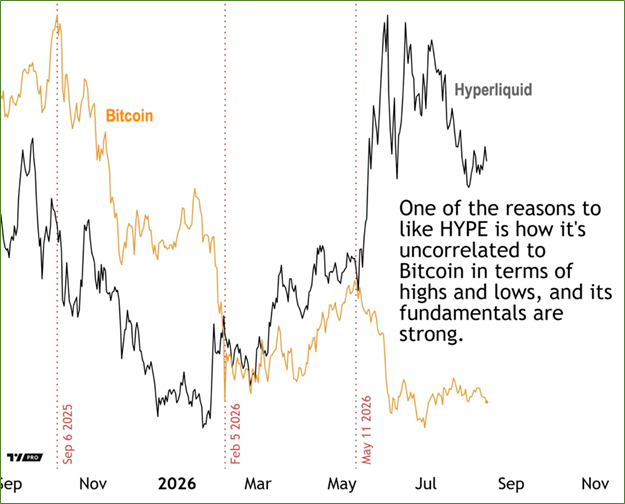
However, the HYPE token has only been trading for about 20 months. And in this limited history, its liquidity cycles don't really follow the rest of crypto.
Still, a coin that’s genuinely divorced from Bitcoin's price action is worth owning precisely because it's divorced.
That's real diversification. In a market where that’s rare.
You can see in the chart above how HYPE ignores Bitcoin’s highs and lows in a way that ZEC didn’t. And yet both still pass the One Question test.
What to Do with the Answers
From a purely investment point, the average altcoin (with a few exceptions) is like Bitcoin, but on worse terms.
Same timing, worse magnitude.
You take on the risk of a crypto asset. But there’s a chance you get less of Bitcoin's upside and more of its downside.
Again, there are clear exceptions. But there are tens of thousands of coins traded every day. And most of them are useless to investors. The One Question test is a first step in sorting out which category your favorite coin will likely fall into.
This way, you don’t just use these updates to build a watchlist. But rather to fine-tune the method you use when structuring your portfolio.
Here’s how I’d break down the One Question test into practical steps …
- Get crypto’s inflexion points from Bitcoin. Then watch how your coin behaves inside them.
- When Bitcoin’s clock says rally and your coin goes sideways, you have your answer. Sell it forthwith. Or at minimum, stop adding to it and wait to unload in the next run.
- When the clock says rally and your coin runs harder than Bitcoin, you have another answer. This is a coin to hold through the next drawdown.
Bitcoin’s clock will tell you what the market should be doing. All you need to do is make sure your altcoins wake up when they hear that alarm.
Best,
Juan Villaverde
P.S. The power of my Crypto Timing Model is that it tracks Bitcoin’s beat and the specific rhythm of the market’s top altcoins.
That edge means my Weiss Crypto Investor members get “buy” and “sell” alerts tailored to each asset while still respecting the one clock that really matters.
To learn how this system can benefit your long-term crypto investments, click here.