 |
| By Mark Gough |
Last week, I warned you about a new scam that’s directly targeting crypto users.
I encourage you to read that first. Because in it, I list a few red flags that’ll help you spot the danger.
These aren’t the tips you may be familiar with. That’s thanks to a new layer to the threat you need to be aware of …
Hackers have now added AI to their toolkits. And that has massive implications for the schemes they can run.
Gone are the days where attacks are manually directed. With AI, everything is faster, cheaper and harder to detect.
According to Binance Research, smart contract exploits now cost attackers as little as $1.22 per contract, down 22% month-on-month. Advanced AI models are achieving a 72% success rate on targeted attacks.
In 2025 alone, crypto-related fraud reached $17 billion, a 30% year-on-year increase.
It’s no wonder that, despite not yet hitting the halfway point in 2026, on-chain hacks have skyrocketed.
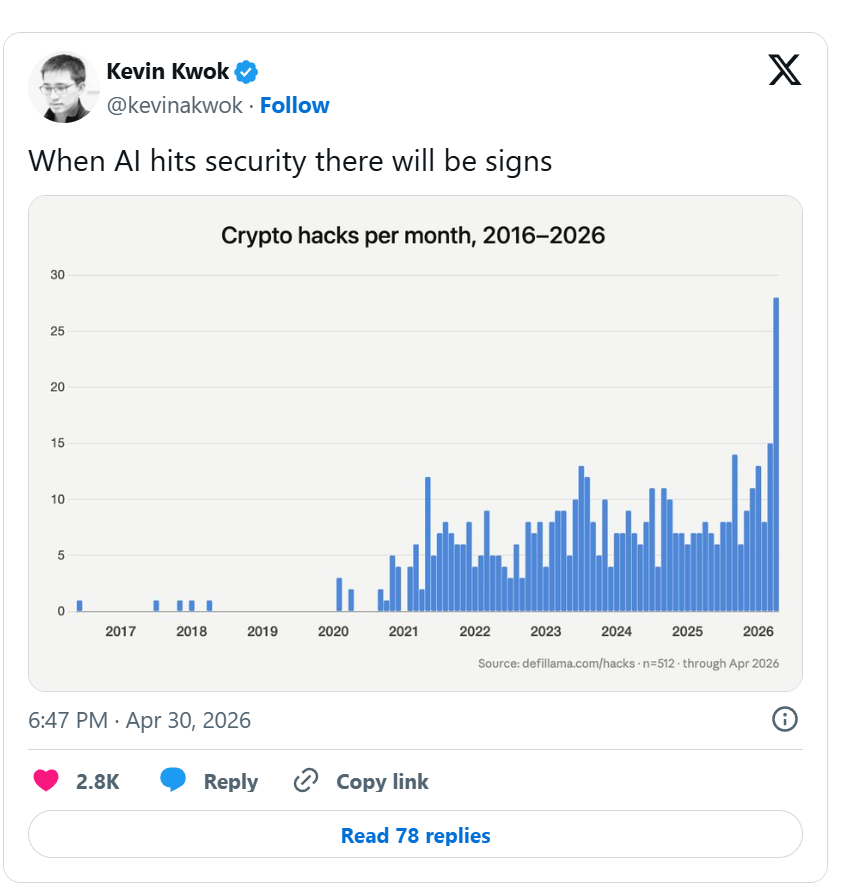
76% of AI-driven scams now fall into the highest category for both scale and severity. The barrier to entry for running these campaigns is collapsing.
Anyone with modest resources and the right toolkit can launch a convincing, high-volume attack against thousands of users simultaneously.
That’s not to say platforms are without defence. In fact, they’re fighting back with the same tools.
Binance deployed over 24 AI-driven security initiatives and more than 100 models to counter these threats. It uses computer vision to detect fake payment proofs, real-time language analysis to surface scam patterns in peer-to-peer transactions and AI-driven decisioning that now powers 57% of its fraud controls.
The result has been a 60%-70% reduction in card fraud rates compared with industry benchmarks.
In Q1 2026 alone, Binance intercepted 22.9 million scam and phishing attempts, protecting close to $2 billion in user funds. Cumulatively, from the start of 2025 through Q1 2026, the exchange blocked over $10.5 billion in fraud across more than 5.4 million users. It also blacklisted over 36,000 malicious addresses and issued more than 9,600 real-time warnings every single day.
Those are serious numbers.
But they also tell you something about the volume of what's coming at the industry. The platforms are working hard. That doesn't mean you can stop paying attention.
Especially when, by Binance’s own analysis, AI is twice as good at attacking than defending.
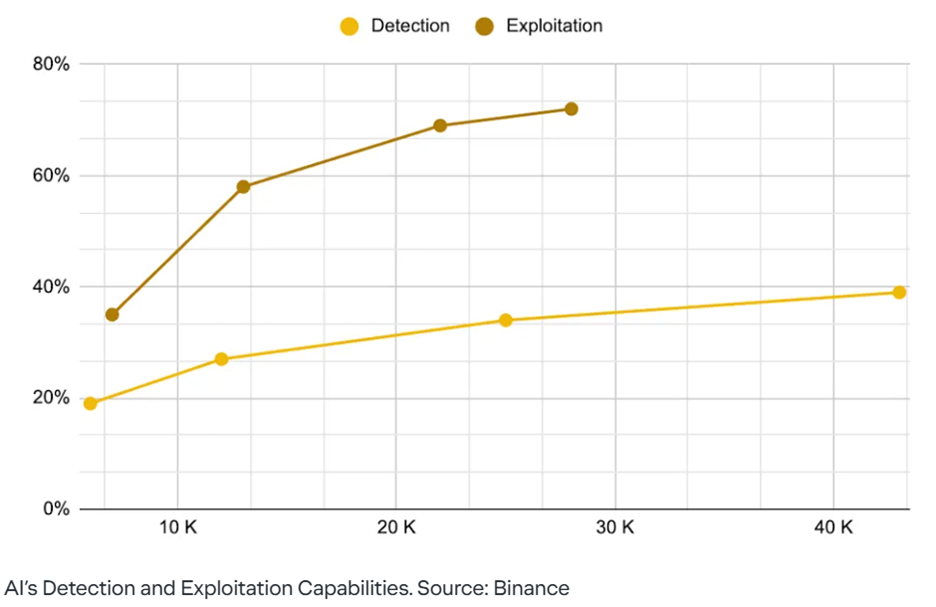
For users, there are two steps to staying safe.
First, be sure to review those red flags I talked about. Those will help you spot attacks send directly into your inbox.
Then, be sure to look at on-chain security audits. Platforms serious about stopping attacks, like Binance, are transparent about how much effort goes in to keeping their code secure.
In fact, Marija Matić recently interviewed an engineer from one of the top crypto security auditors, CertiK.
In their discussion, they lay out even more insights on how you can navigate crypto with even more protection.
Best,
Mark Gough