 |
| By Mark Gough |
Yesterday, Marija Matić let you know that TradFi giant Charles Schwab joined the growing list of financial institutions offering direct crypto access.
Today, I want to look past a single development. Because at some point — as more and more headlines highlight institutional Bitcoin (BTC, “B+”) adoption — the framing shifts.
The story stops being about whether institutions will jump on the bandwagon … and starts becoming about how deeply embedded Bitcoin is becoming within the financial system.
Two developments this week bring that into focus:
- Schwab’s rollout of direct crypto trading to its customer base, and
- A sustained stretch of positive inflows into spot Bitcoin ETFs.
Both matter on their own. Together, they tell a more complete story about where this market is heading.
Schwab Opens the Crypto Door to 37 Million People
When crypto-native platforms like Coinbase or Kraken expand their offerings, they are building on an audience that has already opted in.
When Charles Schwab does it, the audience is fundamentally different.
Schwab serves approximately 37 million clients. Many of whom have spent decades managing portfolios through traditional assets like equities, bonds and mutual funds.
Related story: Schwab’s $11 Trillion Crypto Gambit
These are not early adopters or crypto-native users. They are long-term investors, retirement savers and individuals who typically move capital slowly and deliberately.
This distinction matters.
Because Schwab isn’t just offering another ETF. It’s launching a service with direct access to Bitcoin and Ethereum (ETH, “B+”), not via ETFs or synthetic exposure.
These assets sit alongside traditional instruments within the same interface clients already use.
This integration will change behavior over time.
It lowers friction, removes the need for external platforms and gradually normalizes digital assets as part of a diversified portfolio rather than a separate, speculative allocation.
And it’s not just investor behavior that’ll change. As BTC and ETH are treated more an more as part of a diversified TradFi portfolio, their trading behavior will likely change as well.
In fact, we’ve already seen it start to. And the speed of this change is likely to increase.
Other institutions have already taken steps in this direction. Fidelity Investments, for example, has been building out crypto custody and trading infrastructure for years. Meanwhile, Morgan Stanley has introduced Bitcoin-related products to its client base.
But Schwab’s position within the retail brokerage ecosystem gives this rollout particular weight. It signals that the compliance environment has matured enough for even the most risk-conscious firms to participate.
What the ETF Flow Data Is Telling Us
Alongside Schwab’s move, the ETF data continues to reinforce the same trend.
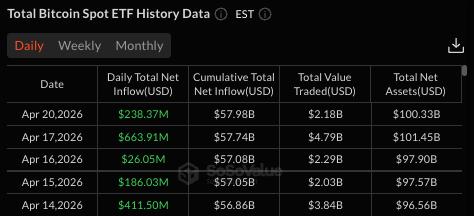
On April 20, spot Bitcoin ETFs recorded $238 million in net inflows, marking five consecutive days of positive flows. BlackRock’s iShares Bitcoin Trust ETF (IBIT) led with $256 million, while Grayscale’s Bitcoin Trust ETF (GBTC) continued to experience outflows.
The rotation from GBTC into lower-fee alternatives like IBIT is more than a simple preference shift.
It suggests that the capital entering these products is becoming:
- More cost-aware,
- More strategic in allocation,
- And more aligned with long-term positioning
Zooming out, the scale becomes clearer …

In Q1 2026, total inflows have hit $18.7 billion. But since the first BTC ETF launch back in January 2024, we’ve now seen over $58 billion in inflows.
That’s well beyond the max $15 billion experts estimated at the time. The market has significantly outperformed those expectations. And the consistency of demand suggests this is not a one-off surge.
It is also worth noting that Bitcoin has recovered 21% from its March lows and is trading at approximately $79,000 at the time of writing.
That move coincides directly with the return of positive ETF inflows and continued corporate accumulation. Which tells us the market is still moving to the institutional — not retail — beat.
So, what comes next for Bitcoin?
Well, a sustained break above the $83,000 to $85,000 range would be the technical confirmation traders are watching for to signal a bigger rally.
That zone is where the 200-day exponential moving average currently sits. And that’s the level that needs to flip for a genuine trend reversal from the downtrend in place since the all-time highs.
But you’ll have to watch for my colleague Juan Villaverde’s update later in the week to see when his Crypto Timing Model and key indicators suggest that’ll happen.
Why the Depth of This Matters
The most important shift is not ownership: It is functionality.
Two years ago, institutions were primarily focused on gaining exposure to Bitcoin as an asset.
Today, they are integrating it into broader financial operations.
Major institutions such as JPMorgan Chase, Wells Fargo and BNY Mellon have developed Bitcoin-backed lending infrastructure. In some cases, both spot BTC and ETF shares are being accepted as collateral within credit facilities.
This changes how Bitcoin is used within financial systems.
It is no longer just something institutions buy and hold. It is something they can …
- Lend against
- Use as collateral
- Integrate into structured financial products
At the sovereign level, capital is also entering through regulated channels. Mubadala Investment Company has accumulated significant exposure via IBIT, illustrating how state-backed investors are approaching Bitcoin within a compliant framework.
This is what maturation looks like in real time. The infrastructure is expanding beyond simple access and into utility.
The Risks You Should Not Ignore
Despite the strength of these trends, the risks remain relevant.
These are the ones to keep in mind as we look for crypto’s spring …
Flow volatility: ETF inflows can reverse quickly. While five consecutive days of inflows is constructive, historical data shows that macroeconomic shifts, interest rate changes or geopolitical events can lead to sharp outflows.
Regulatory uncertainty: The CLARITY Act remains unresolved. Without clear jurisdiction between regulators, institutions face ongoing compliance ambiguity. Any delay or failure in legislation could slow further expansion.
Concentration risk: BlackRock’s IBIT dominates ETF inflows. This creates dependency on a single product, increasing systemic sensitivity to any changes affecting that fund.
Retail behavior: Access does not guarantee resilience. While Schwab’s platform makes it easier for retail investors to enter the market, it does not ensure they will hold through volatility.
Historical cycles suggest retail sentiment can shift quickly during drawdowns.
The Bottom Line
The data this week does not introduce a new narrative. It reinforces a more advanced phase of an existing one.
Bitcoin is no longer being treated as an experimental asset on the edge of finance. It is being integrated into the core infrastructure of global markets.
That means Bitcoin’s direction is clear. The question now shifts from access to behavior.
Institutions have the infrastructure in place. But what we have not seen yet is how that capital will react under real pressure.
Previously, enthusiasts’ conviction meant that cycle downturns were typically met with calls for “diamond hands” — i.e., a refusal to sell through normal volatility.
But that ethos will be tested by this new category of crypto investors. And it will determine whether this is a durable shift … or simply a well-supported phase of the cycle.
We’re no longer in the days of early adoption.
We’re looking at early integration. And successful investors will be the ones who can read and respond to these shifts the fastest.
To keep that edge in your crypto investing, I encourage you to check out Juan Villaverde’s Crypto Timing Model.
You can do that right here.
Best,
Mark Gough