 |
| By Bob Czeschin |
My colleague Juan Villaverde pointed out recently that the only thing markets care about today is oil.
As the Iran War continues and oil supply out of the Persian Gulf remains tenuous, oil prices have skyrocketed …
And weighed heavily on the rest of the markets.
So, you’d be excused for thinking that oil is the most precious commodity in the Middle East.
But it isn’t. Water is.
From the shifting sands of Saudi Arabia to Iran’s Lut Desert, the Persian Gulf occupies one of the world’s least forgiving and driest climates. Summer temperatures routinely exceed 122 degrees Fahrenheit, or 50 degrees Celsius. In this climate, there are no permanent rivers.
Indeed, without the 5,000 large-scale desalination plants — which convert seawater into potable water — modern urban life simply could not exist. In fact, most of the world’s desalination-dependent nations are concentrated in the Mideast.
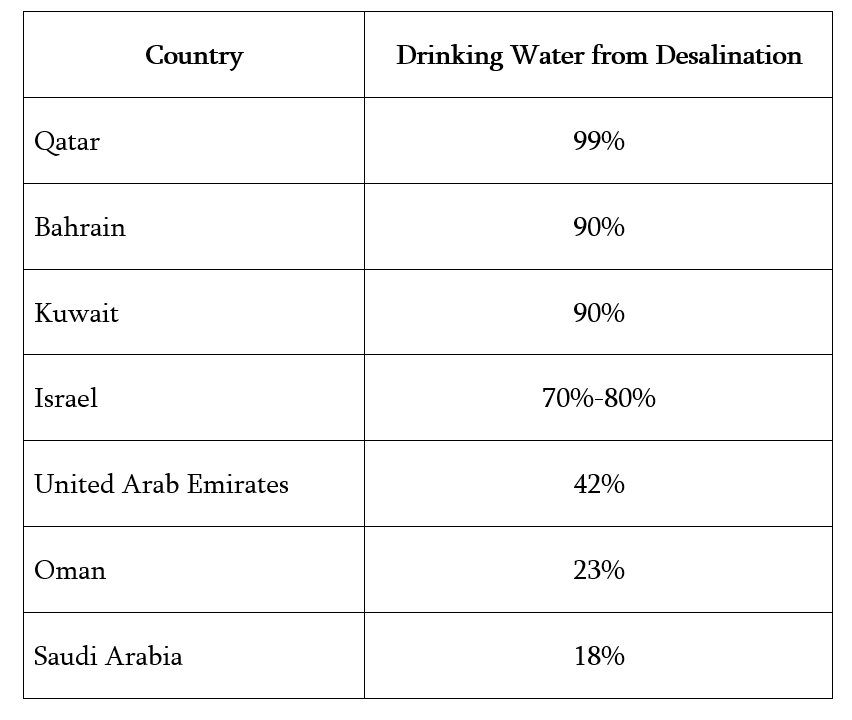
Riyadh, the Saudi capital, gets 90% of its drinking water via a 300-mile pipeline from the giant Jubail desalination plant on the Persian Gulf coast.
Suppose an Iranian attack wrecked this plant, its pipelines, or power supply. The city would have to be evacuated within a week, according to a cable from the U.S. Embassy in Riyadh.
So, while all eyes are on oil, experts are focused on water in the region.
Because while the threats against traffic in the Strait of Hormuz sent oil prices to $119 a barrel and above … there are alternative solutions.
Oil flows can be rerouted. Or at least be partially substituted for — by other hydrocarbons, like natural gas or coal. Or even biofuels.
Water, on the other hand, has no immediate alternative.
Cutting off oil blocks a critical source of revenue for key Persian Gulf countries. But cutting off water could make them uninhabitable.
Which makes desalination plants irresistible military targets, despite being civilian infrastructure and therefore not legal targets. And indeed, they’ve been attacked before.
In 1991, Saddam Hussein ordered Iraqi troops invading Kuwait to open the taps on a key Kuwaiti oil pipeline.
Why?
Because he reckoned spilling millions of barrels of oil into the Persian Gulf could foul the water intakes of nearby Saudi desalination plants.
Threats to Desalination Plans Will Likely Be the Next Escalation
Increasingly, it seems like targeting the Gulf’s drinking water may not be a tactic of the past.
In the past few days, Iran reportedly attacked a power station in United Arab Emirates that supplies electricity to one of its largest desalination plants.
Bahrain also reported an Iranian attack on one of its desalination plants.
Militarily, Iran has no hope of prevailing against the combined might of the U.S. and Israel. Particularly if the Japanese and Europeans join efforts to keep the Strait of Hormuz open.
Apart from negotiating with President Trump, the Iranians’ only realistic option is to hunker down and hammer soft targets like power plants and water installations …
And thereby prolong the conflict until it becomes economically too painful for its adversaries to persist.
For the radical mullahs and Revolutionary Guards, regime survival counts as a win. No matter how much hardship it causes ordinary Iranians along the way.
Investment Impact
Desalinated water underpins nearly all economic activity in the Gulf. That includes refining, petrochemicals, construction, tourism, etc.
And in the 21st century, that also includes the region’s 158 data centers.
According to my colleague, tech expert Michael Robinson, that could impact Phase 2 of AI’s Great Rotation.
Michael invested in Bitcoin (BTC, “B+”) back when it went for $300. And he was one of the earliest to talk about AI plays — long before Nvidia (NVDA, “B”) and ChatGPT were household names.
So identifying and acting on big trends before they happen is old hat for him. And Michael sees another trend is ready to roll out. He says that the big money has already made its gains in AI’s early stages.
Now, it’s ready for the next phase.
To track what AI plays will outperform in this new landscape, Michael relies on his Breakout Signal. And its success speaks for itself.
The Signal helped Michael lock in gains of 100% or more on the biggest AI stocks around. Now, it’ll help him do it again with Phase 2.
To learn more about it, save your seat for Michael's urgent briefing. He'll explain how it works, and the three specific stocks it has already flagged, on Tuesday, March 31 at 2 p.m. Eastern.
That said, times like this remind us that the best investments are the ones we can take with us.
A desalination war would also likely trigger capital flight from the region. As nervous local residents and investors scramble to diversify away from Gulf equities and real estate.
In this environment, many in Iran turned to the blockchain to help. Even an internet blackout couldn’t stop crypto trading.
Now, the war is keeping most commodities down. But two on-chain assets that should still be on your buy list are BTC and gold, via the PAX Gold (PAXG) stablecoin.
Both are safe havens in times of trouble. And by keeping both in your self-custody crypto wallet, you can take them with you anywhere.
If you’re new to crypto, Weiss Crypto Investor is a great way to get your feet wet. In it, cycles expert Juan Villaverde uses his Crypto Timing Model to target the best entry and exit opportunities for crypto’s biggest coins.
That’s how his members were able to lock in an 189% gain on PAXG earlier this year. And how they’re going for another round.
Best,
Bob Czeschin