The Nasdaq’s Worst Week Since 2020: Where the Money Left & Where It Hid

|
Key Takeaways
|
 |
| By Chris Graebe Reviewed by: Jim Nelson |
We’re approaching Black Friday.
It’s the perfect moment to knock out your Christmas shopping at bargain-basement prices (and to pick up a little something for yourself while you’re at it. No judgment here.)
Black Friday came a week early for the market.
The Nasdaq fell 5.3% led by a tech sell-off. Fire-sale deals on almost any tech stock of your choice!
For the week, the index fell 10%, its worst since 2020.
But the Nasdaq wasn't alone …
The S&P 500 dropped 3.7%, and the Dow lost nearly 950 points. Both closed in correction territory, more than 10% below their October highs.
The chart below shows the damage.
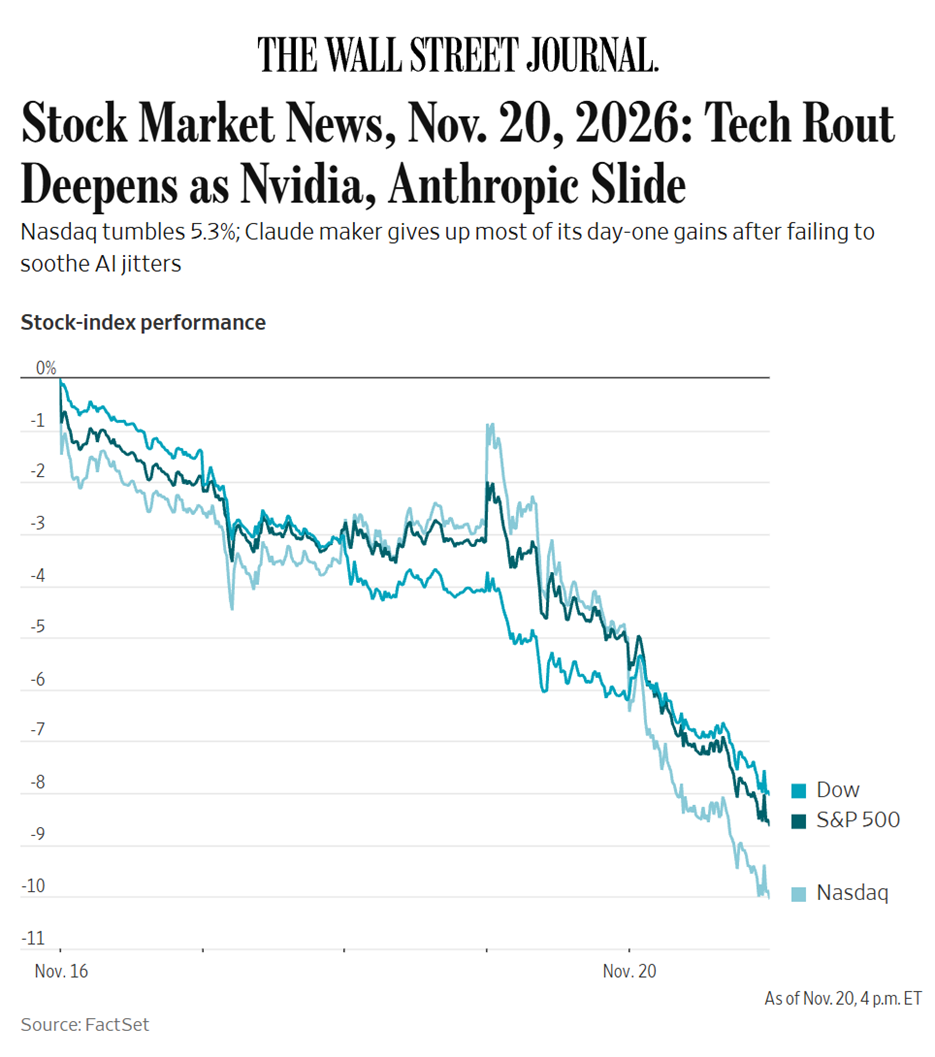
Friday wasn’t a bolt from the blue. Instead, it was the climax of a six-week slide.
Here’s how we got there … and where the money went.
How the Slide Unfolded
It started at the top.
The S&P 500 and Nasdaq both hit records on Oct. 6.
Then rates climbed, with the 10-year Treasury yield reaching two-decade highs.
The most leveraged corner of the AI trade cracked first.
In mid-October, CoreWeave’s (CRWV, “E+”) stock fell as much as 28% in a week, and some of its bonds dropped below 80 cents on the dollar.
November brought politics.
Democrats’ midterm wins on Nov. 3 raised fears of a slower data center buildout. On Nov. 5, the Nasdaq-100 fell 6.4%.
Then Nvidia (NVDA, “B-”) became the story.
A scandal involving CEO Jensen Huang led to a board investigation and his Nov. 12 resignation.
Even Nvidia’s monster earnings beat on the 17th couldn’t save it.
And Anthropic (ANT, Not Yet Rated), which closed its Thursday debut up 17%, fell 8.5% the next day, slipping to within a few dollars of its $83 IPO price.
What Happened Friday
Friday marked the S&P 500’s seventh straight loss.
The VIX volatility index, otherwise known as Wall Street’s fear gauge, jumped to 40, its highest close since March.
Nvidia fell 14% and finished the week down 23%, as the fallout from Huang’s exit and mounting regulatory scrutiny kept weighing on the stock.
By Friday, Nov. 20, Nvidia had lost more than $2.5 trillion from its October high.
Where the Money Left
First, everything that’s tied to AI hardware. The Philadelphia Semiconductor Index lost 10.7% on Friday alone.
Month to date through Friday, SanDisk (SNDK, “C+”) fell 41.04%, followed by Dell (DELL, “B-”) (-29.22%), Marvell Technology (MRVL, “C”) (-28.66%), ServiceNow (NOW, “C-”) (-17.36%) and Intel (INTC, “D+”) (-14.49%).
And the pain spread past chips …
Materials weren’t a clean hedge.
For the same time period, two of the largest copper suppliers to the AI industry, Southern Copper (SCCO, “B”) and Freeport-McMoRan (FCX, “B-”),dropped 24.5% and 27%, respectively, as both names reacted to the AI-infrastructure demand story.
Where the Money Hid
On Friday, consumer staples were the only S&P 500 sector to finish higher, up about 0.7%.
Investors also rushed into Treasurys, pushing the 10-year yield to about 4.93% from 5.04%.
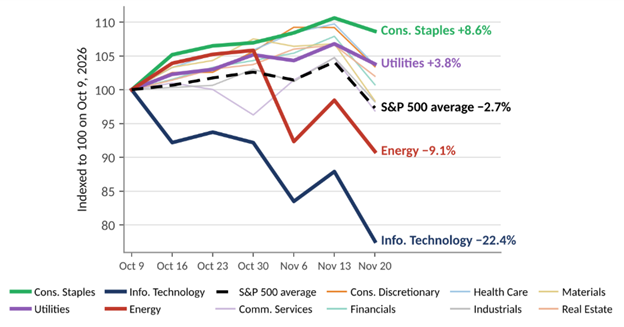
Zoom out, and the rotation is clearer.
Over the six weeks to Nov. 20, staples were up 8.6% on an equal-weight basis, the best of the 11 sectors, with 29 of its 33 stocks rising.
Earnings announcements from the big players in staples added fuel.
Clorox (CLX, “D+”) experienced an 11-day winning streak of 23% after beating profit estimates.
Tyson Foods (TSN, “C”) rose roughly 9% on earnings day as its beef losses narrowed.
Kraft Heinz (KHC, “D-”) gained over 7% intraday after lifting its sales forecast and agreeing to sell its North American coffee business for $650 million.
Utilities joined the rotation out of AI.
Over the same six weeks, the S&P 500 Utilities Index rose 2.8%, second only to staples.
Not surprisingly, the exception was companies that sell power to AI data centers.
Vistra (VST, “C+”) plunged 28.6%, and Constellation Energy (CEG, “C+”) fell 20.4%, as financing worries resurfaced and the midterms raised fears of a slower buildout.
Then Came Monday
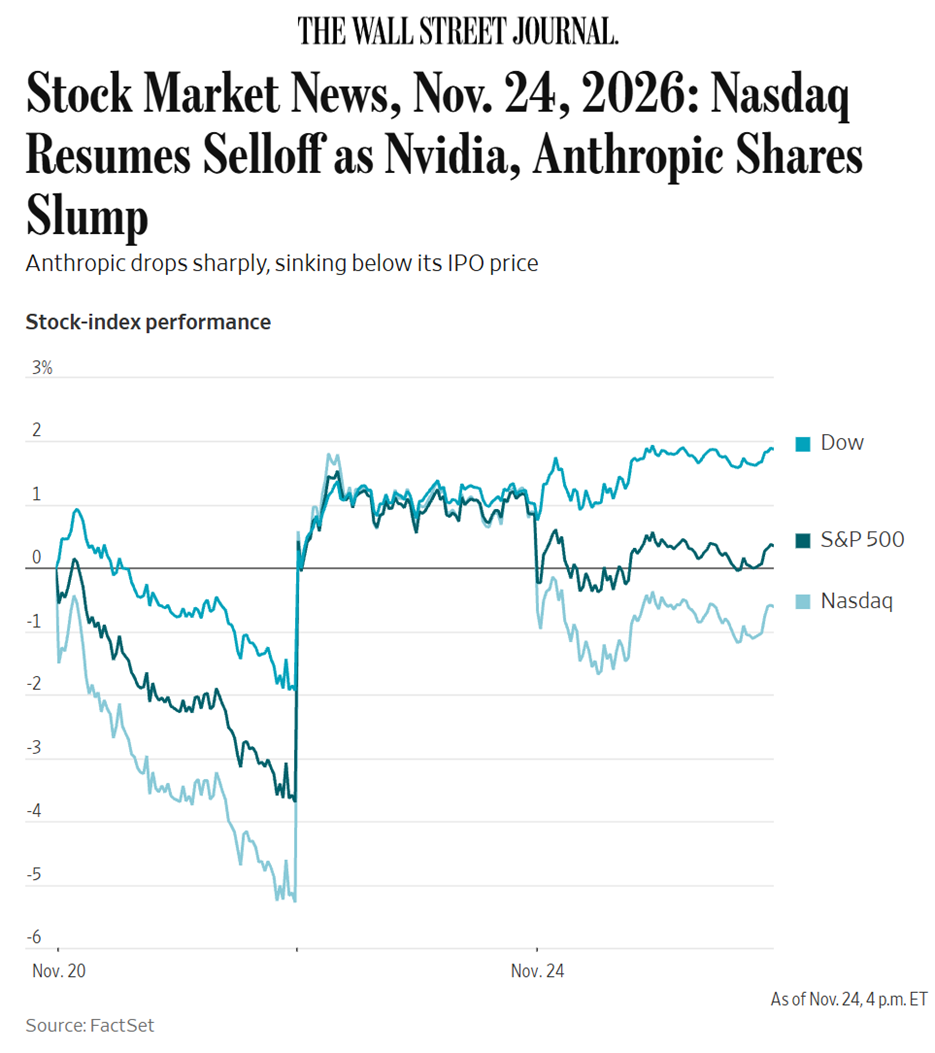
Surprising investors and the rest of the world, Nvidia’s board reinstated Jensen Huang as CEO.
The stock jumped more than 30%, adding back almost $1 trillion in market value and posting its biggest daily percentage gain since 2003.
The Nasdaq opened more than 6% higher, the Semiconductor Index soared about 14%, and CoreWeave gained 22.3% on the news.
Then the bounce faded.
On Tuesday, tech stumbled again as AI worries crept back.
By midday, the Nasdaq was down more than 2%, Anthropic was off over 12%, below its $83 IPO price, and Nvidia had given back a significant portion of Monday’s gains.
Huang’s return could help the AI trade, since it signals the Trump administration sees Nvidia’s chip sales as crucial to the U.S. economy.
But it doesn’t tell us whether data center spending can keep its pace and whether the investment will pay off.
What to Do About It
You can’t time these things …
Almost nobody called Friday’s 5% drop, Monday’s 30% rip or Tuesday’s losses.
You can only control what you own before the next shock arrives.
How much of your portfolio sat in stocks that lost 30% or more? And are the “defensive” holdings you counted on actually working for you?
If you own index funds or ETFs, check them too. They hold these same names.
That’s what Weiss Ratings are for.
We assign letter-grade ratings to tens of thousands of stocks, ETFs, mutual funds, cryptos, banks and insurers.
Look up what’s in your portfolio and see how each one rates.
No rating can shield you from the market whiplash we’ve seen recently …
But it can help you see where you’re exposed.
Happy hunting!
Chris Graebe