This AI App Threw Away Big Tech’s Favorite Growth Trick

|
Key Takeaways
|
 |
| By Beth Canova Reviewed By: Dawn Pennington |
The first person to buy a telephone had a problem. There was no one to call.
The phone only became useful when a neighbor bought one. Then a friend. Then the bank.
Each new line made every other line worth more.
That is a network effect. It is why Visa (V, “B+”), Facebook owner Meta (META, “B-”) and the stock exchange are so hard to dislodge. Once everyone is there, no one wants to leave.
AI chatbots have their own version.
You type. The company keeps your chats. It uses them to make the next model smarter. Better models pull in more users, who type more.
But one fast-growing AI app has thrown that trick away on purpose. It does not keep your chats at all.
So it has to build its network effect another way: with a crypto coin tied to every sale.
Related Story: This AI Crypto Is Making Millions. Here's the Catch ...
The growth is real. The open question is how much of it the coin gets to keep.
What Venice Is
Venice (VVV, “A-”) is an AI app.
You can chat with it, write code, or make images and video.
But Venice does not build its own brain. It rents more than 200 AI models from many makers and puts them in one place.
Think of the fund marketplace at Charles Schwab (SCHW, “B”). You do not open one account at Vanguard and one at BlackRock (BLK, “B”). You pick from many funds in one window.
Venice does that for AI.
It also stores your chat history on your own device, not on its servers. That’s the privacy pitch. And the reason Venice gives up the data flywheel.
The company was founded in 2024 by Erik Voorhees, a well-known name in crypto. In July, it raised $65 million at a $1 billion value. Dragonfly led the round. Coinbase Ventures, the venture arm of Coinbase (COIN, “D+”), joined in.
The Growth Is Not a Rumor
Here is what can be checked.
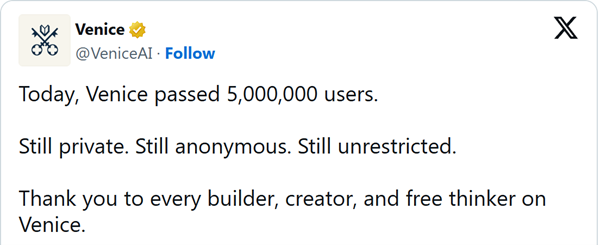
In July, Venice said it had 3.5 million users. On Oct. 19, it posted that it had passed 5 million. The jump from 4 million to 5 million took just 68 days.
That comes from a filing last week by KR1 plc (KROEF, “D-”), a firm listed on the London Stock Exchange.
The same filing says Venice now handles more than 1 trillion "tokens" a day. (In this context, a “token” just means a small chunk of text, often part of a word.) At the end of September, the figure was about 250 billion.
What about market share?
No one publishes a clean number for it. But there is a good stand-in.
Twice a year, the venture firm Andreessen Horowitz ranks the 50 most visited AI websites. It uses traffic data from Similarweb (SMWB, “E+”). ChatGPT is No. 1, by a wide margin.
But in its October list, Venice showed up for the first time, at No. 43.
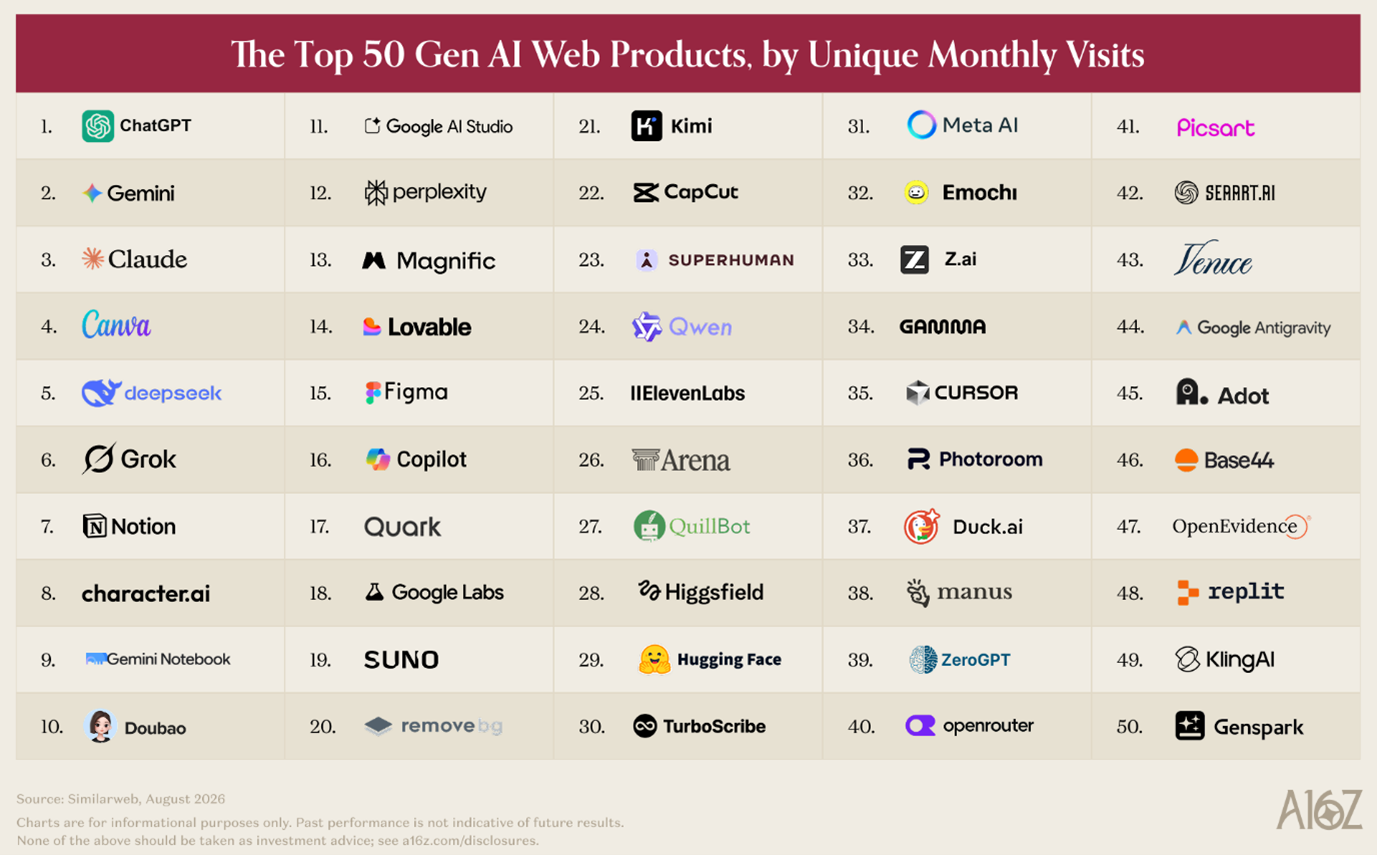
So Venice is a small player. But it is a small player that just broke into the top 50.
Then there is money.
In August, Voorhees posted that Venice had passed $100 million a year in sales, based on its recent pace. On Oct. 14, he said it was above $150 million. The research firm Sacra puts its own estimate near $150 million for September.
That is up from about $10 million at the end of 2025.
Keep one caveat in mind: These are a founder's posts and outside estimates. Venice does not publish audited results.
How Using the App Feeds the Coin
This is where the network effect comes in. Venice ties the app to its coin in three ways.
1. Buybacks
Each new paid plan triggers a small buy of VVV, from $2 to $10 based on the tier. So does 5% of what developers spend on credits. Then, the coins are "burned," or destroyed for good.
It works like a company that buys back its own stock and retires it. Venice also does a larger buyback each month.
On Nov. 9 it burned about $458,000 worth, its biggest yet.
2. Staking
Holders can lock up their VVV with the network, a step called staking. In return, they get paid rewards in new VVV.
KR1 says the rate is about 5.7% a year right now.
3. DIEM
This is the clever part. Lock up staked VVV and you can create a second token, called DIEM. Each DIEM gives you $1 of AI use a day, for as long as you hold it.
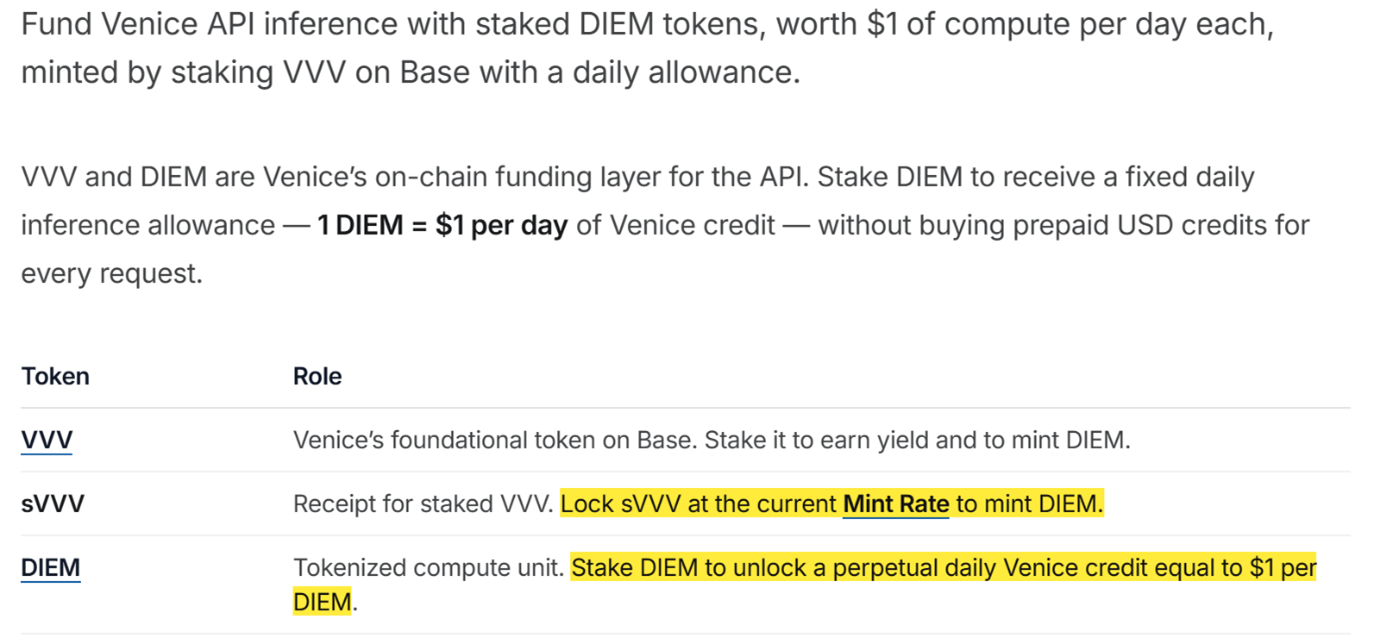
Imagine if owning Anthropic (ANT, Not Yet Rated) gave you access to Claude Pro.
A DIEM sells for about $1,814 today. That is roughly five years of daily credits paid up front.
And the more DIEM that exists, the more VVV you must lock up to make the next one. So as more developers and AI bots want steady access, more VVV gets pulled off the market.
That is the loop.
More users mean more sales. More sales mean more buybacks. And more demand for AI time means more coins locked away.
Where the Loop Leaks
But a loop is only as strong as its weakest link. And Venice has four.
First, the token is not the company. VVV gives you no claim on Venice's profits and no vote. The asset manager 21Shares says so plainly in the fund it launched on Oct. 20 on the Swiss stock exchange.
The data firm Tokenomist did the math: It found the token gets about a tenth of the sales Venice claims.
Second, supply is still growing. Venice creates 2 million new VVV a year to pay stakers. That is down about 86% from launch. But it is still about 167,000 coins a month.
The record November burn covered about one eighth of that, per Bankless.
Third, Venice holds a lot of coins. The company held about a quarter of all VVV in mid-October, according to Tokenomist. And just four of six keyholders can change the payout rules, with no waiting period.
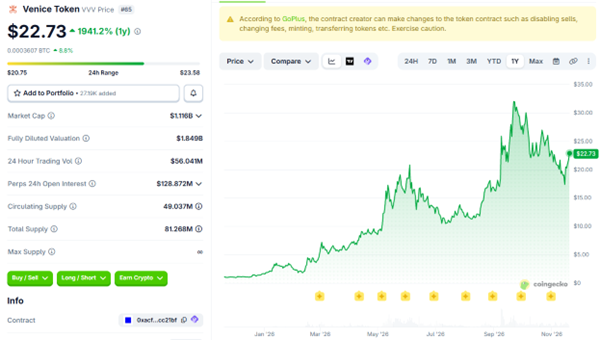
Fourth, the ride is wild. VVV started the year near $1.64. It now trades near $22.59, nearly 14 times higher. But it is down about 35% from its September peak of $34.53.
All VVV is worth about $1.1 billion.
The Burn Line
You do not need to love AI or crypto to track this one. You need one number.
Each month, compare the VVV that Venice burns with the roughly 167,000 new coins it creates. Venice posts its burns in public, and CoinGecko shows the total supply.
If burns climb past that line, every new user starts to shrink the supply. That is when a network effect for the app becomes one for the coin.
If burns stay far below it, Venice can keep growing while holders mostly fund the party.
And buying VVV isn’t the only way to get exposure. There are two other names that ride on the same story.
KR1 owns and stakes VVV on the London market. And for buyers in Europe, the 21Shares fund trades under the ticker VENC, with a 2.5% yearly fee.
Either way, start with the burn line. It will tell you where the profits flow as of now — to the platform, or to the people who hold the native coin.
Best,
Beth Canova