This Crypto Project Makes Millions. So Why Is Its Token Down 85%?

 |
| By Beth Canova |
Every time you book a flight, a mechanism behind the scenes works without you ever noticing …
It’s an aggregator.
You no longer open twelve airline sites and manually compare prices. You open one website that checks them all and hands you a price.
It’s not affiliated with any of the airlines. But it goes get a small cut for finding the best route.
Crypto has its own version of that: a decentralized exchange (DEX) aggregator.
Instead of checking each DEX for the best price and cheapest fees, a DEX aggregator does all that for you. Without you needing to jump through any extra hoops.
And on one major network, a DEX aggregator took nearly the whole market.
It is called Jupiter (JUP). It runs on the fast-growing Solana (SOL) network. And it has made money every year since 2020 without ever raising a dollar from backers.
If you only noticed it’s token price, however, you’d likely think this platform isn’t worth your attention. After all, JUP is down about 85% from its 2024 high.
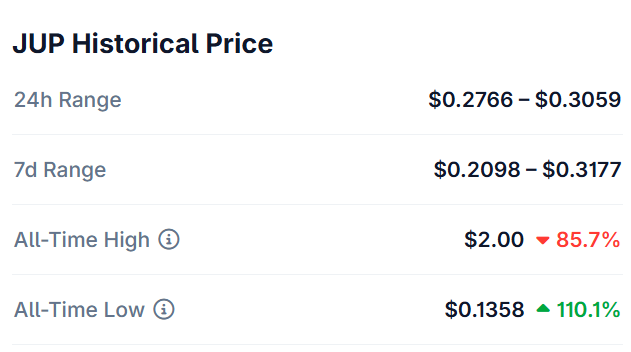
But very little in crypto is that straight forward.
The reason the token is going for a discount isn’t a weakness in the underlying business. It is how the token was set up.
And now, that’s been rebuilt.
Which means you may want to take a second look.
The Business
Solana is fast and cheap, and dozens of trading venues run on it. That splits the pool of buyers. Prices end up all over the place.
Jupiter fixes that disconnect.
You simply say what you want to swap. That’s it.
Then, Jupiter checks every venue, splits your order across the best ones, and shows you one price.
Roughly 95% of trades routed this way on Solana go through Jupiter. More than $1 trillion has passed through it.
But Jupiter isn’t just an exchange. It also offers …
- Lending, with a desk that holds about $1.5 billion.
- Leverage, with a venue for trading with borrowed money.
- A digital dollar, having launched its own stablecoin in January
- Real stocks, via Securitize and Jump Trading Group. Shares are issued and settled on chain under the rules that cover Wall Street,
- And betting markets on real world events.
What It Earns
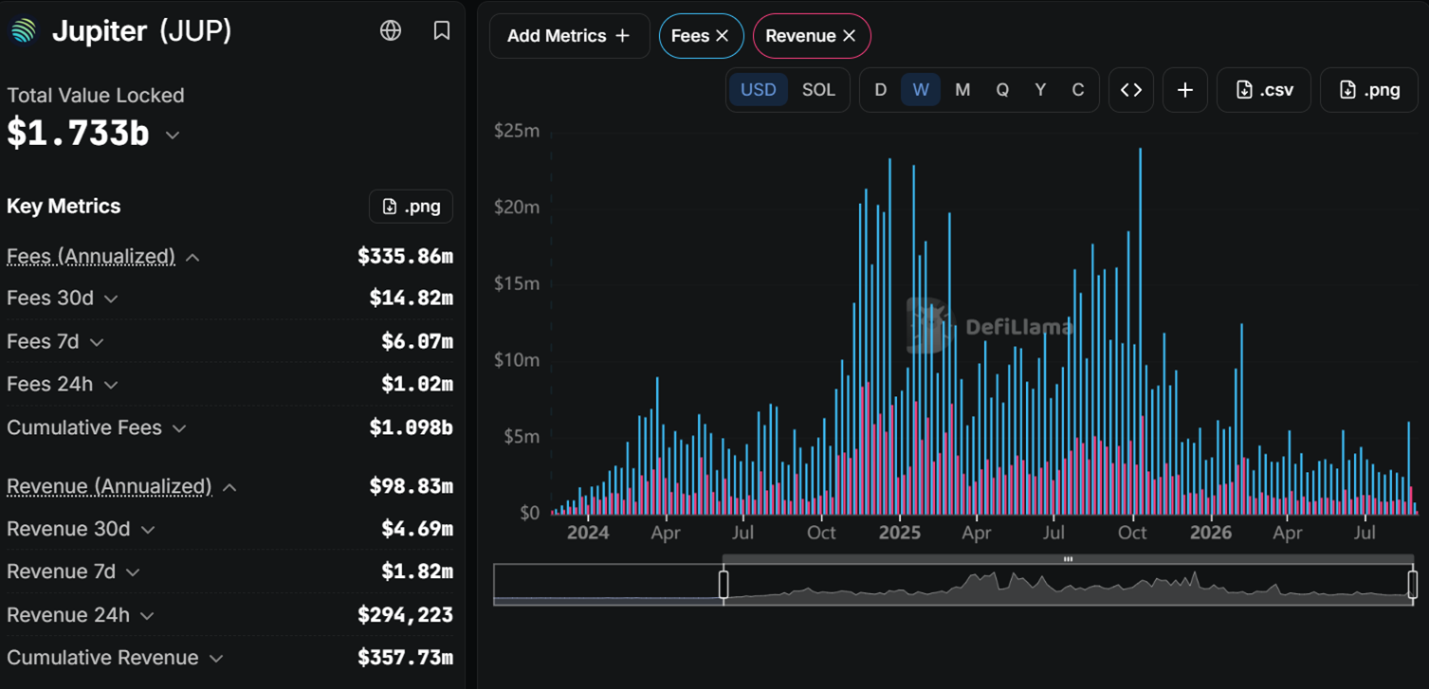
Fees paid by users has increased substantially year over year. Back when Jupiter first launched in 2023, it brought in $7.7 million in fees. By 2025, that number hit $580 million.
Of that, Jupiter kept roughly $181 million in 2025.
That is a real business by any measure. It also swings with the market, and 2026 has been a slow year for trading across all crypto.
That’s why, so far in 2026, Jupiter has pulled in just about $143 million in fees and kept $45 million.2
3 Bullish Catalysts in 2026
Jupiter’s success isn’t happening in a crypto vacuum. It’s already begun to attract notable support from the TradFi crowd, as well.
In fact, there were two major events that happened earlier this year …
- In February, ParaFi Capital put $35 million into JUP at market price,3 with a long lockup. It was the first outside money Jupiter had taken in six years.
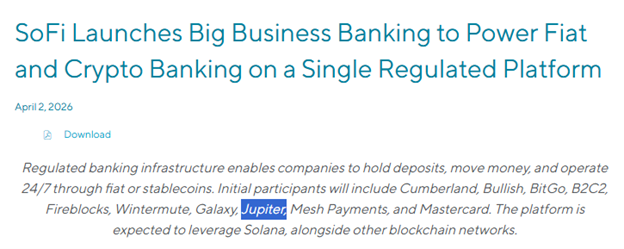
- And in April, SoFi (SOFI) launched a business banking service that handles dollars and crypto in one account. Jupiter was named a launch partner, next to Galaxy (GLXY), Fireblocks, BitGo and Wintermute.
But that’s not all. Bitwise Investments — the crypto index fund manager — holds JUP in its DeFi index fund at a 2.3% weight.5
This is a private fund for rich investors with a $25,000 floor, not something you can buy in a normal account.
And it chose to add JUP to its holdings.
Why the Price Fell
The business was never the problem. The token supply was.
Which makes JUP a perfect example of why due diligence into a project’s tokenomics is vital in any crypto strategy.
When the JUP token initially launched — with a free airdrop to users — in January 2024, its max supply was set at 10 billion coins.
Then, a year later, the team burned about 30% of the supply at the time. That included part of its own stash.
A month after, the team switched its approach from burning to locking additional tokens. Starting in February 2025, half of all Jupiter earnings goes into a fund called the Litterbox. Those funds were then used to buy JUP on the open market and lock it up on the platform for years.
But it wasn’t enough.
For the first two years the platform ran, Jupiter minted new tokens faster than the market could soak them up. And roughly 1.2 billion more tokens were still set to be minted in 2026 alone.
That would have represented a 36% increase in supply in just one year.
No buyback survives that. Money comes in to buy the token while a bigger stream of new tokens pours out.
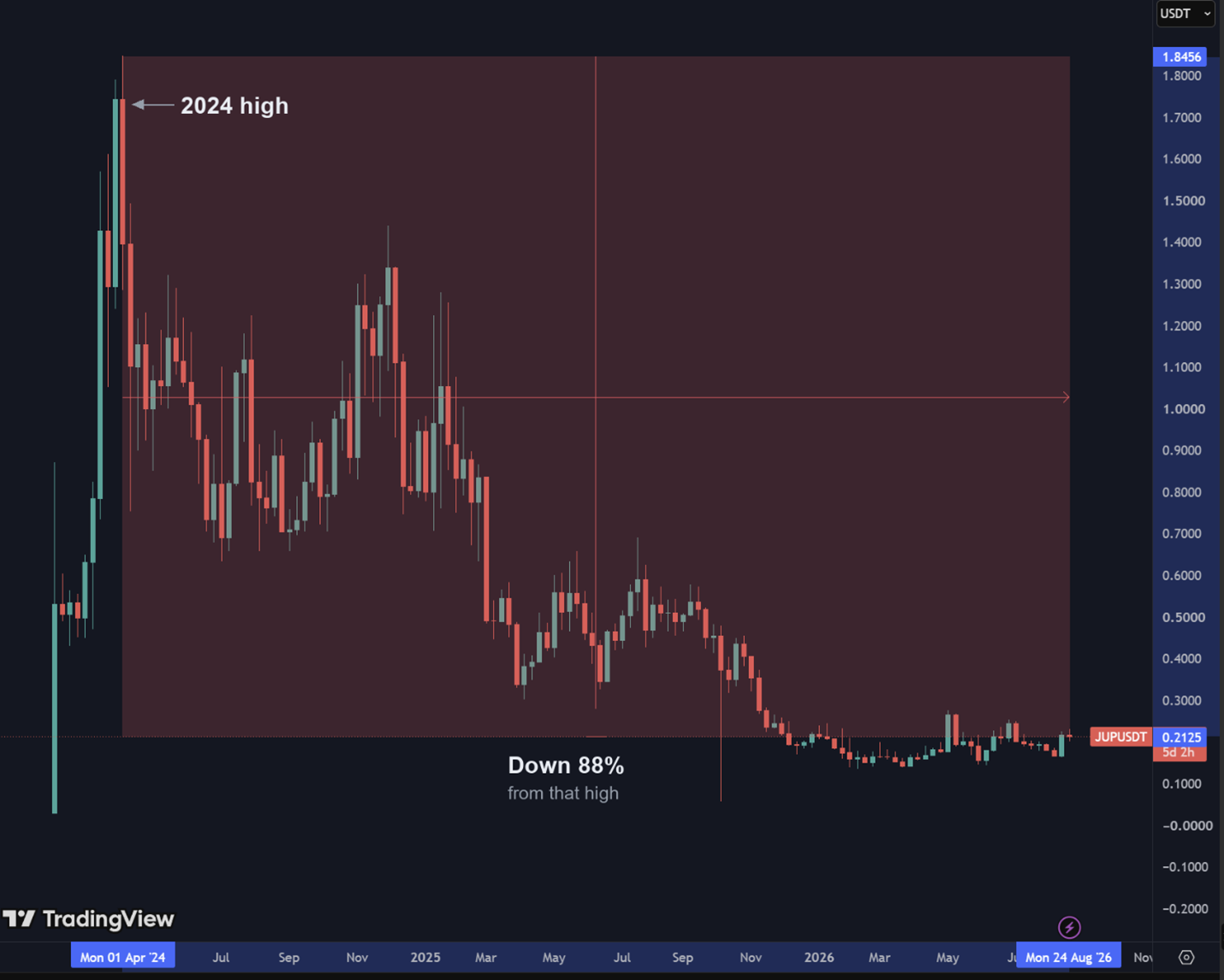
The price began to reflect the inflation, falling even as the broad crypto market was hitting new highs.
That’s why, in late 2025, JUP token holders voted to burn about 130 million JUP the fund had piled up. Then, in early 2026, they voted again to drop 2026 supply creation from 1.2 billion tokens to near zero.6
As of writing, there are 3.3 billion JUP are out in the market. The fund has continued to buy and hold circulating tokens.
What Is Left Running
With new supply near zero, one thing is still running: the buyback program.
Over the past twelve months the fund bought about $49 million of JUP against a token worth roughly $710 million. That is a buyback yield of about 7%.
That’s a significant percentage.
For comparison, the S&P 500 buys back about 2.4% of itself a year. Uniswap (UNI) returns about 1.3%. Aave (AAVE) returns about the same.
And as Juan Villaverde highlighted yesterday, that’s a mechanism investors should look for when searching for their next crypto investment.
Risks Worth Naming
Things are looking up for JUP. And, if its community continues its dogged fight against inflation and votes in a “buyback and burn” mechanism, Jupiter’s revenue should be able to help the coin recover.
That said, it’s not all sunshine moving forward. Investors should be aware of the risks still in JUP’s path. Like …
Trading volume has not yet returned. Fee income runs well below last year, and everything else depends on it.
This is expected to rise again as the last chills of crypto winter fade away. But investors need to wait for confirmation, not act on hope.
Solana is the ceiling. Jupiter’s performance has been impressive. But it is limited to the growth of the Solana network.
Remember, despite its success, Solana still plays second chair to Ethereum’s dominance. Of every dollar locked into aggregators like Jupiter, Ethereum holds about 56 cents. Solana holds six.
Buying is not burning. The fund holds what it buys. Only one vote so far has turned any of it into a permanent burn. And the most successful crypto buyback programs — like Hyperliquid’s (HYPE) — all end in burns.
Where JUP Sits Now
Jupiter is a rare thing in crypto — an undeniably successful project.
As a DEX aggregator, it won its market. It earns real money. And it never needed outside funding.
However, it paired that success with a broken token setup that flooded the market for two years. And JUP’s token paid the price.
Holders have since done the dull work.
They’ve burned 30% of supply, sent half of all income into buying the token back and voted their own new supply down to nothing.
That’s the power of an engaged community.
Now, if trading on the platform returns to the numbers it pulled in 2025, before the crypto winter, income will follow. Buybacks will grow.
And this time, there won’t be any new supply that washes it away.
No link in that chain is a sure thing, and the first one has not happened yet. But for the first time since launch, the only thing standing between this token and its own cash flow is how much people trade.
For anyone tracking it, the number to watch is Jupiter's fee income on DefiLlama.7
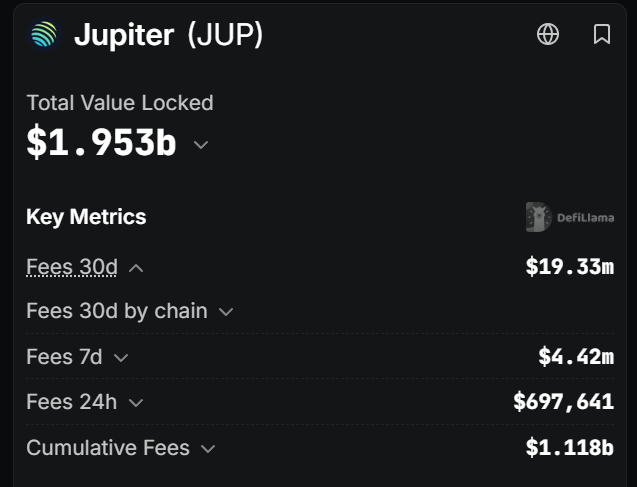
The event to watch is the next holder vote on that growing pile of bought back tokens. For that, you’ll want to keep an eye on Jupiter’s voting portal8 and its social media9 for updates.
And, of course, you can always check in with us here at Weiss Ratings for your breaking crypto news.
Best,
Beth Canova
1https://www.coingecko.com/en/coins/jupiter?chart=type%3Dprice%26mode%3Dline%26timeframe%3Dytd
2https://defillama.com/protocol/jupiter
3https://finance.yahoo.com/news/jupiter-announces-35m-parafi-investment-084502586.html
5https://bitwiseinvestments.com/indexes/rebalance-results/bitwise-crypto-asset-indexes/august-2026