Wall Street Wants Tokenized Stocks. Some Companies Are Saying No

 |
| By Mark Gough |
In your Weiss Crypto Daily updates, we’ve covered how tokenization could change financial markets, from faster settlement to 24/7 trading.
Now, some of the companies whose shares would trade on these new platforms are pushing back.
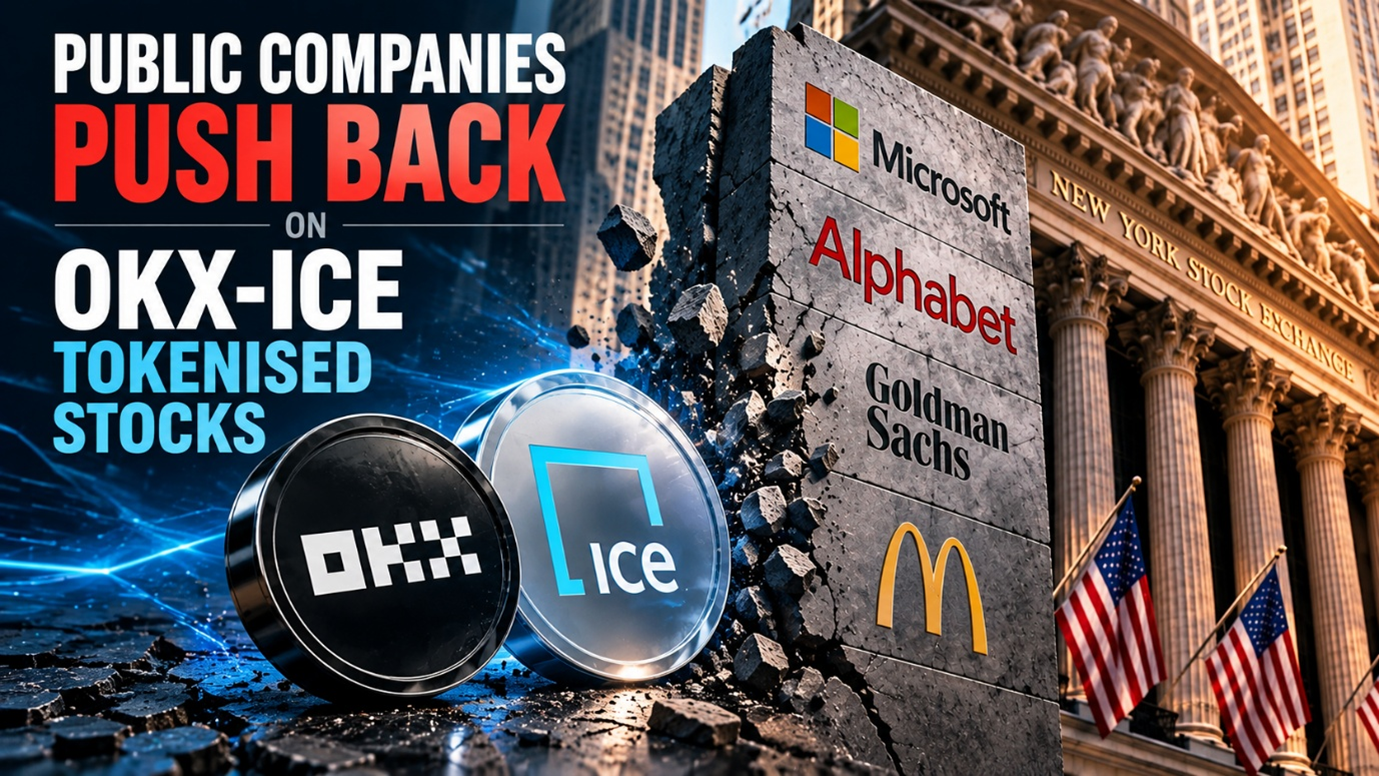
Microsoft (MSFT), Alphabet (GOOGL), Goldman Sachs (GS) and McDonald’s (MCD) are among 16 companies that have objected to having tokenized versions of their shares traded on OKXICE — the proposed blockchain trading venue involving crypto exchange OKX and Intercontinental Exchange (ICE), which owns the New York Stock Exchange.
The latest objections were disclosed on just two days ago. They join an existing list that already included Broadcom (AVGO), Verizon (VZ) and UnitedHealth (UNH).
Their resistance raises a question that hasn’t received as much attention as the technology itself …
What do public companies and their shareholders actually gain by trading their shares on another platform?
I remain positive about the long-term opportunity for tokenization. And that’s come through in my updates here.
But convincing investors to use the technology is only part of the challenge.
Companies also need confidence that these new trading arrangements will benefit their shareholders.
The SEC Opens the Door to Tokenized Trading
On Sept. 17, the Securities and Exchange Commission introduced a five-year conditional exemption to let qualifying venues to add tokenized U.S. stock trading to their offerings.
Under the framework, approved participants can trade through blockchain-based liquidity pools, where software executes transactions against assets supplied by liquidity providers.
For anyone familiar with decentralized finance (DeFi), the concept is similar to how decentralized exchanges operate today.
However, we’re dealing with regulated securities. And ownership rights, dividend payments, and corporate governance requirements must still be respected.
Which is why the SEC has given companies an opportunity to object when an unaffiliated third party wants to tokenize their shares.
A venue must notify the company and allow 30 calendar days to respond. A timely objection prevents that venue from proceeding with the proposed listing under the exemption.
The number of disclosed objections to OKXICE has jumped from nine to 16 in a matter of days.
Let me be clear, though: This doesn’t necessarily mean these companies oppose blockchain technology as a whole.
Their concerns may relate to how their shares would trade on a particular platform, OKXICE. Not the idea of tokenization itself.
Why Companies Are Pushing Back
Nasdaq is an interesting example of this nuance.
Despite pursuing its own tokenization initiatives, Nasdaq has opted not to have its shares tokenized under the SEC’s current experimental framework.
Why? Because of concerns surrounding the new trading arrangements, like …
- transparency,
- price discovery,
- and the possibility of fragmenting trading activity across multiple venues.
Applied Optoelectronics has also questioned the benefits of tokenization and its potential effects on share prices and volatility.
These concerns become easier to understand when we consider how prices might behave outside normal market hours.
The way TradFi trading works is that shares stop moving when the market closes. At 4 p.m. on Friday, Wall Street suits close their computers, pack up their desks, and head home.
Now, imagine a company whose shares finish trading at $100 on Friday.
But because there are also tokenized shares that trade on the blockchain, the price can still move. And on Sunday, a handful of transactions on a tokenized platform do exactly that and push the price to $112.
Has something fundamentally changed about the business?
Possibly. The company might have announced positive news over the weekend.
But it’s equally possible that a relatively small number of buyers moved the price because not enough sellers were willing to trade.
Investors could interpret that 12% increase as a meaningful change in the company’s valuation … only to see the price fall when traditional markets reopen.
Traders usually help narrow pricing differences by buying an asset where it’s cheaper and selling it where it’s more expensive. But this depends on access to both markets and the ability to transfer or redeem the underlying assets.
If those connections are restricted, pricing differences can persist.
How Tokenized Stocks Really Work
Another issue to understand before buying tokenized stocks … is what exactly you own.
Not every product offers the same ownership rights.
Some tokenized products track the price of an underlying share without giving investors direct shareholder rights.
Others are structured to preserve the economic and legal rights associated with owning the stock, including dividends and voting entitlements.
My colleague Marija Matić broke down the differences in detail here.
Here’s why that matters: The SEC’s exemption requires qualifying tokenized shares to provide the same rights and privileges as their traditional equivalents.
Which means issuing the token is only one part of the process.
Products offering only synthetic price exposure don’t qualify simply because they only reference a publicly traded company.
Stock splits, mergers, dividend payments, and shareholder votes must be handled correctly. Investors also need to understand how custody and redemption work, and who is responsible when something goes wrong.
The SEC has introduced safeguards, including restrictions on trading volumes and eligible stocks, operational disclosure requirements, and rules requiring trading to stop when the underlying stock is halted on its primary exchange.
For its part, OKXICE’s proposed platform would use tokens backed one-for-one by shares held through a registered broker-dealer. And its structure is designed to pass through dividends, voting rights, and other shareholder entitlements.
Investors need to complete identity checks and use approved wallets. Trading would take place through Uniswap V4 liquidity pools on X Layer, with stock tokens paired against supported stablecoins.
The Bigger Opportunity for Crypto Investors
I don’t see these objections as a reason to become negative about tokenization. Rather, it’s the typical caution you’d expect to see from established institutions adopting new technology.
So don’t treat fearful headlines as a sign this trend is going away.
It’s not.
In fact, I believe tokenization will give us more than just the chance to trade stocks outside normal market hours.
For example, it could open the door to the use of tokenized shares as collateral in decentralized lending markets.
Consider an investor holding $100,000 worth of shares who wants access to $20,000 without selling part of their portfolio.
In a suitable lending arrangement, that investor could potentially pledge tokenized shares as collateral and borrow stablecoins against them. They would retain economic exposure to their shares while gaining access to funds that could be used elsewhere.
True, traditional brokers already offer securities-backed lending.
But tokenization could make similar services accessible through blockchain-based financial platforms. Potentially with more flexible settlement and integration with other applications.
Of course, borrowing introduces risks.
A sharp decline in the underlying shares could trigger liquidation. While smart-contract failures and lending-platform restrictions create additional considerations.
And not every tokenized share will be eligible for these services. Especially as regulatory frameworks continue to develop.
Bottom Line
Tokenization could eventually let investors move tokenized assets between holding, trading, borrowing, and other financial services.
All without repeatedly selling and repurchasing them.
The companies objecting today may eventually embrace these opportunities. For now, their resistance reminds us that tokenization must deliver practical benefits, not just new technology.
I believe those benefits will emerge as the market develops. Particularly as traditional securities become more closely integrated with blockchain-based financial services.
But for now, this is a good reminder that we are still early to this narrative. Which means you’ll want to size your exposure accordingly.
Best,
Mark Gough