Zcash, Monero and Midnight: 3 Ways to Bet on Crypto Privacy
 |
| By Juan Villaverde Reviewed by: Beth Canova |
I’d be pretty uncomfortable if my bank statement ended up taped to the wall of my local post office.
Just think about it …
Every check you wrote. Every bill you paid. What you gave your church, your doctor, your grandkids.
Anyone can walk in and read it. And it stays up for good.
No one would put up with that from a bank. But that is how most of crypto works.
Bitcoin (BTC, “B+”) keeps a public ledger. Think of it as a shared record book anyone can search. Names are not on it. But once someone ties one payment to you, they can trace the rest of your trail — transaction by transaction — back to day one.
That is why a small corner of crypto has spent years on one job: hiding the details of a payment. These are called privacy coins.
For most of that time, Wall Street wouldn’t touch them with a 10-foot pole.
But crypto isn’t the same market as back then. Now, institutions have come to see the opportunities in crypto technology. And that’s been a boon for privacy coins since the fall of 2025.
Which is why one of its biggest crypto firms bought the front page of the Wall Street Journal to sell one.
But I see investors make a common mistake when researching this sector. Exposure to a privacy coin is not just about one bet.
It is three different answers to the same question: How much of your private finances should the world see?
Related Story: Your Car and Your Chatbot Are Both Keeping a Diary
And the answer a coin picks decides how much trouble it gets from the rules.
Three Ways to Hide a Payment
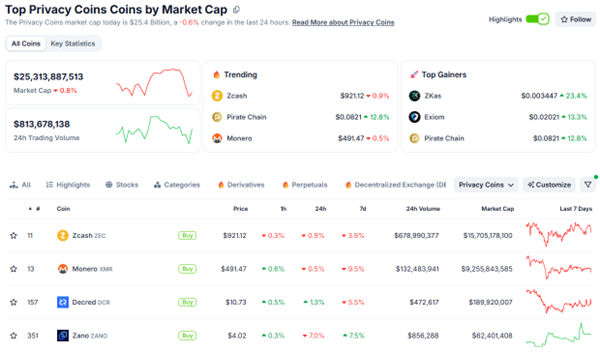
Privacy coins are a small slice of crypto. CoinGecko counts them at about $25.4 billion in all. Two names make up about 98% of that.
Here is how the three main approaches work.
1. Monero (XMR, “C+”): Every Payment in a Sealed Envelope
Monero hides everything, every time.
Its own site puts it plainly. "The sender, receiver, and amount of every single transaction are hidden."
Think of a mail system where every letter goes in a plain sealed envelope, with no return address. You can't opt out.
That is the point. When everyone is hidden, no one stands out.
All Monero is worth about $9.2 billion. It is up about 13% this year, while BTC is down about 28% at the time of writing.
But that all-or-nothing design is also its biggest risk.
Big exchanges can't check where the money came from. So Binance, the largest one, dropped Monero in February 2024. Kraken stopped offering it in Europe that fall. And no U.S. fund holds it.
2. Zcash (ZEC, “C+”): Privacy You Switch On
Where Monero believes “one size fits all,” Zcash gives you a choice.
A payment can be fully public, like on most blockchains. Or you can send it through a "shielded" pool. That is a private lane. It hides who paid, who got paid and how much.
Think of a bank that offers two kinds of accounts. One shows up on a public list. The other is sealed.
You pick which you want for each separate transaction.
That choice is why Wall Street got comfortable first. A fund or an exchange can stick to the public side when it must. While shielding any sensitive transactions permitted by the regulators.
And people do use the private lane. About 30% of all ZEC sat in shielded pools by this spring, up from 8% in early 2024.
All Zcash is worth about $15.6 billion — the 11th largest crypto. It is up about 80% this year. But it is down about 18% in the past month, falling with the broad market.
That said, the criticisms of the set up aren’t without merit. The private lane can be misused. And it has been.
In September, an attacker hit the Bitget exchange for $387.5 million. The company's CEO and the research firm Elliptic said the signs point to North Korea. Investigators then saw about $3.8 million of stolen ZEC go into the shielded pool, where they could no longer follow it.
3. Midnight (NIGHT, “D”): Show Only What You Must
Midnight is the newest of the three.
It comes from Input Output, the team that built Cardano (ADA, “B-”). And its pitch is privacy that can still answer to a regulator. Midnight says it lets you "disclose only what's necessary, when it is necessary."
Records can be shown to an auditor with the right access.
Imagine you need to secure a loan, but don’t want ALL your information public. With Midnight, you could prove the number clears the bar to the loan officer … without handing over your tax returns.
The NIGHT token itself is public. Holding it creates a second, private resource that pays for each hidden transaction.
And use is starting to show up.
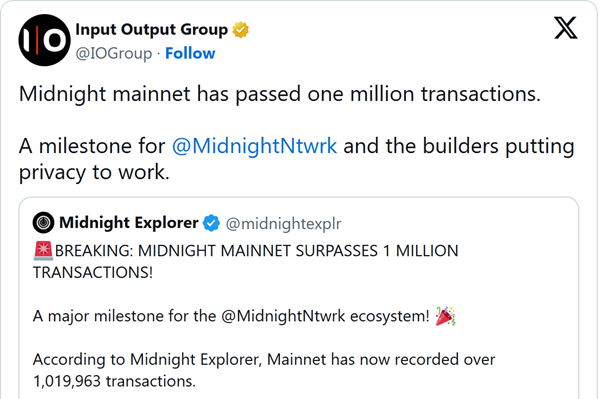
On Oct. 27, the network passed 1 million total transactions. Daily activity jumped from 128 in late September to more than 47,000 a month later. But the network doesn't say how many real users are behind that.
All NIGHT is worth only about $741 million. It is down about 50% this year. Early holders also get their tokens in pieces over 450 days, so new supply keeps coming.
Why This Is in the News Now
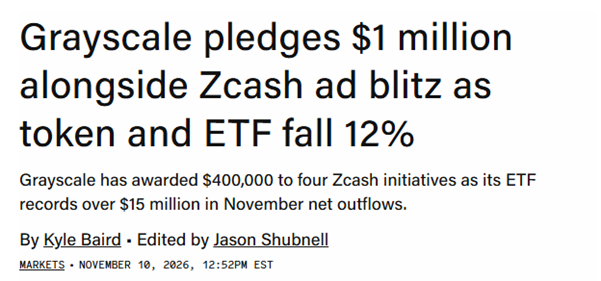
On Nov. 10, Grayscale wrapped the front page of the Journal in zebra stripes — an ode to the mascot of the leading privacy coin, ZEC.
Inside was a full-page ad for its Zcash fund.
Grayscale also pledged $1 million to groups that build Zcash. And it says it will put all the fees from its fund back into the network for up to a year.
That fund, the Grayscale Zcash Trust ETF (ZCSH, “D-”), began trading on NYSE Arca on Aug. 25. It was the first fund to hold Zcash directly. And you can buy it in a normal brokerage account, like a stock.
Grayscale's argument for the partnership is simple: "Financial privacy is becoming essential as more economic activity moves onchain and AI makes it easier to analyze," its head of index, Steve Vanourny, said.
The market, however, didn’t cheer.
Investors pulled more than $50 million from the fund in the first half of November, after $46 million left in October. ZEC fell about 13% on the day of the ad.
But with the broad risk-off sentiment and correction across the crypto market, the question of whether this response was directly because of the fund and underlying asset, or just a symptom of the risk-off environment needs to be considered.
The Rules Are Moving Too
Here is the part every privacy coin owner needs to know.
Owning these coins is legal in the U.S. and Europe. But the firms that sell them are under more pressure each year.
Related Story: AI, War Reenergize Crypto’s Privacy Narrative
The most important date going forward will be July 10, 2027. That's when a new EU anti-money laundering law kicks in. It bars banks and crypto firms from offering accounts that hide payments.
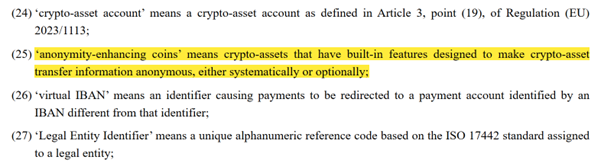
That ban covers hiding them "through anonymity-enhancing coins."
The law covers both coins that hide data all the time and coins that do it as an option. So, both Monero and Zcash.
It does not bar people from holding their own coins.
The U.S. has gone the other way so far.
In January, the Zcash Foundation said the SEC had closed its probe with no action. Seven months later, a Zcash fund was trading on NYSE Arca.
Put those together, and you get a clear pattern: The more a coin hides by default, the fewer places will sell it or support its utility.
Who Gets to See What
You don't need to pick a winner to use any of this.
Before you look at any privacy coin, ask two things.
- Who can see what?
- And who can still sell it to you a year from now?
Those two answers tell you more about the risk of holding and using privacy coins than any price chart.
Then, watch a few numbers.
The flows in and out of ZCSH show whether the Journal ads bring in new money. Exchange listings will show whether Monero keeps its doors open. And Midnight's daily count of transactions shows whether its early burst turns into real use.
Monero is a bet that people will pay for full privacy, no matter where it trades. Zcash is a bet that privacy wins as an option inside Wall Street's walls. Midnight is a bet that privacy wins by working with the rules from day one.
Each one can fall by half in a bad stretch.
And if you want a piece of this narrative as a whole, size it like a long shot and get a little exposure in each bet.
Best,
Juan Villaverde