Nvidia Beat the S&P 500 All 3 Times Yields Jumped. Bond Volatility Is Up 38%.

 |
| By Al Qureiyeh |
If the past month has felt like a market that can't make up its mind, you’re not imagining it.
But you may be looking at the wrong screen.
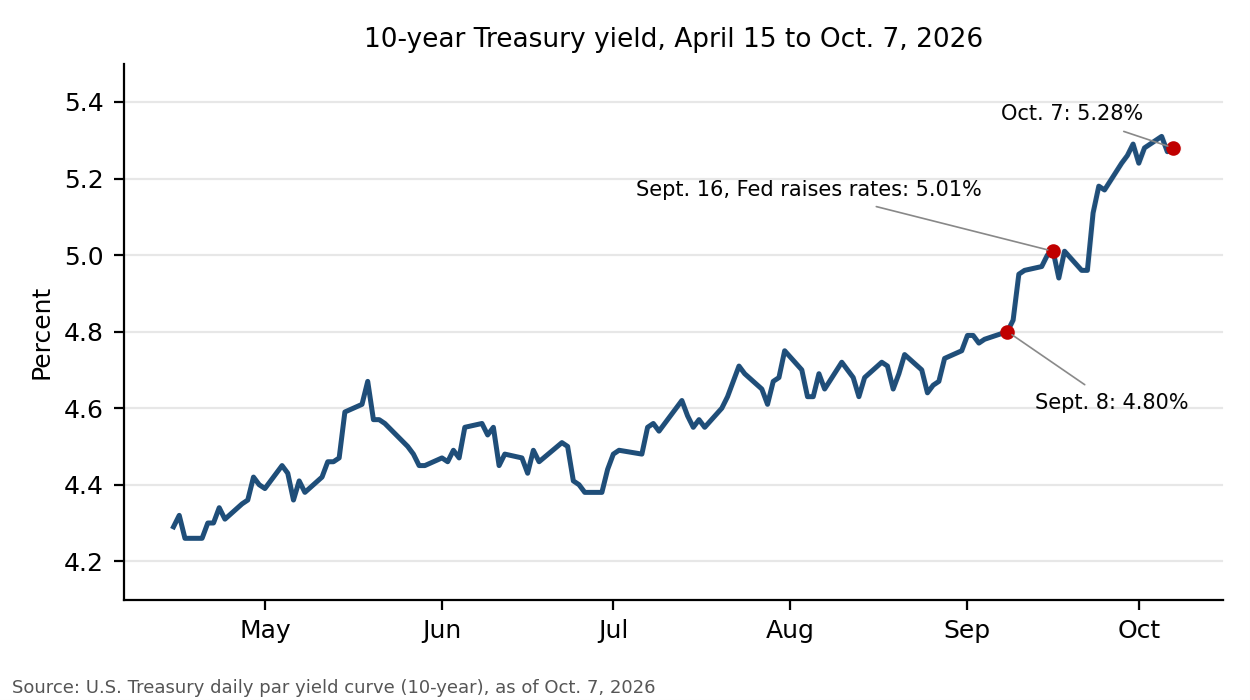
The 10-year Treasury yield now sits near a 24-year high, around five and a quarter percent. It went above 5.3% during Wednesday’s session.
Why does that matter? Because investors tend to rotate out of riskier stocks, and into bonds, when the promise of yield looks more appealing than potential stock returns.
So if you own the average stock, a bond fund or an energy name, your month looked nothing like the benchmark stock index.
While the S&P 500 gained more than 1%, the average stock in it lost about 3%.
The question is where the volatility lives, and what a disciplined process says to own while it does.
What Happened
The Federal Reserve raised interest rates on Sept. 16, and the meeting minutes released Wednesday suggest most officials expect another increase by year-end.
Bond traders shrugged off the minutes. The 10-year ended Wednesday slightly higher. Those dipped only at a well-received 1 p.m. auction.
This month, the 10-year Treasury yield rose about half a percentage point.
The Fed’s minutes say part of that is a higher term premium, the extra yield investors demand for lending money for a long time.
But inflation expectations, as priced in inflation-protected Treasurys, didn’t rise.
The MOVE index is the bond market’s version of the VIX.
It measures how big a swing in Treasury prices options traders expect.
And it’s gone up 38% in a month.
The S&P 500, by contrast, has had no down day of even 1% since the Fed meeting. Meanwhile, oil swung almost every other day.
Why the Nervous Crowd Is Half Right
The American Association of Individual Investors survey for the week ending Oct. 7 is split evenly between bulls and bears.
First, yields.
With the 10-year above 5%, the S&P 500 now yields about the same in earnings as a Treasury pays in interest. The equal-weight version of the index, which tracks the average stock, was heading into a seventh straight losing week at the end of September.
Second, concentration.
Only about a quarter of S&P 500 stocks are above their 50-day average price, a common test of a rising stock. And technology is the only sector up this month.
A few large companies — Nvidia (NVDA), Microsoft (MSFT) and Apple (AAPL) — are holding up the index.
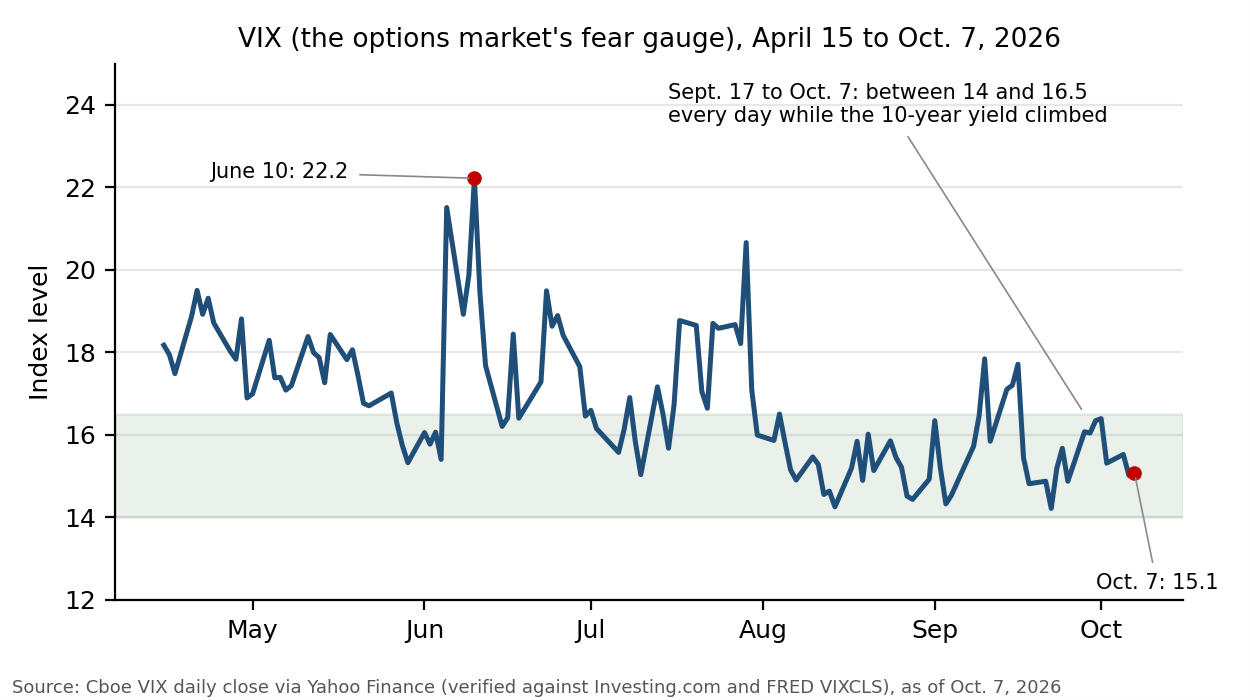
VIX (Cboe Volatility Index), the options market's fear gauge, April 15 to Oct. 7, 2026. Source: Cboe via Yahoo! Finance.
What Weiss Is Saying
The ratings draw the line here.
The index funds — the S&P 500 SPDR (SPY), the Invesco S&P 500 Equal Weight ETF (RSP) and the Invesco QQQ Trust (QQQ) — are all rated "C+," a HOLD.
The small-cap iShares Russell 2000 ETF (IWM) is "C," a HOLD.
The companies holding up the index rate higher than it:
- Nvidia "B+," a BUY;
- Apple and Alphabet (GOOGL) "B," a BUY;
- Microsoft "B-," a BUY.
That gap is the opportunity, and finding it is what a rating is for.
My Scorecard
In Wednesday's issue I recommended Eaton (ETN) and GE Vernova (GEV); both fell about 3% that day while the index barely moved.
We hate a loss, but a rate headline changes neither their orders nor their BUY ratings.
Related story: Google's $4.3B Nuclear Deal Proves AI's Power Hunger. Here's Who Gets Paid First.
What the ‘Safe’ Trade Gets Wrong
Instinct says to hide in quality and defensive names when yields jump. I tested it: Three times since early 2025, the 10-year has jumped at least 0.4 percentage point within a month.
Every time, the iShares MSCI USA Quality Factor ETF (QUAL), "C+," a HOLD, trailed the S&P 500.
So did the equal-weight fund.
And Coca-Cola (KO) and Visa (V) trailed in most of them.
The last time yields hit 5% was October 2023. By then, Coca-Cola was down 16% for the year, while the S&P 500 was comfortably up.
Safe is a feeling, not a result.
What held up every time were Nvidia and the technology sector fund.
They were the fastest growers in my test … both rated BUY … and their earnings come from chip orders, not borrowing costs.
Why Patience Paid, All Three Times
In each of those spikes, the index was down or flat when the spike ended. Within a quarter, it was 9% to 17% higher.
Small-cap stocks, which take the most heat from rising yields, fell harder and bounced hardest.
Anyone who sold at the end of a spike paid for it within months.
That is why the 10-year easing off its recent highs does not worry me.
After all, the leaders fell and the "safe" names rose for a day. Neither their ratings nor that record moved.
That is the case for a rigid process in a market like this.
A Weiss rating is recomputed from a company's books, not the day's headline.
Patience is letting the books decide when you sell.
And nimble investors who want a good opportunity need look no further than one of the names we just discussed.
This ‘Buy’-Rated Stock Is Backed by Weiss’ Rigid Rating and Process
Nvidia sells the chips every AI data center is built around.
Weiss rates it "B+," a BUY, with Growth, Efficiency and Solvency all earning “Excellent” marks.
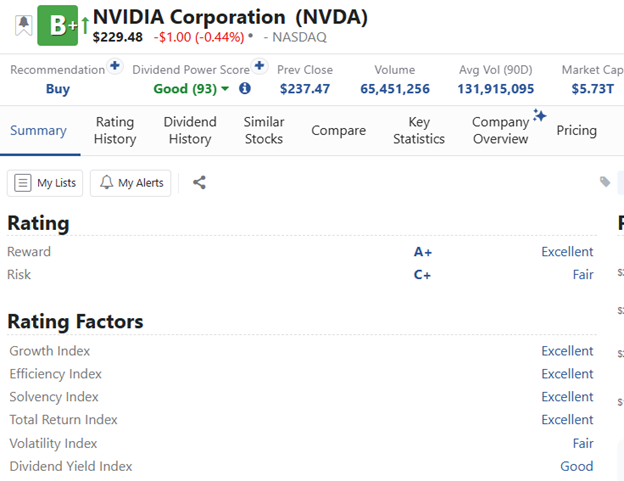
Plus, it beat the S&P 500 Index in every spike.
Thursday's close of $230 is about $98 below the average Wall Street analyst target as of Wednesday. That target, around $329, is a potential gain of about 43% from current levels.
The dividend is a token 25 cents a share per quarter. So it’s the earnings growth, not the payout, pays you to wait.
Give it a year. If you buy today, the first check should arrive around Nov. 18.
What could work against it is a headline that AI customers are spending less than expected, which knocked it down Thursday, and it sits near the top of its yearly range.
Neither changes the orders in hand. And it’s got more where those came from. A lot more.
The Sector Fund That Beat the Index Every Time
Another way to own Nvidia is to buy the Technology SPDR (XLK) at the next close; it closed Thursday at $198.
Weiss rates it "B-," a BUY, and it beat the S&P 500 in every spike.
The risk is the same AI-spending headline. But with the XLK, that risk is spread over more names.
The Takeaway
This week, the 10-year eased off its highest level since 2002. Meanwhile volatility in bonds, oil and the average stock ticked higher.
What it means:
- Fleeing to "safe" stocks has not worked when yields jumped.
- Selling at the end of a spike has cost a double-digit gain every time.
- And owning Weiss “Buy”-rated growers, like Nvidia and the technology fund, worked … and should continue to work.
Discipline and patience are the edge.
NVDA and XLK fall together if AI spending plans are cut; that is the risk you take.
That said, Nvidia is the kind of idea my AI-powered stock-picking process surfaces. My AI Profit Accelerator portfolio holds the ones that pass its stricter, fundamentals-first test.
What you can do today: Buy Nvidia at the next close; the stock closed Thursday at $230. Buy the Technology SPDR at the next close; it closed Thursday at $198.
What We're Watching
First, the VIX, which measures how big a swing in the S&P 500 options traders expect. Above 20, the index is moving too; expect the picks to move with it for a few days, and don't sell for that.
Second, Nov. 18. If Nvidia's data-center revenue misses, I would sell, and I will say so.
Third, small-caps. They take the heat now and bounce hardest later; the Russell 2000 fund, "C," a HOLD, goes to the top of my list the day the 10-year turns down for good.
Take care,
AL Qureiyeh