Since the S&P 500's Record, the Average Stock Is Up and the Index Is Down. Bristol-Myers Beat the Market in All Five AI Sell-Offs.

 |
| By Al Qureiyeh |
If the artificial intelligence (AI) stocks in your account have been swinging while the rest of the market quietly climbed, you're seeing something real.
The S&P 500, which tracks 500 of the largest U.S. companies weighted by size, set its record on Oct. 6.
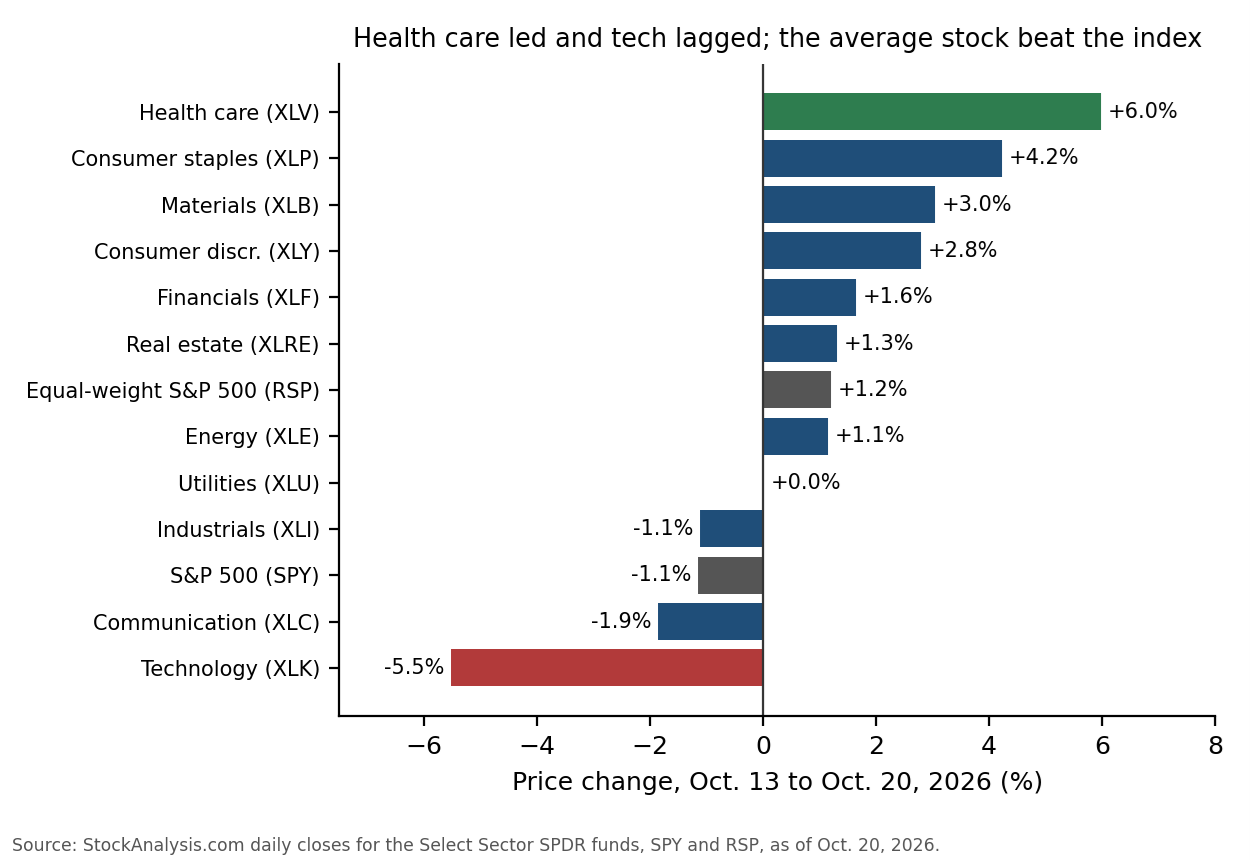
Since then, the Invesco S&P 500 Equal Weight ETF (RSP), which gives every company the same weight, rose about 1.7% through Tuesday. The SPDR S&P 500 ETF Trust (SPY), which tilts toward the biggest companies, fell about 1.3%.
The gap was widest in health care and technology. In the week through Tuesday, the Health Care Select Sector SPDR Fund (XLV) rose about 6%, while the Technology Select Sector SPDR Fund (XLK) fell more than 5%.
Money is moving from the biggest AI companies, such as Microsoft (MSFT), Alphabet (GOOGL) and Amazon (AMZN), to the rest of the market. I'd own a cheap, steady company that has beaten the market when AI stocks fall.
What Happened
Investors worried about AI stocks moved money into health care and consumer companies such as Eli Lilly (LLY) and UnitedHealth (UNH), Reuters reported on Oct. 15. Health care was the best sector that day.
Earnings helped a little. UnitedHealth and Johnson & Johnson (JNJ) both raised their full-year outlooks on Oct. 13. But health care fell that day and jumped on the days tech fell, which tells me the moving money mattered more than the earnings news.
On my scorecard, since I suggested Berkshire Hathaway (BRK.B) on Tuesday and Johnson & Johnson last week, you're ahead of the S&P 500 on both, measured from the close before each report. If you avoided CoreWeave (CRWV), you sidestepped a fall of more than a fifth.
We're behind on Monday's switch out of the Direxion Daily Semiconductor Bull 3X Shares, the fund built to move three times as much as chip stocks each day. It kept rising faster than the VanEck Semiconductor ETF, the risk I named.
Why the Tech Bulls Are Half Right
Investors are split on AI stocks. Some worry the spending won't pay off, while others expect tech to bounce back.
The tech bulls have a point.
First, the gap between tech and everything else has grown so wide that a strategist at Exness says it could pull some money back to tech.
Second, health care has already run: the health care fund reached a record high on Tuesday.
Where I part ways is the idea that the move is over. The biggest companies still carry much of the index, so whenever they fall, the steadier companies have a reason to hold up.
Weiss Rates the Funds HOLDs and Several Drug Makers BUYs
Weiss rates both the health care fund and the equal-weight fund "C+," HOLDs. Lilly makes up the biggest share of the health care fund.
Several drug makers rate higher. Johnson & Johnson and Amgen (AMGN) are "B+," AbbVie (ABBV) and Lilly are "B," and Bristol-Myers Squibb (BMY) is "B-," all BUYs. UnitedHealth and Merck (MRK) are "C," HOLDs.
The Oct. 19 Weiss Ratings Daily piece "The Danger You Face as AI Outpaces Consumer Spending" noted that seven big technology companies make up about a third of the S&P 500. I agree, and that's how the average stock can rise while the index slips.
The Oct. 18 piece "5 AI Stocks to Avoid" named five SELL-rated AI cloud companies, including CoreWeave. I agree: the weakest AI names are where the selling started.
Bristol-Myers Has Beaten the Market When AI Stocks Fell
When money leaves AI stocks, it doesn't vanish. Lately, much of it has gone to companies whose profits don't depend on the AI build-out, such as drug makers.
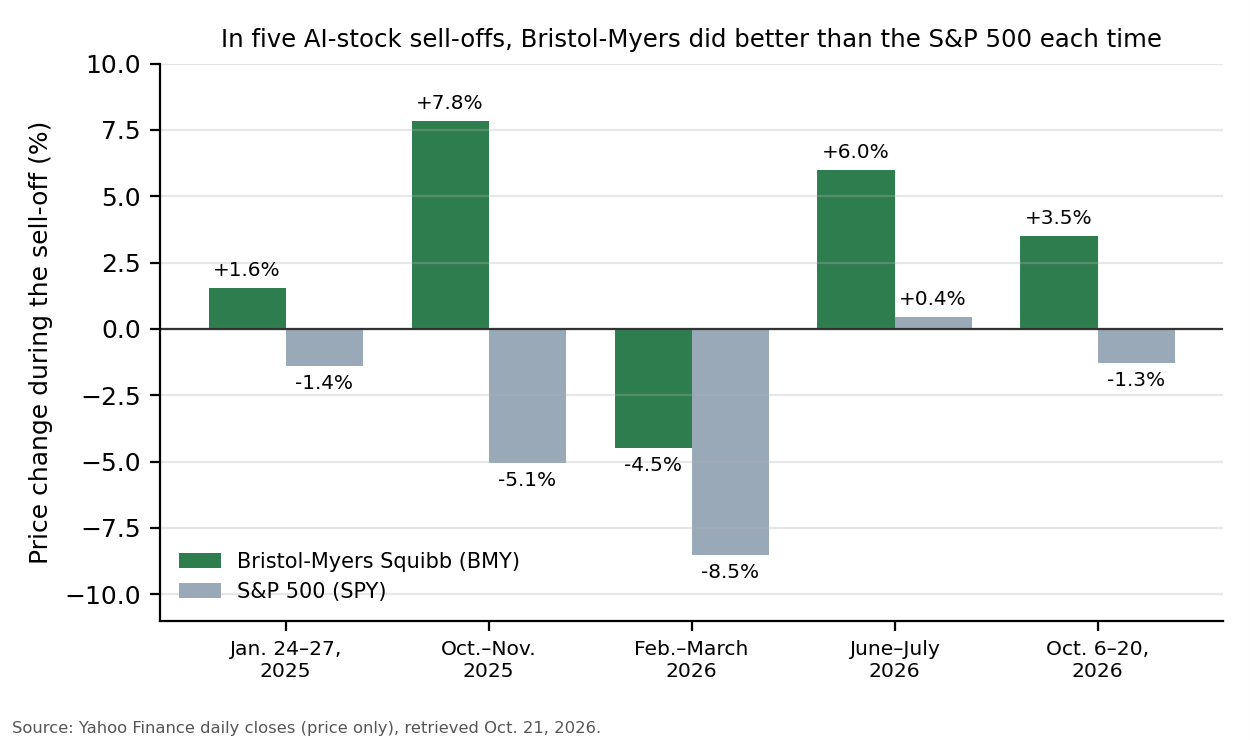
Bristol-Myers is one of the clearest examples. In each of the last five times AI stocks sold off, starting in January 2025, it did better than the S&P 500.
This "B-" BUY Costs About Half What the Market Does
Buy Bristol-Myers Squibb (BMY) at the next close; the stock closed Tuesday at $62.
Bristol-Myers sells medicines for blood clots, cancer and mental health. Demand for them doesn't rise or fall with AI spending.
Weiss rates it "B-," a BUY, with Reward rated "A-," Excellent. Its Risk grade is "C," Fair, and I take that seriously, for the reasons below.
The stock costs about 9 to 10 times next year's expected earnings. You pay less for each dollar of its profit than for the average big company.
Tuesday's close was about $3 to $4 below the average Wall Street target at MarketBeat and StockAnalysis, as of Oct. 17 to Oct. 19. That's a potential gain of about 5% to 6%.
Bristol-Myers pays you to wait: $0.63 a share each quarter, a yield of about 4%. Give it a year, with the first check at its Oct. 29 report.
What could work against it: its main drug, Eliquis, faces a lower Medicare price this year and generic copies later, and analysts have been cutting their targets. If money rushes back into tech, it would likely lag, as it did after most past sell-offs.
Bristol-Myers is the kind of idea my process surfaces. If you want ideas tested against a stricter, fundamentals-first screen and tracked for you, that's what my AI Profit Accelerator does.
The Takeaway
What happened: Since the S&P 500's record, the average stock has risen while the index fell, and health care led.
What it means: When money leaves AI stocks, steady, cheap companies like Bristol-Myers have beaten the market.
What to do today: Buy Bristol-Myers Squibb (BMY) at the next close; the stock closed Tuesday at $62.
If money rushes back into tech, Bristol-Myers would likely lag; that is the risk we take.
What We're Watching
First, tonight's reports from Meta (META) and Lam Research (LRCX). Strong AI spending could pull money back into tech; that's when Bristol-Myers would lag.
Second, Bristol-Myers' Oct. 29 report. If it cuts its 2026 profit outlook, I would sell, and I will say so.
Third, AbbVie, "B," a BUY. Of the drug makers I checked, it beat the S&P 500 most often when AI stocks fell, but it closed above the average Wall Street target. I'll revisit it if it falls below that target, about $280.
Take care,
AL Qureiyeh