The Clock Is Ticking on Social Security’s 2032 Shortfall

 |
| By Sean Brodrick |
Social Security will be insolvent by mid-2032, triggering a 26% benefit cut, which will rise to 40% by the end of the century, according to the latest projections from the Congressional Budget Office (CBO).
And though the deadline is six years away, the time to prepare is now.
Even if you’re not counting on Social Security money, you probably have friends who are.
First, what is this crisis?
The Congressional Budget Office’s September 2026 projections say the Social Security trust fund is on track to exhaust its reserves by mid-2032.
Under current law, Social Security cannot borrow funds or pay out more than it brings in via tax revenue.
Related story: What the ‘Blue Collar Social Security Fairness Act’ Actually Does
When reserves reach zero, benefit checks would automatically drop to match ongoing payroll tax receipts, resulting in an immediate cut ranging from 22% to 26%.
The CBO’s projected cuts are deeper than the 22% benefit reduction forecast by the Social Security Trustees in June.
The cuts will be automatic unless Congress acts first to strengthen the system.
Congress Could Fix This But Won’t
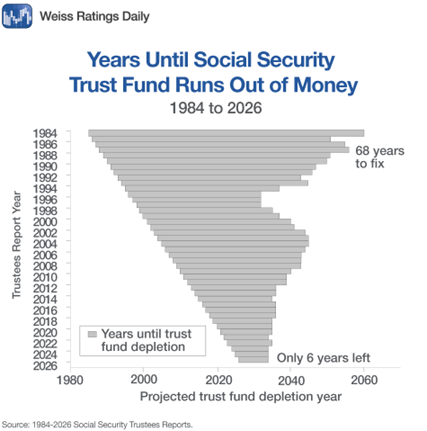
As you can see from the chart, Congress has had decades to fix this.
They haven’t. The hope that they’ll fix it in the next six years is dim at best.
The frustrating part is that this problem is fixable.
One option is to raise the Social Security taxable maximum. Currently, earnings above $184,500 are exempt from Social Security payroll taxes.
Subjecting more of those earnings to the tax could significantly improve the program’s long-term finances.
Of course, that’s not the only proposal on the table.
Congress could raise taxes elsewhere, reduce benefits, change the retirement age or combine several different approaches.
The problem isn’t a lack of options. It’s a lack of action.
And after decades of delay, I wouldn’t bet my retirement on Congress suddenly getting its act together.
What Anyone Who Is Depending on Social Security Should Do
1. Stress-Test Your Baseline Retirement Plan
Model retirement income assuming a 20% to 25% "haircut" on projected Social Security benefits starting in 2032.
- Let’s say a household expects $4,000/month ($48,000/year) from combined Social Security benefits. A 25% cut leaves $3,000/month, creating a $12,000 annual deficit.
- Using a standard 4% safe withdrawal rule, covering a $12,000/year gap requires an additional $300,000 in invested retirement capital by 2032.
2. Charge Hard into Roth IRAs
Roth IRA investments grow completely tax-free, and qualified withdrawals in retirement are 100% income-tax-free.
So, expanding pre-tax and Roth contributions provides the buffer needed to replace potential lost benefits:
- Roth Conversions: Strategically converting traditional IRA/401(k) balances to Roth up to the top of current federal tax brackets locks in existing rates and shields future income from mandatory distributions and benefit-offset formulas.
- Defusing the Social Security “Tax Torpedo”. Social Security benefits are not automatically tax-free. Because distributions from traditional IRAs and 401(k)s count as ordinary income, pulling an extra $10,000 from a traditional IRA can push an additional $8,500 of Social Security benefits into taxable territory.
This "tax torpedo" causes effective marginal tax rates to spike to 22% to 40% on modest income bands. Putting more of your money in a Roth defuses the tax sting.
3. Re-Evaluate When You Claim Social Security
The 2032 insolvency timeline changes the math for when to claim:
- The Case for Waiting Until Age 70: Delaying benefits from Full Retirement Age (FRA) to age 70 permanently boosts your base benefit by 8% per year (delayed retirement credits). If Congress implements an across-the-board percentage reduction, receiving 75% of an enhanced age-70 check still yields significantly more nominal cash flow than 75% of an age-62 check.
- The Break-Even Risk: On the other hand, if Congress adopts means-testing or freezes high-earner benefits rather than cutting everyone equally, workers who delay past FRA could face that policy risk.
Your choice depends on your work circumstances.
4. Build Independent, Inflation-Protected Cash Flow
To replace reliance on Social Security's automatic CPI-W cost-of-living adjustments:
- Fixed Income & Real Yields: Lock in positive real yields using Treasury Inflation-Protected Securities (TIPS) to insulate near-term living expenses. I recently wrote an explainer column on TIPS.
- Cash-Flow Productive Equities: Focus on sectors with real pricing power and high cash-flow yields. Those include critical infrastructure, energy midstream, pipelines and dividend growers. These companies generate passive distribution income without forcing asset sales during down markets.
- Debt Elimination: Entering 2032 with zero fixed obligations (paying off primary mortgages or high-rate debt) reduces baseline overhead, mitigating the cash-flow crunch of a smaller monthly check.
As I said, this is avoidable.
But someone else is steering the ship, and it sure looks like they’re aiming us for an iceberg.
Prepare ahead of time, and take care of your financial lifeboat, so Congress’ feckless fumbling doesn’t tarnish your golden years.
All the best,
Sean
P.S. Some parts of the market are poised to surge as Western economies race to secure critical resources away from foreign dominance.
Investors can reap extraordinary gains on stocks leveraged to these resources. I recently visited the remote mine where the future is being made. If you want to know more, click here.