The Surprising Profits Hidden Inside Chinese Hacks

 |
| By Michael A. Robinson |
The FBI recently took down a secret hacking network with a frightening list of targets.
We’re talking power companies, hospital systems, government agencies, and even U.S. election systems.
The network had infected thousands of devices around the world.
Hackers then used those devices to hide their activity inside normal internet traffic.
This operation wasn’t run by a group of teenagers in somebody’s basement.
According to U.S. officials, it was linked to a private Chinese company that allegedly sold access to hacked networks and stolen information to Chinese intelligence services.
It’s the latest reminder of a simple fact …
Cyberattacks aren’t going away.
They’re getting bigger, smarter and harder to detect.
Related story: Your Private Info’s Protection Has an Expiration Date
And that’s creating an enormous opportunity for the companies that protect us.
Today, I’ll show you a simple way to invest in this trend — one that’s beaten the broader market by more than 150% since April.
An Invisible War
The details of this latest cyberattack sound like something out of a spy movie.
The FBI recently said U.S. officials disrupted a China-linked hacking operation that had targeted everything from government networks to healthcare systems.

The operation had reportedly been running since 2018.
And its secret weapon was a massive network of hacked devices and cloud infrastructure.
Rather than launching attacks from an obvious location, hackers routed their activity through these devices.
That allowed malicious traffic to blend in with ordinary internet use, making it far harder to detect.
The network targeted devices and organizations in more than 130 countries.
This Is the Same Challenge Companies Face Today
As defenses improve, hackers adapt. And now artificial intelligence is accelerating this arms race.
Hackers can use AI to automate attacks, find vulnerabilities, and create more convincing scams.
Meanwhile, cybersecurity companies are using AI to spot threats faster and automate their response.
That helps explain why worldwide information-security spending is expected to reach $244 billion this year.
Related story: How to Play the Sixfold Increase in Quantum Funding
Even more striking, Gartner expects spending specifically on AI cybersecurity to jump from about $51 billion this year to $86 billion in 2027.
For investors like us, there’s a simple way to capitalize.
Own the Cybersecurity Boom
It’s called the Amplify Cybersecurity ETF (HACK).
Launched in 2014, HACK was the first cybersecurity ETF. It invests in companies that provide cybersecurity hardware, software, and services.
Today, it holds 23 stocks and has nearly $3 billion in assets. And given how quickly cybersecurity is changing, I like this broad approach.
You see, AI could create winners we don’t expect. It could also hurt companies that fail to keep up.
Related story: Developers Are Already Solving Bitcoin’s Quantum Problem
HACK lets us spread our bets across many of the sector’s leaders rather than trying to pick just one.
The fund includes pure-play cybersecurity companies as well as businesses involved in defense infrastructure, networking and semiconductors.
An Impressive Roster
Make no mistake. The are some of the best names in the business. Take a look:
Palo Alto Networks (PANW) — The firm is HACK’s biggest holding, representing about 6.5% of the fund.
It offers security tools for networks, cloud systems and other digital infrastructure.
More importantly, it’s moving aggressively into AI security.
Palo Alto recently acquired Portkey, a company focused on securing AI agents. Management says demand is rising as customers look to protect their own AI deployments.
Cloudflare (NET) — Cloudflare operates a massive global network that helps make websites and applications faster and safer. And business is booming.
Second-quarter revenue jumped 36% to $696 million. Management believes the rise of AI agents is fundamentally changing internet traffic, creating new opportunities for Cloudflare’s network and security products.
The stock now represents roughly 5.4% of HACK.
Qualys (QLYS) — Qualys helps companies find weaknesses in their computer systems before hackers exploit them.
Its cloud-based platform serves more than 10,000 subscription customers, including a majority of the Forbes Global 100 and Fortune 100.
Revenue rose 11% last quarter, and Qualys is expanding into both “AI for security” and tools designed to secure AI itself.
Broadcom (AVGO) — You probably know Broadcom for its semiconductor business. But it’s also a major cybersecurity player.
Its portfolio includes Symantec and Carbon Black, which protect devices, networks, email and sensitive corporate data.
This year, Broadcom introduced Symantec CBX. It combines technology from those two businesses into one cloud security platform aimed at organizations with limited cybersecurity resources.
Fortinet (FTNT) — Fortinet is another heavyweight in cybersecurity and represents about 5.3% of HACK.
Its technology helps businesses protect networks, cloud systems, and devices from attack. And investors have taken notice.
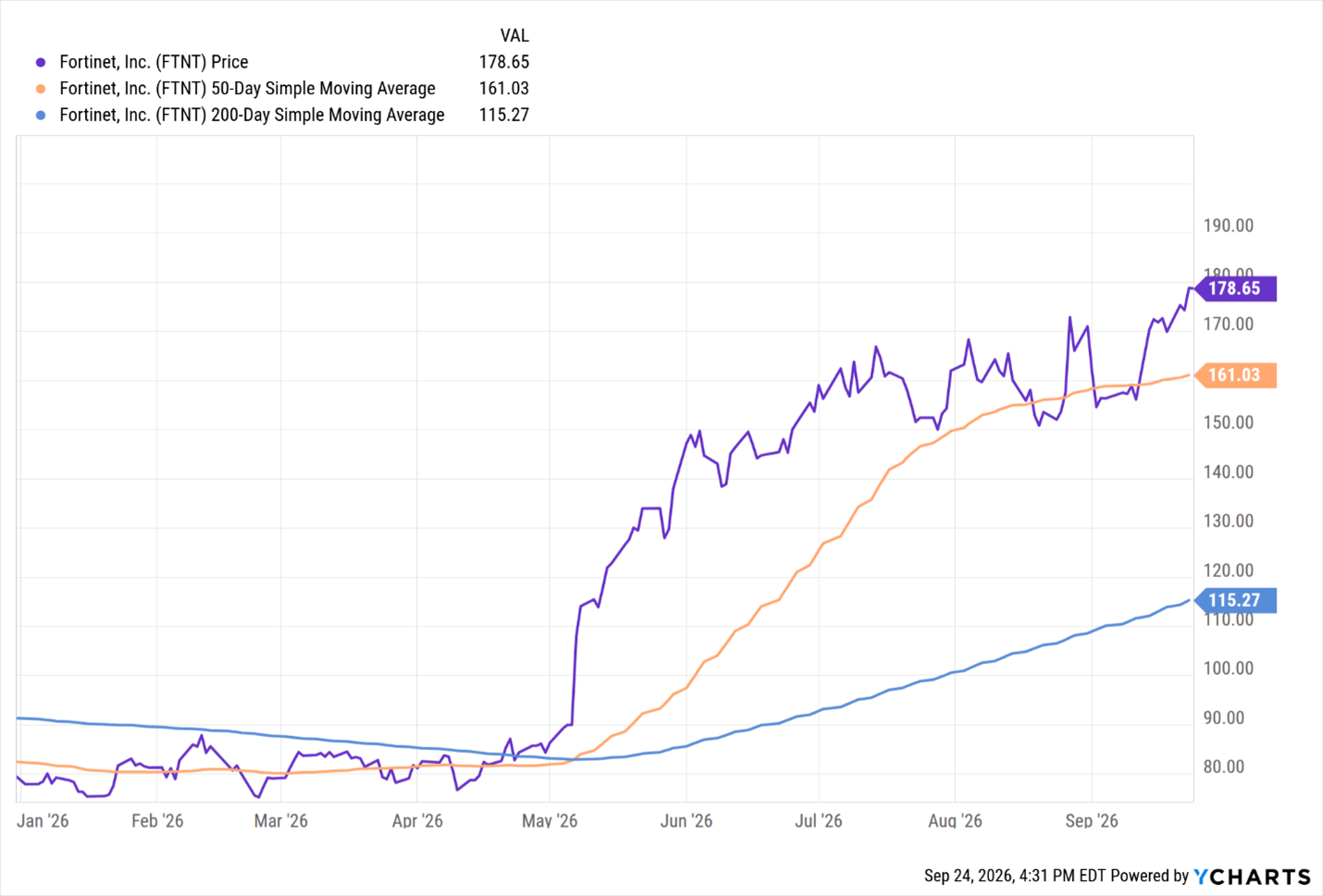
As of early August, Fortinet shares had climbed 105% in 2026, making it one of the strongest performers in a cybersecurity group that IBD ranked near the very top of the market.
A Simple Way to Profit
Businesses can postpone buying new computers. Governments can delay construction projects. Consumers can put off buying new phones.
But when hackers are targeting hospitals, power grids and election systems, cybersecurity isn’t optional.
Related story: Why Hospitals Can’t Treat Cybersecurity as an Afterthought in 2026
AI is making the threats more sophisticated. But it’s also creating new markets and new tools for the companies fighting back.
That’s why HACK offers such an appealing way to invest.
Year to date, HACK has surged roughly 52%.
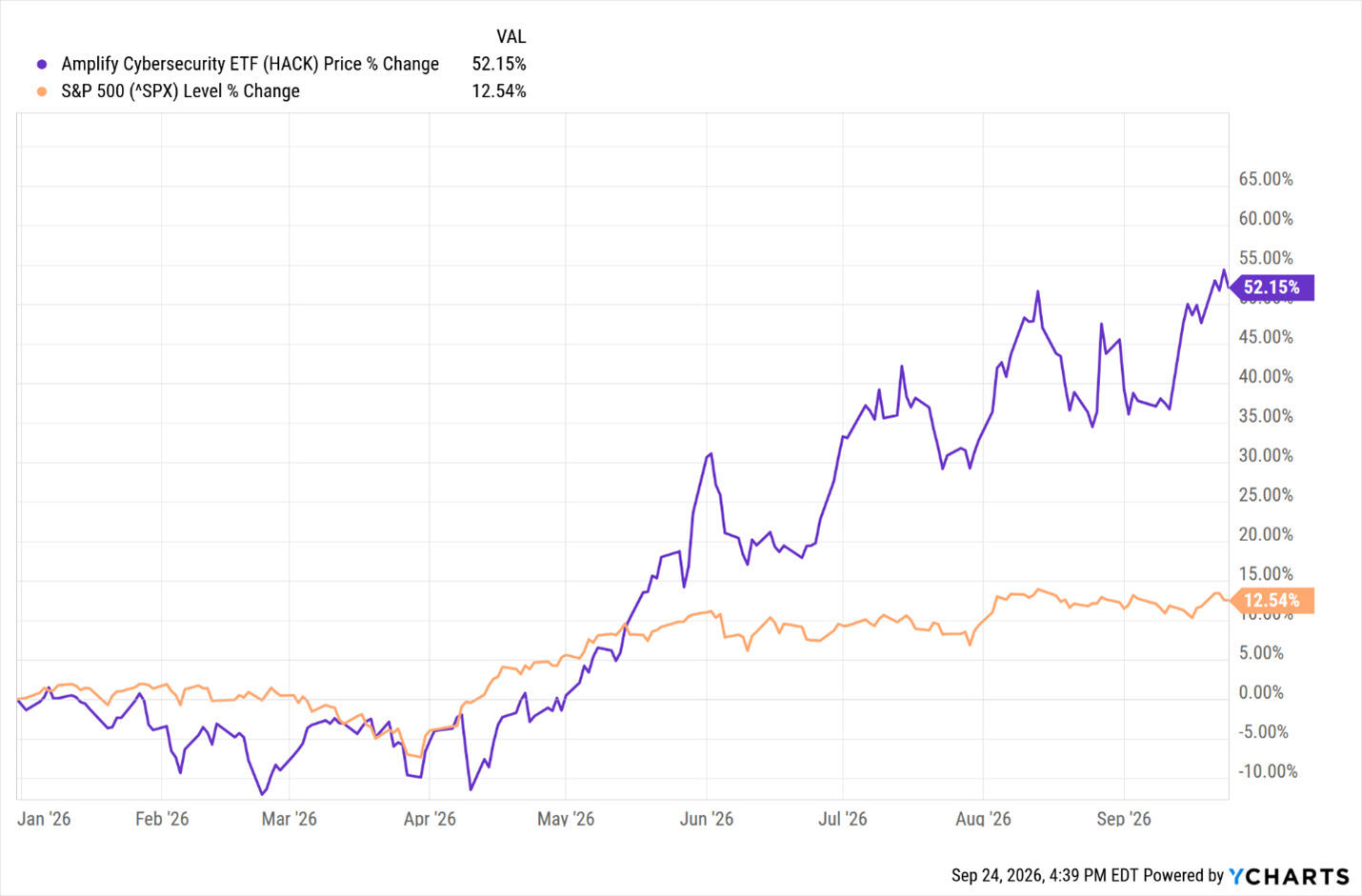
The S&P 500 has gained about 12.5% over the same period.
In other words, HACK has trounced the market in 2026.
With cyber threats growing and AI ramping up the pressure, I expect plenty more upside ahead, meaning you can count on strong returns for many years to come.
Best,
Michael A. Robinson
P.S. The U.S. government, thanks to the $300 million CHIPS and Science Act, is investing in companies that can defend against cyber attacks. Here are just a few potential beneficiaries.