3 Checks to Run Before You Buy a Famous-Name Crypto

|
Key Takeaways
|
 |
| By Dawn Pennington Reviewed by: Beth Canova |
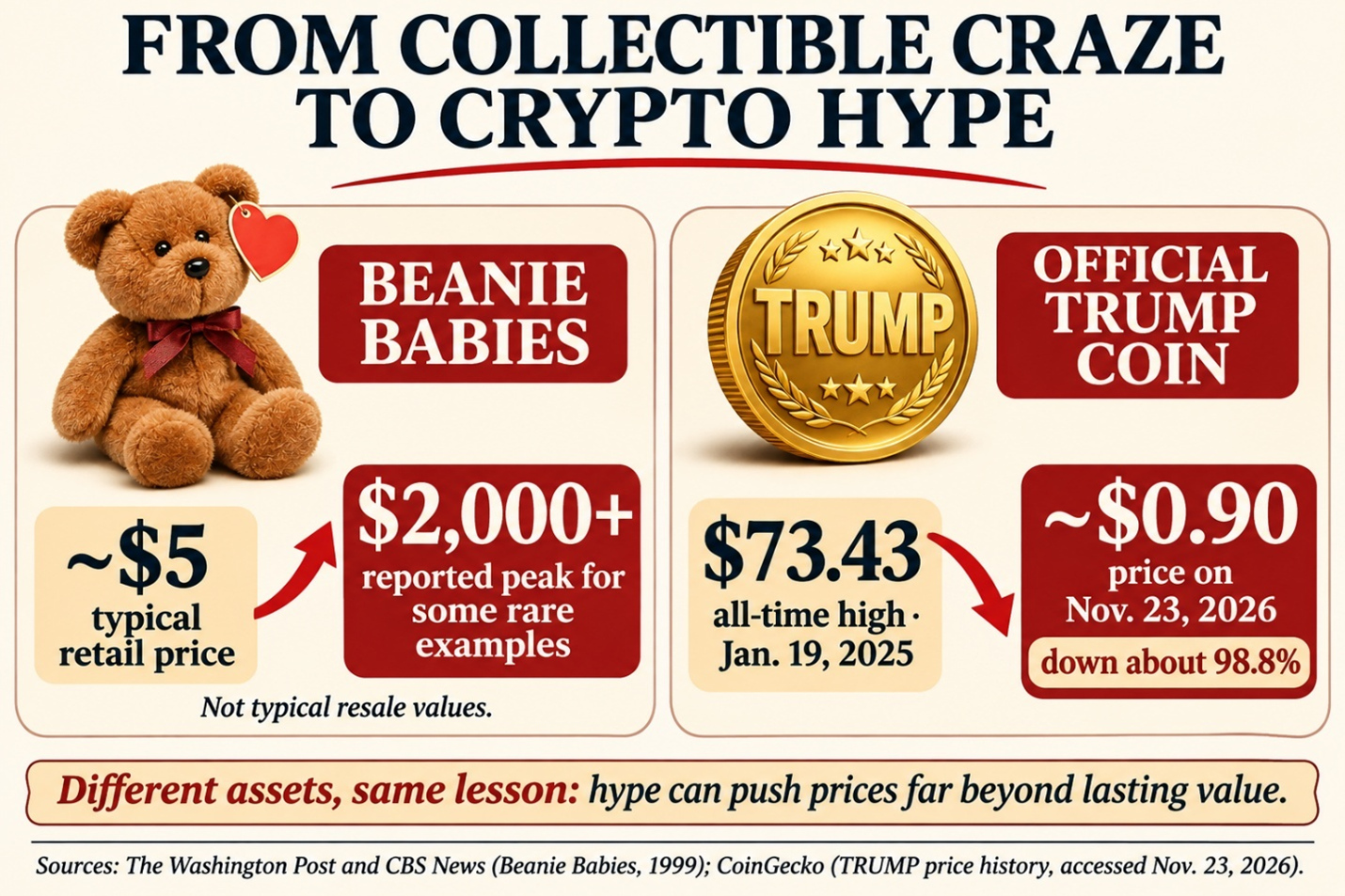
In 1999, grown adults lined up at toy stores before dawn for Beanie Babies. Those small, stuffed bears could sell for hundreds of dollars.
Some buyers even kept them in plastic cases, convinced they would become a the basis of a well-funded nest egg.
But a toy has no sales, no profit and no board of directors.
Its price came from one place: the next buyer.
When the buyers stopped coming, the price cratered.
That story is back. This time the toy is digital, and it carries a famous name.
Over the past two years, coins tied to big names in U.S. politics hit the market. Each one drew a rush of buyers in its first hours.
Each one now trades far below its peak.
These coins are a clear case study in one pattern.
The people who create the supply get paid first. The buyers who show up on the headline pay for it.
What Is a Memecoin?
A memecoin is a crypto token built around a joke, a mascot or a famous face.
There is typically no company behind it. It has no sales, no earnings and no dividend. Owning one gives you no vote and no claim on anything.
Think of it as a trading card that lives on a blockchain — a shared public ledger that records who owns what.
Related Story: Robinhood Chain Reveals How Memecoins Still Drive Crypto Growth
Regulators see it the same way.
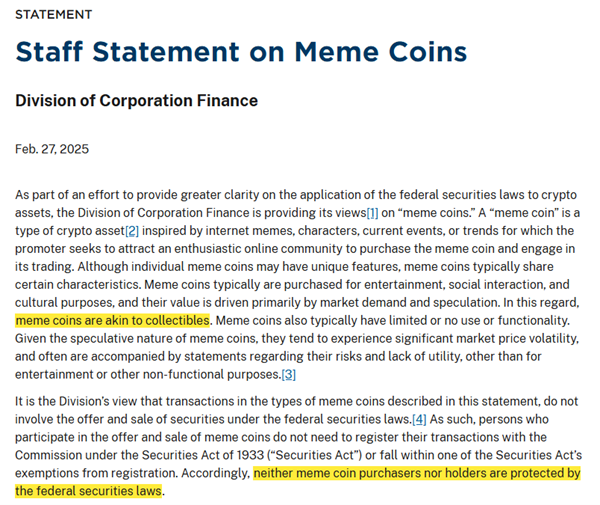
In February 2025, the SEC said memecoins are "akin to collectibles." And buyers "are not protected by the federal securities laws."
That means none of the disclosure rules that cover a stock apply here.
The staff did note that fraud can still be pursued by other federal or state agencies.
The Scoreboard
Here is how three of the best-known political memecoins have done, based on CoinGecko data as of Nov. 19, 2026.
Official Trump (TRUMP, “D-”) launched on Jan. 17, 2025, three days before his second inauguration. It runs on the Solana (SOL, “B-”) network, a fast blockchain built for cheap trades.
Within two days, it hit $73.43. At that price, the 200 million tokens out there were worth about $14.7 billion. Today it trades near 96 cents.
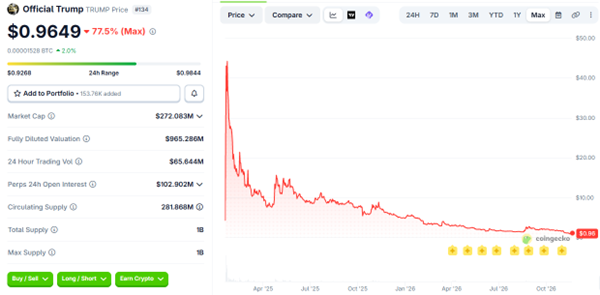
That is a drop of more than 98%.
Official Melania Meme (MELANIA, “E+”) came out the same weekend. Its market value peaked near $2 billion.
It now trades near five cents, down more than 99% from its high. The whole coin is worth about $47 million.
Hunter Biden's Laptop (LAPTOP, “E-”) is the newest.
Hunter Biden, son of former President Joe Biden, launched it on Sept. 9, 2026. It runs on Base, a network built by the centralized exchange Coinbase (COIN, “D+”).
Within two minutes of opening, it touched about $199. An hour later it was under $5. Today it sits near two cents, down more than 99.9%.
Related Story: Hunter Biden's $LAPTOP Crashed. What It Might Take to Reboot This Memecoin
The entire value of the coins in circulation is about $3.5 million.
Three coins. Three crashes. The same shape on the chart.
Who Holds the Supply
Every one of these coins starts with a fixed number of tokens. The key question is who got them, and when they can sell.
Take TRUMP, for example …
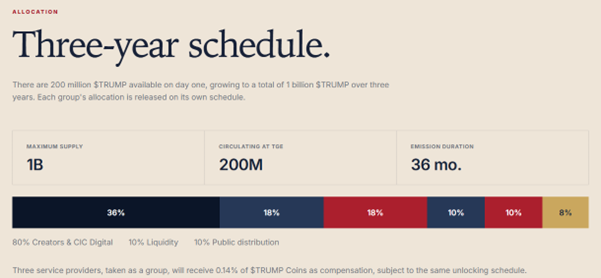
Most tokens were never available to the public. The coin's own website says two firms, CIC Digital and Fight Fight Fight, own 80% of the supply.
Those tokens unlock over three years.
An unlock works like the end of an IPO lockup. When a hot company goes public, insiders usually have to wait months before they can sell. When the wait ends, a wave of new shares can hit the market.
Related Story: How to Find the Strongest Tokens in Crypto
Crypto unlocks do the same thing, on a set calendar.
And for TRUMP, that calendar is in motion.
A Washington Sun report found that about $70 million worth of TRUMP moved in September to an account that would let it be sold. The account holds the pool set aside for the coin's creators.
MELANIA shows the same pattern.
Its site promised 35% for the team. But blockchain tracker Bubblemaps (BMT, “E+”) found close to 90% of the supply in a single wallet.
And in April 2025, Bubblemaps also flagged about $30 million worth of tokens moved out of a "community" fund and sold, with no word from the team.
LAPTOP set aside 30% for its founders, locked for six months and then paid out over two years.
The team says insiders did not buy early. But tracker Arkham (ARKM, “D-”) saw 100 million tokens — roughly a tenth of the supply — go to a project wallet a week before launch, CoinDesk reported.
Another 15.5 million went to a trading firm four days before.
Who Made Money and Who Lost It
Now look at the other side of the trade.
As of the end of June, Nansen — an on-chain analytics and AI-powered crypto trading platform — counted 988,905 wallets that had lost money on TRUMP.
That is about two out of every three buyers. Their losses added up to $3.81 billion.
The winners were a much smaller group. In May 2025, Chainalysis found that just 58 wallets had made more than $10 million each.
Related Story: What Tokenomics Can Reveal About Your Favorite Crypto
Most of the gains went to buyers who got in during the first hours.
And the president earned $636 million from the coin, based on his latest financial filing.
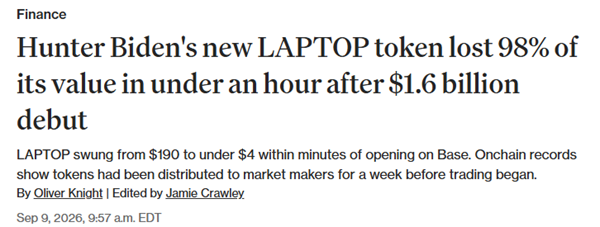
LAPTOP followed the same script, only faster. Bubblemaps found that about 80% of its traders ended up with a loss. Close to 11,000 of them lost small sums.
What Happened After the Crashes
The fallout went past price.
Hours after LAPTOP's crash, X suspended the project's official account. The team moved its updates to Medium and said it was working to get the account back.
It blamed "sniper bots" — programs that buy in the first seconds and sell into the rush. It also denied that insiders cashed in.
For its part, MELANIA has drawn a lawsuit.
The class action, filed in New York federal court, targets the firms that helped launch it. It claims they ran the same playbook on as many as 15 tokens.
And TRUMP keeps adding perks. Its 185 largest holders qualified for a seat at a Nov. 22 dinner with the president. The top 29 got preferred seating and a VIP reception.

CBS News found that at least 52 of the 100 wallets on the public leaderboard had moved funds through exchanges that prohibit U.S. customers.
Those wallets accounted for nearly $6.8 million of the leaderboard's more than $15 million in value.
That doesn't prove the buyers were foreign. But it does suggest that Trump's crypto dinner attracted substantial overseas interest.
And while buyers compete for a seat at the president's table, Trump-affiliated entities still control 80% of the token supply.
3 Questions Before You Buy a Famous Name
A Beanie Baby buyer in 1999 could not see how many bears sat in the warehouse. A crypto buyer can.
The data is public. You just have to look.
What you want to find are the answers to three questions …
1. Who holds the supply? Check the coin's own site and a tracker like Bubblemaps. If one group owns most of the tokens, you are not buying alongside them. You are buying what they plan to sell.
2. When can they sell? Find the unlock calendar. Treat each date like an IPO lockup ending. Big unlocks ahead mean a steady stream of new supply … and downside pressure.
3. What does the token earn? If the answer is nothing, then the only thing that can lift the price is the next buyer.
That is fine for a collectible you enjoy owning. It is a weak base for a retirement account.
Here’s a bonus test that takes only 10 seconds: Compare the coin's market value to the cash in its trading pool. Most price sites show that cash as "liquidity."
If the first number is huge and the second is tiny, it’s still just a number on a screen. Not value the market has fairly assigned.
Together, these answers give you a sense of a coin’s tokenomics. And whether it’s worth your time and investment capital.
To your health and wealth,
Dawn