Robinhood Chain Reveals How Memecoins Still Drive Crypto Growth

 |
| By Mark Gough |
A quick look over the past few weeks reveals a strong trend: Crypto and traditional financial infrastructure have begun to merge.
It feels like each week, we have yet another announcement hit the headlines. In fact, my colleague Juan Villaverde recently suggested investors should Bet on the Plumbing When Crypto & Wall Street Collide.
But the latest development in this narrative isn’t just another point in the trendline. It reveals a deeper truth: Not all infrastructure plays have what it takes to last.
I’m talking about the launch of Robinhood Chain.
It went live on July 1. Its goal is to “bring traditional markets, crypto, and real-world assets together on a fast, efficient, and open network.”
In plain English, Robinhood wants to be another one-stop shop for investors. No matter if they’re interested in stocks, cryptos or tokenized assets. That’s not unlike what Coinbase (COIN) is doing. Just from the other side of the financial divide.
Related story: Coinbase Wants to Be Everything, Everywhere, All at Once
Despite being a company blockchain, it is still permissionless. That means anyone can build on Robinhood Chain, if they want.
That matters. A lot.
It’s why Robinhood Chain was able to find early success. And why it may have an edge going forward.
It All Started with a Cat
Robinhood Chain has given an impressive performance in the two weeks since its launch. It attracted over 1 million addresses and became one of crypto’s busiest new networks.
Within days, its blockchain had processed more than 38 million transactions.
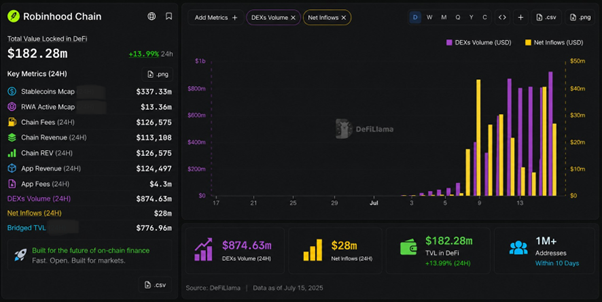
Here’s the catch: The activity wasn’t coming from tokenized stocks or real-world assets. You know, the products Robinhood actually built the chain for.
It was coming from a cat.
As I said, anyone can build on Robinhood Chain. And one of the first platforms built on the blockchain was … a token launchpad. From there, anyone can create their own token.
Cash Cat (CASHCAT, Not Yet Rated) is a memecoin named after an early Robinhood codename. It went from an obscure launch on Robinhood Chain to a market cap above $200 million in little more than a week.
This brought a lot of attention to NOXA. Built directly on Robinhood Chain, it’s the platform CASHCAT used for its launch. As of this writing, it has issued roughly 60,000 tokens and briefly captured more than 75% of all new token deployments on Robinhood Chain. And as of earlier today, it had recorded more than 293,000 active addresses.
Let me put that in context.
Pump.fun is a memecoin launchpad on the Solana (SOL, “B-”) network. And it has largely defined the memecoin launchpad category. But for five consecutive days, NOXA generated more in daily protocol fees than this sector leader.
On July 13 alone, NOXA earned $1.94 million against Pump.fun’s $1.61 million. Cumulative protocol fees eventually passed $14.5 million.
In short, this new launchpad on a new blockchain outperformed the sector leader, built on one of the largest and most popular networks.
Then, at the height of the frenzy, it stopped launching tokens.
NOXA’s Swift End
The details of why NOXA suspended the creation of new tokens on July 11 are still hazy. Officially, the team blamed bots mass-producing copycat projects and overwhelming the platform.
But what initially looked like a temporary pause quickly became something more serious: The entire front-end interface went dark.
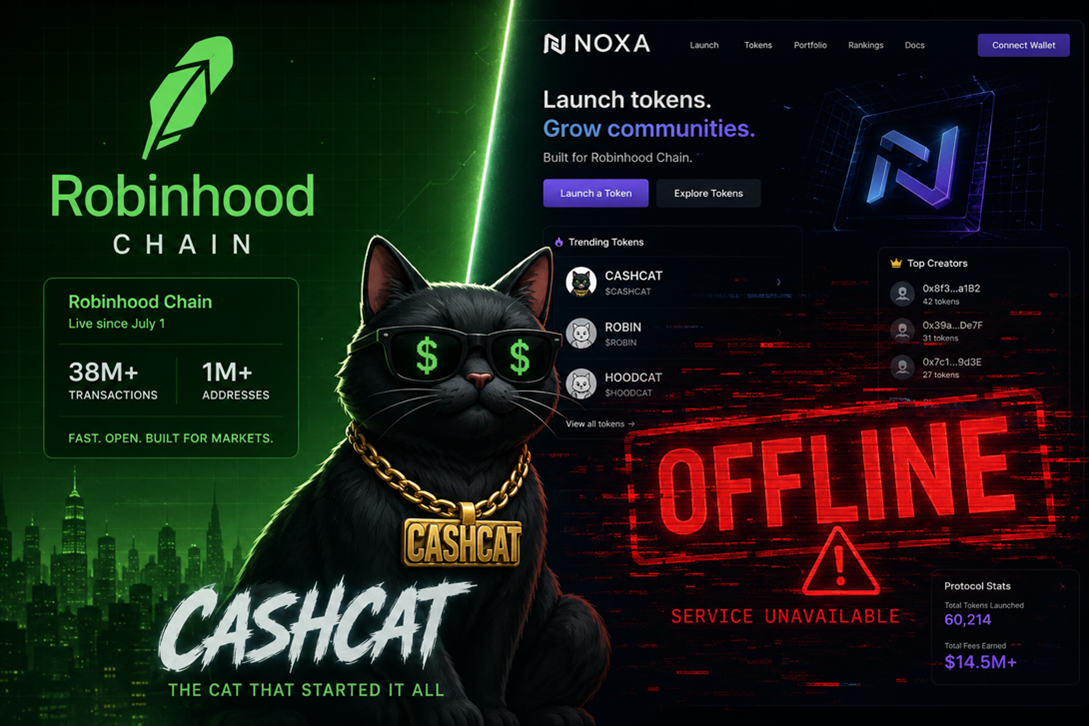
The reason? Apparently NOXA was having problems with Cloudflare, its traditional domain and IP access. But when those issues were resolved and the new interface finally appeared on July 15, the launch function was still missing.
This wasn’t a traditional rug-pull scam. There’s no evidence NOXA drained liquidity or stole user funds. The contracts continue to operate, and every token remains tradable on Uniswap (UNI, “C”).
So, there’s definitely a story here. But I’m less concerned about NOXA’s fall.
Instead, my focus is on what this means for Robinhood Chain.
The Robinhood Angle
Here’s the uncomfortable part for Robinhood: CASHCAT had no official connection to the company.
Robinhood didn’t launch it, list it or endorse it. The closest connection came when CEO Vlad Tenev acknowledged that, although Robinhood Chain was designed for real-world assets, it appeared to work rather well for memes too.
But the Robinhood name was still central to the trade.
The cat referred back to the company’s early history. The token launched on Robinhood Chain. The wider ecosystem quickly filled with coins using Robinhood, HOOD, Vlad and similar branding.
That is the trade-off Robinhood accepted by building an open network.
The company can create the infrastructure, but it cannot decide what developers deploy or what traders choose to buy. There is no central listing committee approving every token before it appears. Anyone can launch one.
That openness is precisely what could eventually allow tokenized equities to connect with decentralized exchanges, wallets, aggregators and countless third-party applications.
It is also what allowed a memecoin casino to emerge around the Robinhood brand without ever asking Robinhood for permission.
You don’t get one without accepting the risk of the other.
Why It Matters
Robinhood didn’t build its chain to become another memecoin casino. It wants to move more of the traditional financial system on-chain.
But those products weren’t responsible for the network’s first major burst of activity. Speculation was.
That is hardly unusual in crypto.
The industry likes to talk about utility, institutional adoption and the future of finance. But speculation is often what brings the first wave of users through the door.
People arrive to trade. Liquidity follows. Developers notice the activity and begin to build. More applications appear.
Only then does the ecosystem get a chance to mature.
Whether investors like memecoins or not, they have repeatedly served as one of crypto’s most effective customer acquisition tools.
Just look at Ethereum as an example: It provided the rails, while developers and users ultimately decided what would be built on top. That open access, first-mover advantage and continued improvements are why Ethereum still stands as the No. 2 crypto by market cap, lagging only Bitcoin.
Robinhood Chain may have discovered the same dynamic.
CASHCAT attracted traders, liquidity and developers before the chain’s tokenized stock market had time to develop. It also gave the network a real-world stress test almost immediately after launch.
None of this kills the Robinhood Chain thesis.
In fact, it could strengthen it.
The Bull Case
The question now is whether Robinhood Chain can keep the attention CASHCAT brought.
And so far, the answer is “Possibly.”
The speculative capital didn’t sit idle or leave during the NOXA blackout. It stayed.
Without NOXA, other launchpads — like Flap, Bankr, Klik and Trench.today — stepped in to fill the gap. Flap alone handled more than 11,000 launches in a single day and captured over 35% of daily issuance.
More than 20 launchpads are now competing for the activity NOXA left behind.
This suggests the network’s early momentum was no longer dependent on a single application. Traders had already discovered the chain — liquidity had been established, and competing platforms were ready to fight for the order flow.
For investors, that is an important distinction. Infrastructure networks should be judged separately from the applications built on top of them.
Ethereum continued growing despite thousands of failed dApps over the past decade. Robinhood Chain may prove capable of doing the same.
NOXA may disappear as the dominant launchpad. CASHCAT may never recover its peak. Most of the 60,000 tokens it launched will almost certainly go nowhere.
But Robinhood Chain has captured something every new blockchain struggles to manufacture: Attention.
What happens next will determine whether that attention can be converted into something far more durable.
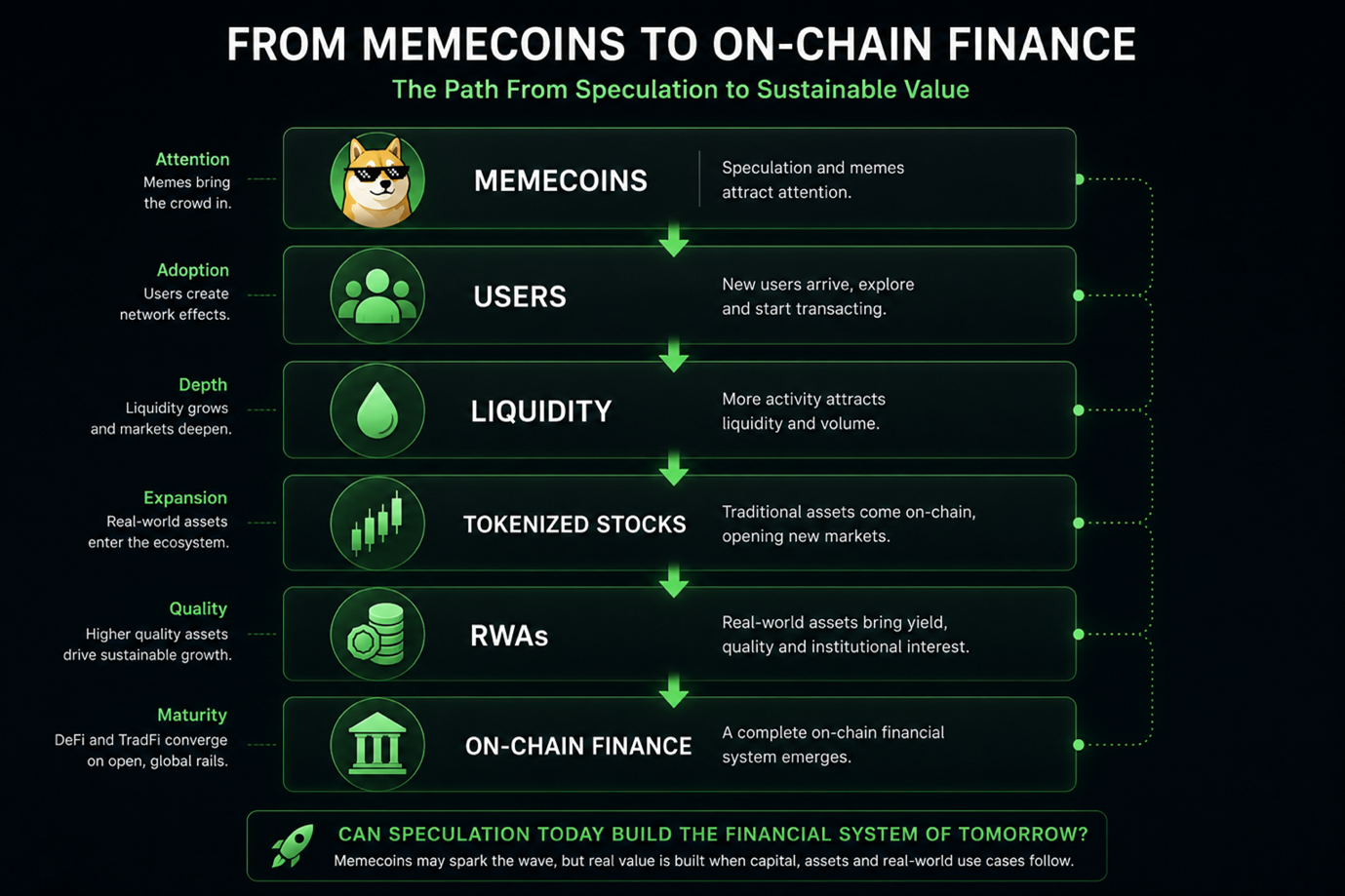
- Can memecoin traders become stock-token users?
- Can today’s liquidity migrate into tokenized equities, real-world assets and more sophisticated financial applications?
- Can Robinhood keep the network open without having every speculative excess attached to its brand?
Those questions remain unanswered.
But the lesson from NOXA is already clear: A memecoin’s value is attention. Attention is organized through an interface. And interfaces can disappear overnight, even when they’re generating nearly $2 million a day.
For investors, this means any infrastructure play needs to be able to overcome the instability individual interface failures can bring. And convert any attention into activity on the underlying network itself.
Best,
Mark Gough