Big Banks Loaded Up on Bitcoin ETFs Before the Drop. Here’s What to Watch Next.

|
Key Takeaways
|
 |
| By Beth Canova Reviewed By: Dawn Pennington |
Bitcoin (BTC, “B+”) fell near $62,000 over the weekend. That's its lowest price since July.
And while prices have bounced slightly to $63,800, "Extreme Fear" is still the overwhelming sentiment on-chain.
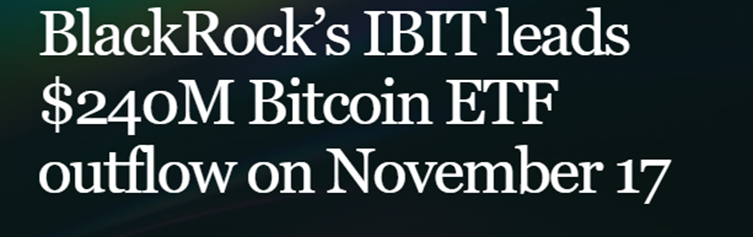
Yesterday, investors pulled nearly $240 million from U.S. spot Bitcoin ETFs. That brings the total pulled from these funds to more than $1 billion in just five trading days.
Sounds grim, right?
But look closer: While many investors are rushing for the exits, some of Wall Street’s biggest banks had been building huge Bitcoin positions.
How huge? In the billions of dollars’ worth.
Wall Street's $4 Billion Bitcoin Bet
This week, a new batch of filings gave us a rare look at what Wall Street was doing behind the scenes.
They're called 13F filings. These are reports that large investment firms must send to the Securities and Exchange Commission (SEC) every quarter.
They show which stocks and certain funds those firms held at the end of the quarter.
In this case, that quarter ended Sept. 30. That was before Bitcoin’s November slide.
And the latest reports tell quite a story for three banking titans …
- Wells Fargo (WFC, “B”): More than doubled its shares in BlackRock's iShares Bitcoin Trust (IBIT, Not Yet Rated) to 49.58 million. Those shares were worth $2.35 billion on Sept. 30.
- Goldman Sachs (GS, “C”): More than doubled its total spot Bitcoin ETF holdings to roughly $1.28 billion.
- Bank of America (BAC, “B”): Raised its IBIT holdings more than eightfold to 14.48 million shares, worth about $685 million.

That's more than $4.3 billion in reported Bitcoin ETF holdings across just three firms.
Keep in mind, these filings are a snapshot. They show what the banks held on Sept. 30, not what they’ve done since.
And they weren't alone.
- Hedge fund Brevan Howard raised its IBIT share count by 211%.
- Susquehanna grew its Bitcoin ETF holdings to about $622 million.
- Even two major investment funds from Abu Dhabi held a combined $1.09 billion in IBIT.
That's a lot of money tied to Bitcoin.
There is one caveat, however: Much of the Bitcoin held by banks belongs to their clients, not the banks themselves.
In fact, about 85% of Wells Fargo's IBIT shares were held through its brokerage and wealth units.
Still, it shows that Bitcoin had become a real part of many large investment accounts.
And that's not something we should ignore.
So, Why Is Bitcoin Falling?
If Wall Street held so much Bitcoin, why is the OG crypto now trading near $64,000?
The answer comes down to timing.
Cycles expert Juan Villaverde has been tracking an anticipated low between late October and mid-November for weeks. What he didn’t anticipate was a broad, risk-off correction.
Multiple markets — from gold to oil to stocks — are looking to bottom. Crypto is just another one, but it tends to swing faster and harder than its more established peers.
In the first two weeks of November, U.S. spot Bitcoin ETFs lost more than $2 billion to net withdrawals.
Then came a brief bright spot.
On Monday, Nov. 16, the funds took in $7.9 million. That’s the yellow blip on the far right of the chart below.
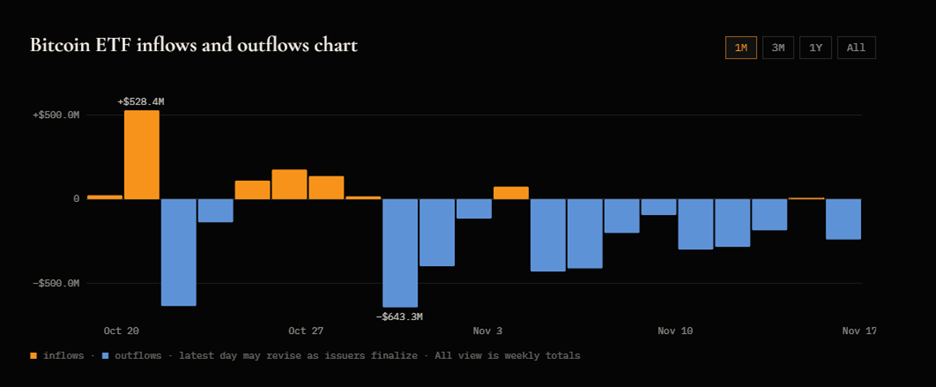
It was a small gain. But it broke a seven-day streak of outflows.
That’s not enough to confirm a trend shift. After all, investors pulled another $239.9 million on Tuesday.
But it does point to something interesting …
The Bigger Picture Looks Different
It's easy to focus on the money leaving Bitcoin ETFs. After all, $1 billion in five days is a huge sum.
But we need to look at what remains.
As of Nov. 17, U.S. spot Bitcoin ETFs still held about $79.6 billion in assets.
And since these funds first launched in January 2024, they've taken in roughly $54.5 billion more than investors have withdrawn.
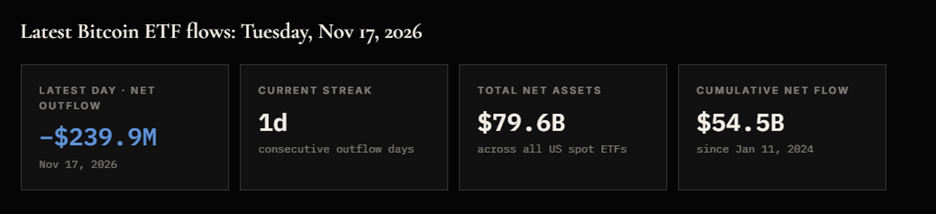
That's a large pool of money still tied to Bitcoin. It also shows why we shouldn't judge the whole market by one bad week.
Think about it this way…
A few years ago, banks stayed away from crypto, Bitcoin included. In fact, crypto-friendly banks found themselves in hot water just three years ago.
Today, investors can buy Bitcoin funds through some of the biggest names in finance.
That’s not a small change. It’s a whole new financial reality.
That doesn't mean Bitcoin can't fall further. The past two weeks have shown us we can.
But the tools that let big investors own Bitcoin are now in place. And that’s a massive tailwind for the market that one short-term sell-off can’t erase.
3 Signs to Watch Before Bitcoin's Next Move
So, what should you do with all this news?
Rather than trying to guess the exact bottom, I suggest watching three key signs.
1. Watch Bitcoin ETF flows.
The first sign is simple: Are investors putting money back into Bitcoin funds?
One good day isn't enough.
We want to see a steady run of net inflows. That would tell us demand is starting to grow again.
2. Watch whether Bitcoin holds its recent lows.
Bitcoin fell near $62,000 on Nov. 15.
That makes this an important price area to watch. If buyers keep stepping in near that level, it could be a sign that selling pressure is easing.
3. Watch what the big firms do next.
The latest 13F reports show what Wall Street held at the end of September.
The next reports are due in February 2027. They’ll show what firms hold at the end of December.
Related Story: Bitcoin's 320-Day Cycle Points to a New Buy Window in 2027
That will give us a better idea of whether these large investors stayed the course, bought more or reduced their positions.
And that matters far more than trying to guess what Bitcoin will do tomorrow.
Best,
Beth Canova