Bitwise Sees Solana at $1,100 by 2031 as Tokenization Takes Off

 |
| By Mark Gough Reviewed by: Beth Canova |
If you’ve followed Solana (SOL, “B-”) over the past few years, you’ve likely heard more about memecoins than stocks.
After all, the memecoin boom put the network under pressure as traders rushed to buy and sell.
But a new report from Bitwise argues that the network could become a major venue for trading tokenized stocks. In its most optimistic scenario, SOL could reach $1,100 by 2031.
That valuation depends in part on the fees traders pay. If a typical transaction costs a fraction of a cent, who’s willing to pay more?
More importantly, what do they get for it?
Solana Was Built for Trading
In the third quarter of 2026, Solana processed 14.2 billion non-voting transactions, and its median transaction cost was just $0.00057.
If you’re sending money to another wallet, a short delay may make little difference. But if you’re trying to buy before the price moves, it matters a lot more.
And paying a priority fee can improve your chances of getting your trade through first.
Which is exactly what Solana lets users do.
Some strategies also depend on trades happening in a particular order. A trader might want to buy an asset on one exchange and sell it on another before the price gap closes, for example.
On Solana, users can submit both trades as a bundle and include an extra payment, known as a tip, to give a validator an incentive to process them together.
Solana users paid $69 million in fees and tips in the third quarter. That’s nearly 10 times the estimated base fees alone.
In the report’s sample of 14.2 million transactions, the highest-paying 1% accounted for 67.3% of fees and tips. The top 10% accounted for 87.1%.
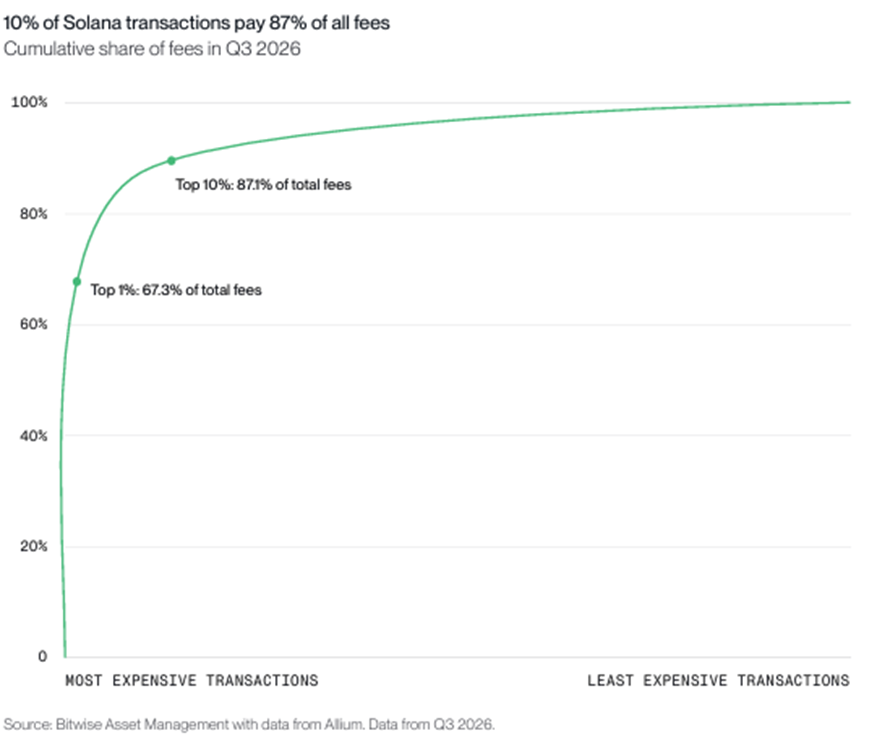
Now, imagine how big institutions could use a system designed to prioritize transactions that pay more.
Why Tokenized Stocks Matter
Tokenization lets investors hold and transfer assets such as stocks and fund shares as digital tokens on a blockchain. Depending on the product, investors can trade and use their holdings around the clock.
That’s a very appealing proposition for institutions who have been relegated to trading only during business hours. Which is why the value of tokenized stocks and exchange-traded funds grew from about $700 million at the start of 2026 … to $3.3 billion by the end of September.
That’s nearly a fivefold increase!
And there’s more room for growth, as the market is still small alongside the roughly $152 trillion in listed-company value cited in the report.
Related Story: NYSE Picks Avalanche (AVAX) for Tokenized Stocks as Wall Street Goes All In on Crypto
From January through September, $13.4 billion worth of tokenized equities traded on Solana. The report puts Solana’s share of that at 42%. Though I’ll note it excludes BNB Chain (BNB, “C+”) because trading incentives there can distort reported volumes.
Over those same nine months, Solana’s decentralized exchanges handled $719 billion in spot trading — almost twice Ethereum’s $383 billion.
How the Valuation Gets to $1,100
Solana already has the trading apps and liquidity it needs to attract traders.
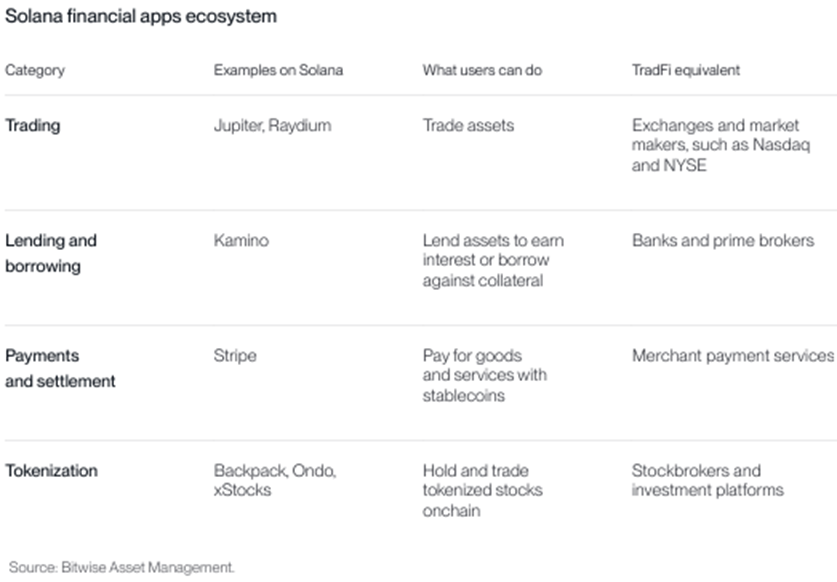
But for the $1,100 scenario to play out, the market for tokenized stocks would need to grow substantially, and Solana would need to win a larger share of it.
The model starts with what the report calls real economic value. It adds up the base fees, priority fees and tips users pay. Much of that money goes to the validators that process transactions.
The bull case assumes that 5% of projected global stock trading volume is tokenized by 2031. In this scenario, Solana would capture 65% of that market, and tokenized shares would trade three times as often as conventional shares.
Under those assumptions, Solana would handle $30.7 trillion in tokenized-stock trading that year.
The model also assumes that the number of transactions from crypto trading and other activity grows by 50% a year, while payments and transfers increase fifteenfold by 2031.
Across the whole network, that would bring the annual count to about 1.3 trillion transactions. That would include completed trades, failed attempts and the transactions that support trading.
Together, those activities would generate an estimated $12.83 billion in annual network fees. If investors value Solana at 60 times those fees, the network would be worth about $770 billion.
Dividing that by the projected total supply of 700 million SOL gives roughly $1,100 per token.
The base case assumes that 4% of projected global stock trading volume is tokenized and Solana captures half of that market. At 40 times projected annual fees, the model values SOL at $385 in 2031.
In the bear case, the tokenized share reaches 3%, Solana captures 30% of that market, and investors value the network at 20 times annual fees.
That puts SOL at $80 in 2031.
The Hurdles Ahead
Nothing about the bull case laid out in the report will be easy. Competition in the tokenization race is already fierce.
Ethereum (ETH, “B+”) and its Layer-2s already have significant tokenized funds and Treasury products. Base — Coinbase’s (COIN, “D+”) blockchain — and Robinhood (HOOD, “C”) have massive distribution channels, and institutions may prefer a permissioned model where they have more control.
Related Story: Coinbase’s U.S. Bank Charter Is a Big Win for Crypto
So Solana has to be proactive. And continue to increase its capacity.
The bull case requires the network to process around 3.6 billion transactions a day, approximately 23 times its current load. Tokenized-stock transactions alone would require about five times the network's present block-compute limit.
Trading apps could also pay validators directly to get their customers' orders in first. If more traders go down that route, then some of what they pay would be removed from the network fees that are used in the valuation.
What I’m Watching Next
I’ll be watching how much tokenized-stock trading takes place on Solana — how much of that market it wins, and what traders pay in fees.
For me, the fees carry the most weight. If trading volume takes off and fee income barely moves, I’d struggle to justify anything close to $1,100.
That’s not to say there won’t be opportunities to trade Solana. Or that you shouldn’t hold it.
But I suggest you look deeper the next time you see a sky-high valuation in your crypto headlines. And run the numbers yourself to see if they add up to you.
Best
Mark Gough