Coinbase’s U.S. Bank Charter Is a Big Win for Crypto

 |
| By Mark Gough Reviewed by: Beth Canova |
Coinbase (COIN, “D+”) has secured something relatively few cryptocurrency companies possess: a federal trust charter from the Office of the Comptroller of the Currency (OCC).
On Monday, Nov. 9, the company announced that it had received final approval to establish Coinbase National Trust Company.
It will be a federally regulated institution focused on digital asset custody.

Why does this matter?
Because it gives Coinbase a clear edge.
As more financial institutions offer crypto investment products, Coinbase can provide custody under federal oversight.
That could help it win more of institutional business.
Coinbase Moves Under Federal Banking Supervision
Until now, Coinbase's institutional custody services have operated through Coinbase Custody Trust Company, regulated by the New York State Department of Financial Services (NYDFS).
But this new charter places the trust company under federal supervision. And it gives Coinbase a structure through which it can expand its custody operations.
Efforts to make this massive move started in October 2025.
Preliminary conditional approval came on April 2, 2026. Then, after Coinbase completed the regulatory requirements, the charter became effective on Nov. 6.
The company announced the milestone three days later.
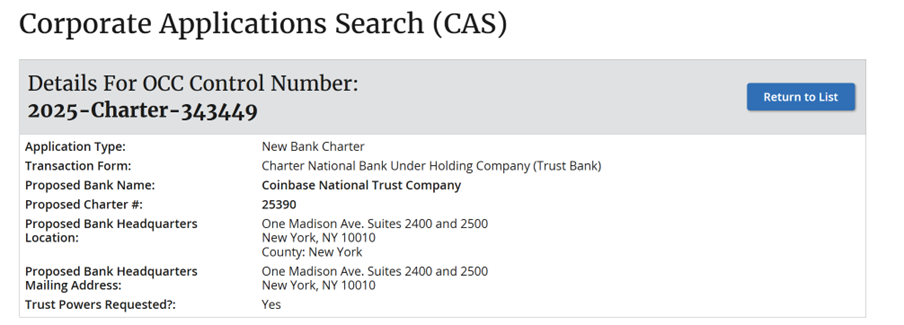
According to the OCC's original approval documents, Coinbase plans to transfer its existing custody business to the national trust company over three years.
Why Institutional Investors Care About Custody
Large financial institutions — pension funds, asset managers, insurers, etc. — face more complex requirements than individual investors.
They have to consider …
- Regulatory obligations,
- Operational security,
- Asset segregation
- And oversight
All before they can commit capital.
Reliable custody infrastructure is therefore essential to institutional investment.
Spot Bitcoin (BTC, “B+”) exchange-traded funds (ETFs) illustrate why: Investors can gain exposure to Bitcoin through conventional brokerage accounts, but the underlying Bitcoin still needs to be held and safeguarded.
Coinbase already provides custody services to institutional investors and cryptocurrency investment products.
But a federal charter will likely make its offering easier for some financial firms to assess. Particularly those that prefer federally supervised service providers.
That could help Coinbase compete for additional institutional business as more banks, asset managers and investment firms expand their digital asset services.
Of course, institutional allocations will still depend on valuations, market conditions, liquidity and risk appetite.
But with this move, Coinbase at least removes two barriers to entry — regulations and operational requirements — for financial institutions to offer these products.
Coinbase Isn't Becoming a Traditional Bank …
To be clear, just because Coinbase got a banking charter doesn’t mean it’ll become your neighbourhood bank.
It won’t.
In fact, it’s not allowed to take ordinary customer deposits and use them to make loans.
Its focus will be on custody and related trust services. That includes holding and safeguarding digital assets specifically for institutions.
Customers may also access services such as staking, prime trading, and financing through other Coinbase entities.
Related Story: Coinbase Wants to Be Everything, Everywhere, All at Once
Those services, however, aren't being provided directly by the new trust company.
The approval also comes with regulatory requirements. Coinbase must, for example, maintain at least $60 million in Tier 1 capital. And it has to hit and keep prescribed liquidity levels during its early operations.
Here’s the key point to understand: The charter doesn’t make Coinbase the next JPMorgan Chase (JPM, “A-”).
Instead, it gives the exchange a federally supervised structure.
Which means Coinbase can now take a larger role in unlocking crypto utility to institutions. Many of which were forced onto the sidelines or be satisfied with limited access until now.
… But It’s Growing into More Than an Exchange
Along with the announcement of its banking charter, Coinbase also revealed it plans to expand its partnership with PNC Bank.
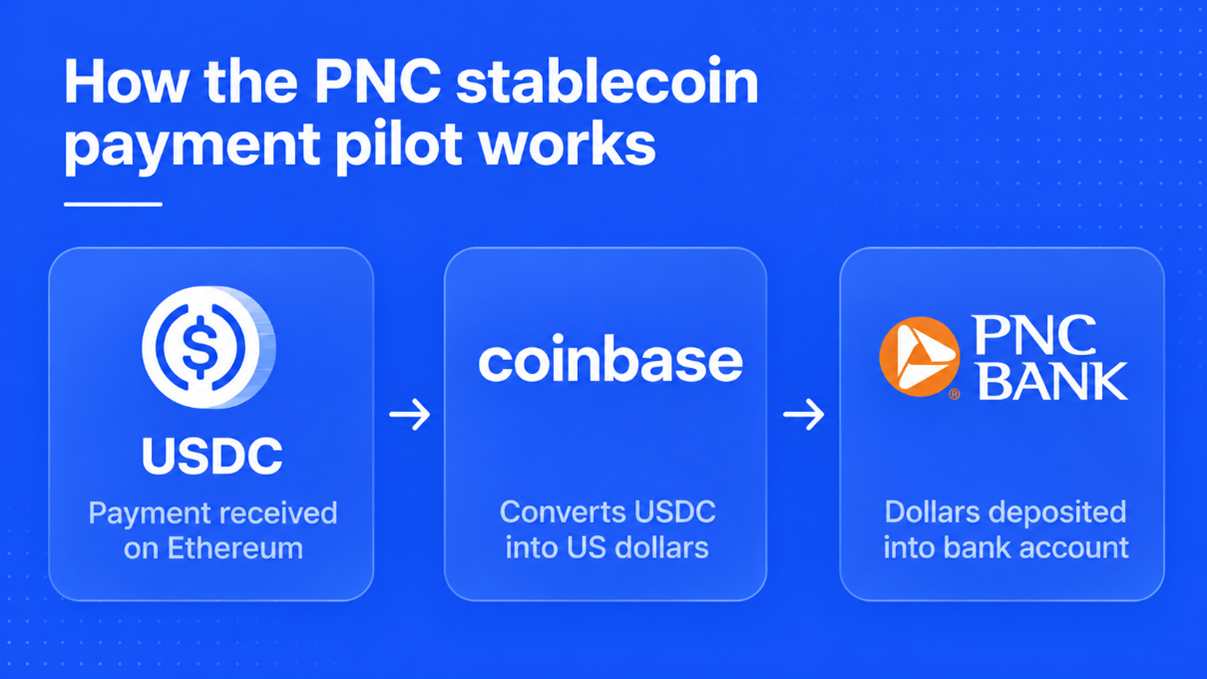
Under a new pilot program, PNC's corporate and institutional banking customers can receive payments in USD Coin (USDC), the dollar-backed stablecoin issued by Circle (CRCL, “D+”).
The pilot uses the Ethereum (ETH, “B+”) blockchain, with Coinbase to provide the payment infrastructure.
Here’s how it works.
When an eligible business receives USDC, the funds are automatically converted into U.S. dollars and deposited into its designated PNC account.
That means companies can receive stablecoin payments … without holding any crypto on their balance sheets.
The arrangement shows how blockchain-based payments can be incorporated into existing banking services.
It brings faster settlements and smoother cross-border payments to the companies who need them most … without forcing institutions or their customers to learn how to navigate DeFi or set up a separate account.
For Coinbase, the opportunity extends beyond trading fees.
Between the charter and this partnership, Coinbase is poised to carve out a place for itself as critical cross-market infrastructure.
Which will allow it to work with established institutions, rather than compete with them for customers.
A Wider Shift Across the Banking Industry
Coinbase isn't alone in seeking greater integration with the U.S. banking system.
Ripple, Circle, BitGo (BTGO, “D”) and Paxos have also pursued federal trust charters, with regulators approving applications at different stages.
They’re following Coinbase’s lead, trying to operate within established financial frameworks, rather than wait for crypto’s regulatory buildout.
Related Story: Elizabeth Warren Is About to Run the Committee That Writes Crypto's Rules
On the one hand, it gives regulators a way to supervise parts of the industry through recognized institutions. And it gives companies a clearer route to serving institutional customers.
To be clear, federal approval doesn't remove the risks associated with digital assets.
Cryptos are still volatile assets. Even though the recently ended bear market was “mild” by crypto standards, it still proved that big swings are still a defining characteristic of the market.
And questions remain about operational safeguards. Not to mention the boundaries between traditional banking and crypto services.
But the growing number of applications suggests there’s something to this approach. Where cryptocurrency companies see federal supervision as an important step in expanding their offerings.
Particularly to the biggest customers around.
What This Means for Crypto Investors
I see Coinbase's approval as another positive development for the industry's longer-term prospects.
Especially at this moment in time — as more financial institutions look to offer digital asset services ahead of the coming bull market.
The clearest commercial opportunity is for Coinbase itself.
The company already provides custody infrastructure to institutional investors. A federal charter could help it attract additional clients while expanding its existing relationships.
For investors holding Bitcoin, Ethereum or other digital assets, the benefits are less direct.
Greater institutional participation could support demand for digital assets over time. But increased use of blockchain technology won’t be reflected in price action right away, or for every crypto.
As adoption grows, you’ll want to pay close attention to which companies and networks capture the economic value created by the expanded access and new activity.
Those results will tell us more about the longer-term investment opportunity than the charter announcement alone.
Best,
Mark Gough
P.S. There’s a reason Coinbase and other crypto companies are building institutional capacity now: We’re on the cusp of the next bull market.
They anticipate the smart money will flow once that gets underway. And they want to be ready to catch it when it does.
You don’t want to be left behind. For insight on when cycles expert Juan Villaverde believes the bull will kick off in earnest …
And which coins he believes will blow Bitcoin out of the water …
You’ll want to watch his FREE recent crypto briefing now. It’ll go offline soon.